Akiko : la nourriture, les quantités et les repas
What this chapter covers
- I can make a shopping list and say where to buy food (la boucherie, la boulangerie, l'épicerie, le rayon fromage) (1.1)
- I can choose between le / la / les (food in general), du / de la / de l' / des (some) and pas de / pas d' (none) (J'adore les pâtes. Je vais prendre du fromage. Il n'y a pas d'eau.) (1.1)
- I can say how often I eat something with toujours, souvent, quelquefois, ne … jamais (1.1)
- I can read a recipe, name its ingredients and give instructions with mélanger, faire cuire, couper, mettre, ajouter (1.2)
- I can express a quantity with un paquet de, une boîte de, une cuillère de, un morceau de, une tranche de (1.2)
- I can say the sounds [k] and [g] (couper, quantité, gâteau, légumes) (1.2)
- I can give advice with devoir (je dois, tu dois, il doit, nous devons, vous devez, ils doivent) and use boire (1.3)
- I can use un peu de, assez de, beaucoup de, trop de to judge a quantity, and name the four meals of the day with their times (1.3)
- I can read a brasserie menu and compose a menu with dishes and desserts (1.4)
- I can convert litres, centilitres, decilitres, kilograms and grams, and spoonfuls into grams or centilitres (1.5)
Module 4 of Adosphère 2 is called Akiko. Akiko loves cooking and she is very gourmande (she loves good food), but she also pays attention to what she eats: un peu de tout, mais pas trop. In this module you learn to shop for a picnic, follow and write a recipe, say how much of something there is, and give advice about healthy eating. In the UASA paper these topics come back in Partie 1 (articles, quantities, devoir, word banks), Partie 2 (short texts with vrai ou faux) and Partie 3 (a shopping list or a short message about food).
| Lesson | Book pages | You learn to |
|---|---|---|
| Opener : Akiko | 49 | meet Akiko and the aims of the module (contrat d'apprentissage) |
| Leçon 1 : Des courses pour notre pique-nique | 50-51 | make a shopping list; the partitive articles du, de la, de l', des; the negative pas de |
| Leçon 2 : Les bonnes recettes d'Akiko | 52-53 | read and write a recipe; quantity words with de; cooking verbs; the sounds [k] and [g] |
| Leçon 3 : Bon appétit ! | 54-55 | give advice with devoir; peu, assez, beaucoup, trop; the four meals of the day |
| Leçon 4 : À la table des Français | 56 | read a brasserie menu and compose a menu |
| Mon cours de maths | 57 | litres, centilitres, grams and spoonfuls |
| Entraîne-toi, Évaluation DELF, Ton dico | 58-60 | practice, a DELF-style test and the word list |
1.1Shopping for a picnic (Leçon 1)
Akiko, Hugo and Wassim are in a supermarket with a list for their class picnic. They split up: each goes to a different rayon (department). Read the dialogue on p. 50 and listen for who goes where and who likes what.
| Who | Does what | Why / what they say |
|---|---|---|
| Akiko | goes to the grocer's (l'épicerie) for pasta, then looks for the vegetables | She has a super recipe for pasta salad. Vegetables are good for health (c'est bon pour la santé). |
| Hugo | goes to the butcher's department (le rayon boucherie) for the chicken | He does not like vegetables (je n'aime pas les légumes). He wants chips. |
| Wassim | is asked to go to the cheese department (le rayon fromage); then to the bakery (la boulangerie) for bread; he also takes water and fruit juice | He loves pasta (j'adore les pâtes) and reminds the others that sandwiches need bread. |
The chips are not on the list and they are not good for health, so Akiko says no. Hugo then argues that chips are vegetables, and Wassim wonders whether potatoes (les pommes de terre) count as vegetables. In exercise 3 the answers are: a true, b false (Wassim loves pasta), c false (Hugo does not like vegetables), d false (chips are not good for health).
Where do you buy it?
| Place | You buy | Examples |
|---|---|---|
| la boucherie (butcher's) | meat | la viande, le poulet |
| la boulangerie (bakery) | bread | le pain (une baguette) |
| l'épicerie (grocer's) | packets and tins | les pâtes, les chips |
| le rayon fromage | cheese | le fromage |
| le supermarché | everything on la liste de courses | les courses = the shopping |
In exercise 5 the three pictures are bread (1. le pain at la boulangerie), pasta (2. les pâtes at l'épicerie) and chicken (3. le poulet at la boucherie).
Food vocabulary (Ton dico, pp. 60 and 113)
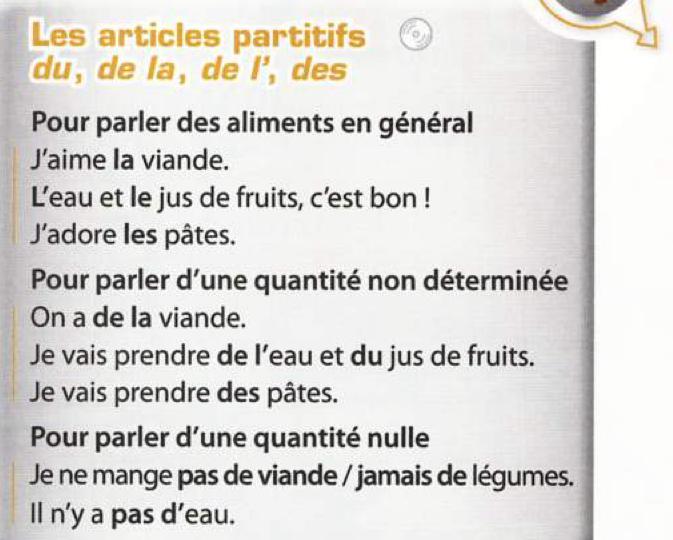
The partitive articles du, de la, de l', des
The grammar box on p. 51 gives three uses. Study the picture of the box, then the table.
Adosphère 2, p. 51
| Use | Article | Example |
|---|---|---|
| Food in general (you like it, love it, hate it) | le, la, l', les | J'aime la viande. J'adore les pâtes. |
| An undetermined quantity (some; you buy it, eat it, have it) | du (masc.), de la (fem.), de l' (before a vowel), des (plural) | On a de la viande. Je vais prendre du jus de fruits, de l'eau et des pâtes. |
| A nil quantity (none) | pas de / jamais de, pas d' before a vowel | Je ne mange pas de viande. Il n'y a pas d'eau. |
Notice that in J'aime la viande there is no "some": you like meat in general. Compare Il y a des pâtes dans le sac (some pasta) with Il n'y a pas de pâtes (no pasta).
How often do you eat it?
Exercise 8 asks you to say what you eat often, never or sometimes. Put the adverb after the verb: Je mange souvent du fromage. With ne … jamais, the article after it is de.
| French | English | Example |
|---|---|---|
| toujours | always | Dans un pique-nique, il y a toujours des chips. |
| souvent | often | Tu manges souvent du fromage ? |
| quelquefois | sometimes | Je mange quelquefois des pâtes. |
| ne … jamais | never | Je ne mange jamais de fromage. |
(a) J'adore (du / le) pain.
(b) Je vais prendre (de la / la) viande.
(c) Il n'y a pas (de / des) légumes.
(d) Wassim va prendre (de l' / du) eau.
Show answerHide answer
(b) de la: you take some, and viande is feminine.
(c) de: nil quantity.
(d) de l': eau starts with a vowel sound (du is wrong because eau is feminine).
1.2Recipes and quantities (Leçon 2)
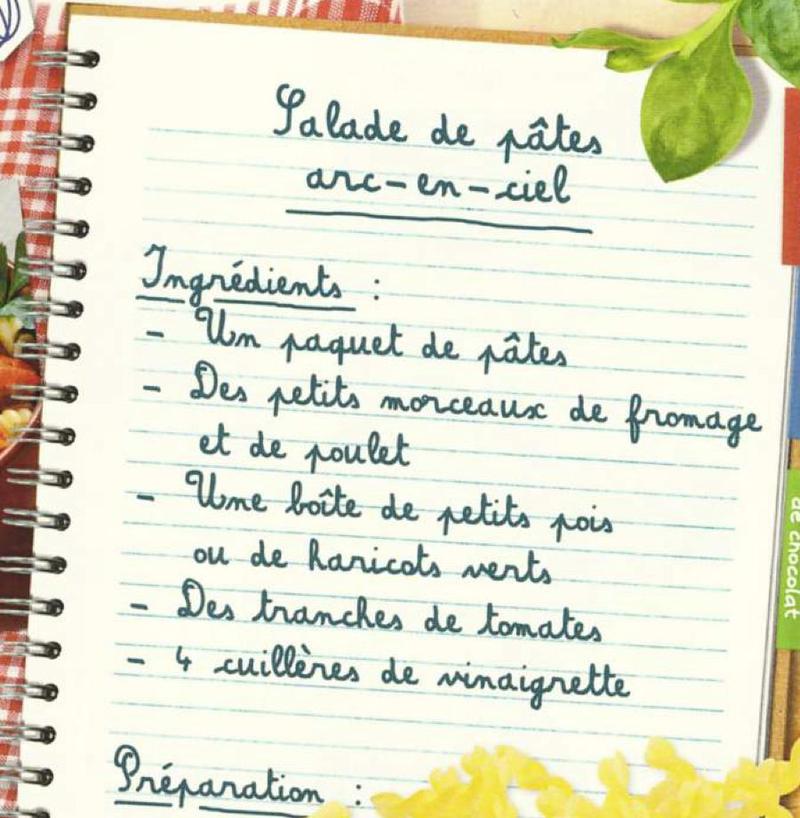
Lesson 2 is Akiko's recipe notebook (Ma page perso). Three tabs are visible: la salade de pâtes arc-en-ciel (rainbow pasta salad), les sandwichs rigolos (funny sandwiches) and les fruits en robe de chocolat (fruit in a chocolate coat). Only the first is open on the page.
Adosphère 2, p. 52
The ingredients
| On the list | English |
|---|---|
| un paquet de pâtes | a packet of pasta |
| des petits morceaux de fromage et de poulet | small pieces of cheese and chicken |
| une boîte de petits pois ou de haricots verts | a tin of peas or of green beans |
| des tranches de tomates | slices of tomato |
| 4 cuillères de vinaigrette | 4 spoonfuls of dressing |
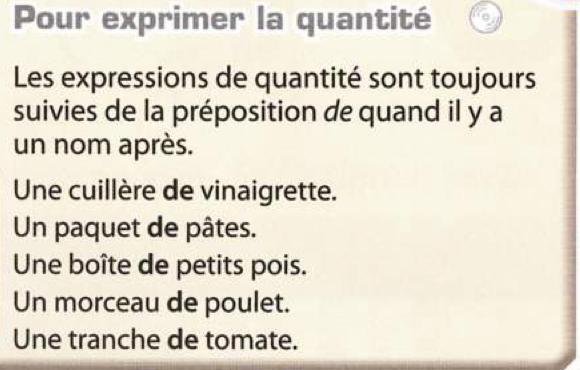
Expressing a quantity with de
A quantity word is always followed by de (or d' before a vowel), with no article after it. Compare Je mange des pâtes (some pasta) with Je mange un paquet de pâtes (a packet of pasta).
Adosphère 2, p. 53
| Container or measure | English | Example |
|---|---|---|
| un paquet de | a packet of | un paquet de pâtes |
| une boîte de | a tin / box of | une boîte de petits pois |
| une cuillère de | a spoonful of | une cuillère de vinaigrette |
| un morceau de | a piece of | un morceau de poulet |
| une tranche de | a slice of | une tranche de tomate |
| une assiette de | a plate of | une assiette de fromages |
| un gramme / un litre de | a gram / litre of | un litre d'eau |
Cooking verbs and tools (exercises 5 and 6)
| Verb | English | With what / where |
|---|---|---|
| mélanger | to mix | avec une cuillère (with a spoon) |
| faire cuire | to cook | dans une casserole (in a saucepan) |
| couper | to cut | avec un couteau (with a knife) |
| mettre | to put | au frigo (in the fridge) |
| ajouter | to add | ajoute les petits pois |
In a recipe the instructions use the tu command form. For -er verbs it is the tu form without the final s: Tu coupes → Coupe le fromage; Tu ajoutes → Ajoute les petits pois; Tu mélanges → Mélange tout. Two to know: Mets la vinaigrette au frigo and Fais cuire les pâtes.
When you write your own recipe in exercise 11, you can add the extra sequence words d'abord (first), puis or ensuite (then) and enfin (finally); they are not in the book, but they make the steps clear.
Phonetics : [k] and [g]
The book's tip on p. 53: to say [k], put your tongue forward in your mouth; to say [g], put it back. The letter c sounds [k] before a, o, u and the letters qu sound [k]: couper, cuillère, quantité, quatre. The letter g sounds [g] before a, o, u or before r: gâteau, gros, légumes, vinaigrette. Before e or i the letters c and g are soft (cinq, orange).
(b) Correct the mistake: Un paquet des pâtes.
(c) Write the command: you tell a friend to cut the tomatoes.
Show answerHide answer
(b) Un paquet de pâtes: after a quantity word comes de alone.
(c) Coupe les tomates.
1.3Healthy eating : devoir and quantities (Leçon 3)
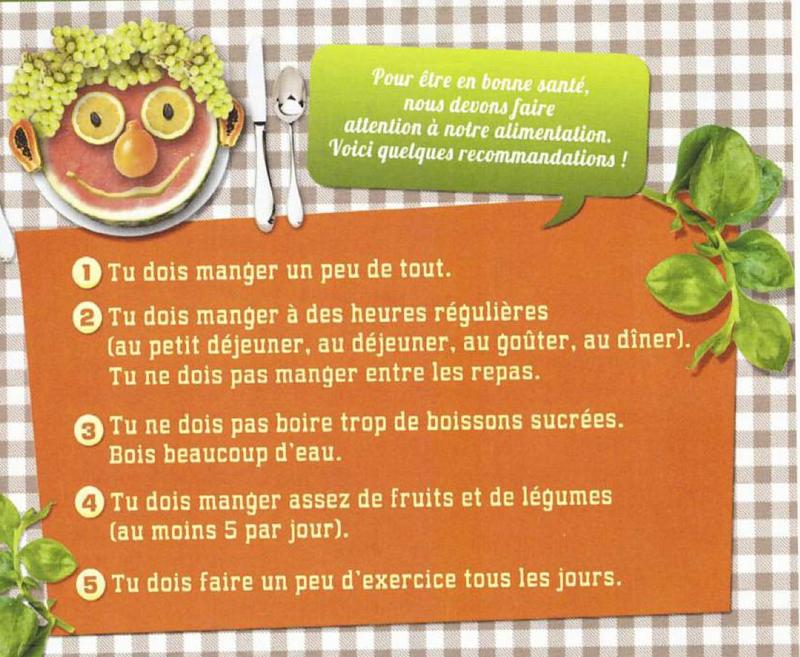
Lesson 3 is a website called Bon appétit. It gives five recommandations for good health. Each one uses tu dois or tu ne dois pas (you must / you must not).
Adosphère 2, p. 54
| No. | Recommendation | English |
|---|---|---|
| 1 | Tu dois manger un peu de tout. | Eat a little of everything. |
| 2 | Tu dois manger à des heures régulières. Tu ne dois pas manger entre les repas. | Eat at regular times; do not eat between meals. |
| 3 | Tu ne dois pas boire trop de boissons sucrées. Bois beaucoup d'eau. | Do not drink too many sweet drinks; drink lots of water. |
| 4 | Tu dois manger assez de fruits et de légumes (au moins 5 par jour). | Eat enough fruit and vegetables (at least 5 a day). |
| 5 | Tu dois faire un peu d'exercice tous les jours. | Do a little exercise every day. |
The verb devoir (must, to have to)
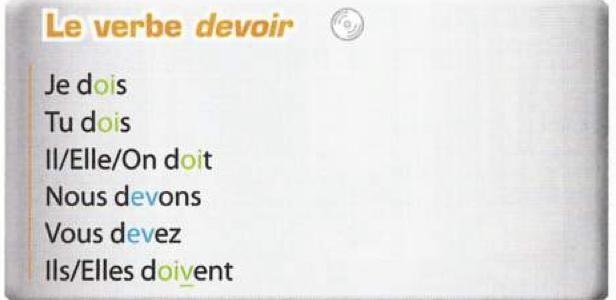
Adosphère 2, p. 55
| Pronoun | devoir | Example |
|---|---|---|
| je | dois | Je dois manger des légumes. |
| tu | dois | Tu dois boire de l'eau. |
| il / elle / on | doit | Elle doit faire du sport. |
| nous | devons | Nous devons manger de tout. |
| vous | devez | Vous devez faire attention. |
| ils / elles | doivent | Ils doivent manger assez de fruits. |
Devoir is followed by an infinitive. To make it negative, put ne … pas around devoir, not around the infinitive: Nous ne devons pas manger de viande le midi et le soir. Note the stem change: dois / doit, then dev-, then doiv-.
The verb boire (to drink)
In exercise 6 on p. 58 you hear boit and buvons. Learn the whole verb: je bois, tu bois, il / elle / on boit, nous buvons, vous buvez, ils / elles boivent. Its pattern is the same as devoir: oi in the singular, v in nous / vous, oiv in the third person plural.
How much? peu, assez, beaucoup, trop
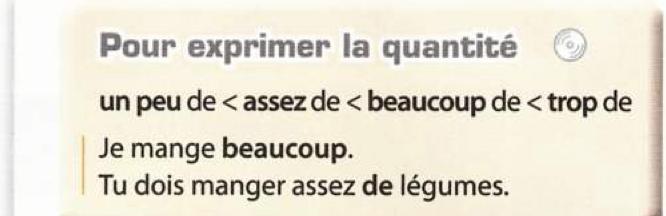
Adosphère 2, p. 55
| Expression | Meaning | Judgement |
|---|---|---|
| un peu de / peu de | a little / little | C'est peu ! (not much) |
| assez de | enough | Ce n'est pas assez ! (not enough) |
| beaucoup de | a lot of | C'est beaucoup ! |
| trop de | too much / too many | C'est trop ! |
The order from least to most is un peu de < assez de < beaucoup de < trop de. All four are followed by de or d', exactly like a container: Il y a beaucoup de légumes. Tu manges trop de sucre. Il n'y a pas assez d'eau. With a verb alone there is no de: Je mange beaucoup.
The meals of the day
French teenagers eat four meals a day (p. 54, exercise 4).
| Meal | English | Time on the clocks |
|---|---|---|
| le petit déjeuner | breakfast | 07:00 |
| le déjeuner | lunch | 12:30 |
| le goûter | afternoon snack | 16:00 |
| le dîner | dinner | 20:00 |
Reading the article Une bonne alimentation (p. 60)
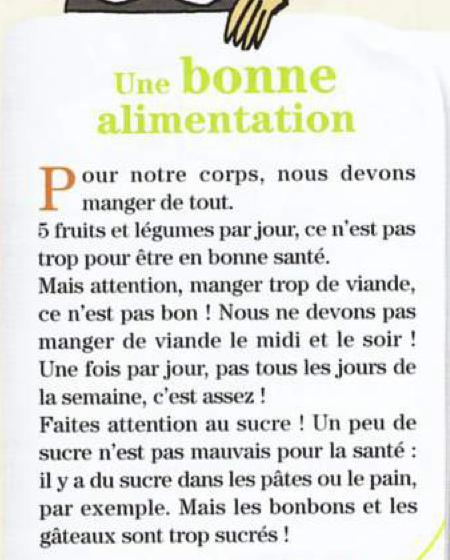
Adosphère 2, p. 60
| Topic | The article says |
|---|---|
| Fruit and vegetables | Five a day is not too much for good health. |
| Meat | Too much is not good. Do not eat meat at midday and in the evening; once a day, not every day, is enough. |
| Sugar | A little is not bad: there is sugar in pasta and bread. But sweets and cakes have too much. |
(b) Put in order from least to most: trop, un peu, assez, beaucoup.
(c) Say in French that you must not eat too much sugar.
Show answerHide answer
(b) un peu, assez, beaucoup, trop.
(c) Je ne dois pas manger trop de sucre.
1.4At the French table (Leçon 4, Ma page culture)
Page 56 shows a brasserie: a French restaurant (answer a in exercise 1), not a supermarket or a canteen. The blackboard menu has two parts: Plats du jour (dishes of the day) and Desserts du jour.
| Menu | Items | English |
|---|---|---|
| Plats du jour | Omelette salade | omelette with salad |
| Steak frites | steak with chips | |
| Croque-monsieur | toasted ham and cheese sandwich | |
| Assiette de fromages | plate of cheeses | |
| Desserts du jour | Crêpes au sucre | pancakes with sugar |
| Mousse au chocolat | chocolate mousse |
One photo on the page is an intrus (an intruder): a dish that is not on the menu. It is the plate of snails (les escargots). Use the question Quel plat est-ce que tu voudrais goûter ? and answer Je voudrais goûter… or Je ne voudrais pas goûter…, as in the dialogue on p. 58 (Je voudrais aussi de l'eau, s'il vous plaît).
1.5Mon cours de maths : litres, grams and spoonfuls (p. 57)
The maths page gives two reference documents. You use them to convert quantities in a recipe.
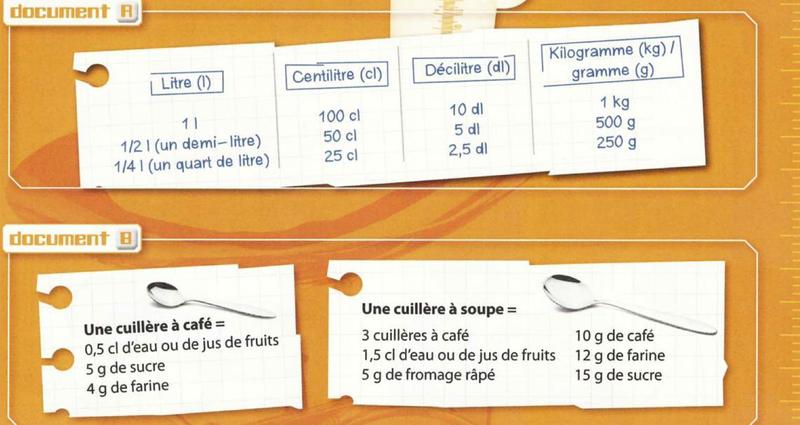
Adosphère 2, p. 57
| Litre (l) | Centilitre (cl) | Décilitre (dl) | Kilogramme / gramme |
|---|---|---|---|
| 1 l | 100 cl | 10 dl | 1 kg |
| 1/2 l (un demi-litre) | 50 cl | 5 dl | 500 g |
| 1/4 l (un quart de litre) | 25 cl | 2,5 dl | 250 g |
In French, the decimal comma is used: 2,5 dl, not 2.5 dl. Remember: 1 l = 10 dl = 100 cl, and 1 kg = 1 000 g.
| One spoonful | Water or fruit juice | Sugar | Flour | Other |
|---|---|---|---|---|
| une cuillère à café (coffee spoon) | 0,5 cl | 5 g | 4 g | |
| une cuillère à soupe (soup spoon) = 3 coffee spoons | 1,5 cl | 15 g | 12 g | 10 g coffee; 5 g grated cheese |
15 dl = 15 ÷ 10 = 1,5 l, so Nous devons boire 1,5 l d'eau par jour.
Pour faire cuire les pâtes, j'utilise 12,5 dl d'eau.
1 dl = 10 cl, so 12,5 × 10 = 125 cl.
Show answerHide answer
1.6Practice, DELF and word list (pp. 58-60)
Entraîne-toi revises four things: the partitive articles (exercises 1 to 3), the adverbs of quantity (exercises 4 and 5), devoir and boire (exercise 6) and vocabulary (exercises 7 to 9: food, quantities, meals). The sounds [k] and [g] come back in exercises 11 and 12.
Au déjeuner : de la viande, des légumes, du fromage.
Au goûter : un gâteau, des fruits.
Au dîner : de la soupe, une salade, un yaourt.
The Évaluation DELF on p. 60 has four tasks, 5 points each: (1) listening, complete the quantities of the ingredients; (2) speaking, say what you eat for dinner; (3) reading, an article with true or false; (4) writing, a shopping list of at least five foods for a snack for four friends. For task 4 write the quantity too: un paquet de biscuits, deux litres de jus d'orange, une boîte de chocolats, des bananes, du fromage.
Ton dico : the word list on p. 60
1.7Summary for the exam
| Topic | Remember |
|---|---|
| Articles | in general le, la, l', les; some du, de la, de l', des; none pas de, pas d', jamais de |
| Quantities | container or measure + de + noun with no article: un paquet de pâtes; un peu de < assez de < beaucoup de < trop de |
| Recipes | mélanger, faire cuire, couper, mettre, ajouter; commands Coupe, Ajoute, Mélange, Mets, Fais cuire |
| devoir | dois, dois, doit, devons, devez, doivent + infinitive; ne … pas around devoir |
| boire | bois, bois, boit, buvons, buvez, boivent |
| Meals | petit déjeuner 07:00, déjeuner 12:30, goûter 16:00, dîner 20:00 |
| Measures | 1 l = 10 dl = 100 cl; 1 kg = 1 000 g; soup spoon = 3 coffee spoons; sugar 5 g and 15 g, flour 4 g and 12 g |
| Sounds | [k]: c before a, o, u and qu; [g]: g before a, o, u |
1.
2.
3.
4.
5.