myUASARevision for UASA
Mathematics notes, chapter 7

Coordinates

Textbook Mathematics Form 2 (DLP), pages 120–143

What this chapter covers

  • Explain the meaning of distance between two points on the Cartesian plane, and use the scales of the axes (7.1.1)
  • Find the distance between two points that share the same x-coordinate or the same y-coordinate (7.1.2)
  • Derive and use the formula for the distance between any two points on a Cartesian plane, and solve problems on distance (7.1.3, 7.1.4)
  • Explain the midpoint between two points, derive the midpoint formula and use it to find coordinates, including a missing end point (7.2.1 to 7.2.4)
  • Solve problems that combine distance, midpoint and the properties of shapes on the Cartesian plane (7.3.1)

7.1Distance in the Cartesian coordinate system
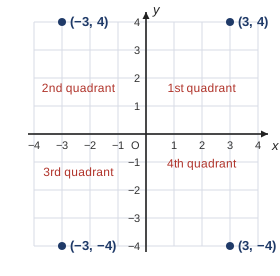
The Cartesian plane has a horizontal x-axis and a vertical y-axis that cross at right angles at the origin O(0, 0). A point is written as (x, y): the x-coordinate always comes first.
Cartesian plane with four labelled points, one in each quadrant: (3, 4) in the 1st, (−3, 4) in the 2nd, (−3, −4) in the 3rd and (3, −4) in the 4th
The four quadrants. The signs of (x, y) are (+, +), (−, +), (−, −) and (+, −).

Values increase going right and going up, and decrease going left and going down. The distance between two points is the length of the straight line that joins them. The textbook (p. 122) finds it by drawing a right-angled triangle: a horizontal side and a vertical side, read from the scale of the axes.

Always read the scale first. If one square on the x-axis is 5 units, then 6 squares are 6 × 5 = 30 units (textbook p. 124). One square is not always one unit.

Points with a common x-coordinate or y-coordinate

SituationLine isDistance
Same y-coordinate: (x1, y) and (x2, y)Horizontalx2 − x1
Same x-coordinate: (x, y1) and (x, y2)Verticaly2 − y1

Subtract the smaller value from the larger so the distance is positive. Distance is never negative.

Textbook example, p. 126: distance between the points
(a) (2, −3) and (4, −3): same y, so distance = 4 − 2 = 2 units
(b) (0, 1) and (0, −2): same x, so distance = 1 − (−2) = 3 units
Textbook example, p. 126: a missing coordinate
A(1, y) is directly above C(1, 3) and AC = 5 units, so y − 3 = 5 and y = 8. A is (1, 8).
B(x, 3) is level with C(1, 3) and CB = 4 units, so x − 1 = 4 and x = 5. B is (5, 3).
Writing 1 − (−2) as 1 − 2 = −1. The minus sign of the coordinate stays: 1 − (−2) = 1 + 2 = 3. Count the squares across the axis through zero if unsure.
Find the distance between (a) (−6, 4) and (3, 4)   (b) (5, −2) and (5, −9).
Show answerHide answer
(a) Same y: 3 − (−6) = 9 units
(b) Same x: −2 − (−9) = 7 units

Distance between any two points

If the line is slanting, draw the horizontal and vertical sides to make a right-angled triangle. The line is the hypotenuse, so Pythagoras' theorem gives the length (textbook p. 127).
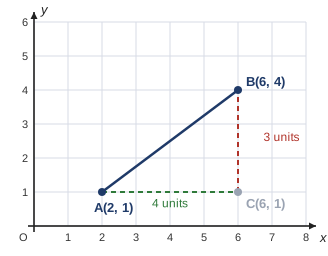
Points A(2, 1) and B(6, 4) joined by a line; a horizontal dashed line of 4 units from A to C(6, 1) and a vertical dashed line of 3 units from C to B
AC = 6 − 2 = 4 units and CB = 4 − 1 = 3 units, so AB² = 4² + 3² = 25 and AB = 5 units.
Distance formula. For A(x1, y1) and B(x2, y2):
AB = √[(x2 − x1)² + (y2 − y1)²]
Textbook example, p. 128: P(−2, 6) and Q(4, 1)
PQ = √[(4 − (−2))² + (1 − 6)²]
= √(6² + (−5)²)
= √(36 + 25) = √61
= 7.81 units
The order of the two points does not matter, because each difference is squared. A negative difference becomes positive after squaring. A common check: the answer must be longer than both the horizontal and the vertical distance.
Writing (x2 − x1)² as x2² − x1², or adding the two differences instead of squaring them. Work out each bracket first, then square, then add, then take the square root of the whole sum.

Solving problems on distance

Textbook example, p. 129: perimeter of an isosceles triangle
Vertices A(1, 1), B(3, 4), C(5, 1).
AC = 5 − 1 = 4 units (same y)
AB = √[(3 − 1)² + (4 − 1)²] = √(4 + 9) = √13 = 3.6 units
BC = √[(5 − 3)² + (1 − 4)²] = √13 = 3.6 units, so AB = BC
Perimeter = 3.6 + 3.6 + 4 = 11.2 units
Textbook example, p. 129: find the value of v
A(v, 3) and B(6, 9) with AB = 10 units.
√[(6 − v)² + (9 − 3)²] = 10
(6 − v)² + 36 = 100, so (6 − v)² = 64
6 − v = 8, so v = −2
Find the distance between A(−1, 2) and B(5, 10). (Hint: the answer is a whole number.)
Show answerHide answer
Horizontal 5 − (−1) = 6, vertical 10 − 2 = 8
AB = √(36 + 64) = √100 = 10 units

7.2Midpoint in the Cartesian coordinate system

The midpoint of a line segment is the point that divides it into two equal parts. It is where the perpendicular bisector of the line meets the line (textbook p. 133).

For a slanting line, the midpoint is found by halving the horizontal distance and halving the vertical distance. The x-coordinate of the midpoint is the average of the two x-coordinates and the y-coordinate is the average of the two y-coordinates.
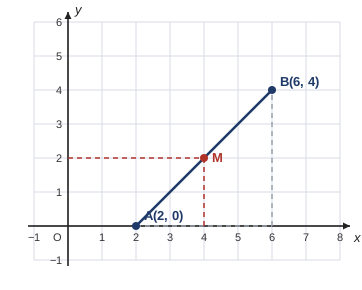
Line from A(2, 0) to B(6, 4) with its midpoint M marked at (4, 2); dashed guide lines from M to both axes
Textbook p. 135: A(2, 0) and B(6, 4) have the midpoint M(4, 2).
Midpoint formula. For A(x1, y1) and B(x2, y2):
Midpoint = ( (x1 + x2) / 2 , (y1 + y2) / 2 )
Textbook example, p. 136: midpoint of A(2, 5) and B(2, 1)
Midpoint = ( (2 + 2)/2 , (5 + 1)/2 ) = (4/2 , 6/2) = (2, 3)
Textbook example, p. 136: midpoint of M(10, 7) and N(4, 1)
Midpoint = ( (10 + 4)/2 , (7 + 1)/2 ) = (14/2 , 8/2) = (7, 4)
Add the two x-coordinates, then halve. Do the same for y. Keep negative signs: the midpoint of (−6, 3) and (4, −9) is ((−6 + 4)/2, (3 + (−9))/2) = (−1, −3).
Using the midpoint formula with a subtraction, as in (x2 − x1)/2. That gives half the distance, not the coordinate. The midpoint formula adds the coordinates.

Finding a missing end point

If the midpoint and one end are known, put the known numbers into the midpoint formula and solve for the unknown coordinates, one equation for x and one for y.

Textbook example, p. 137: P(2, 9) is the midpoint of KL and K is (−3, 12)
(−3 + x2)/2 = 2, so −3 + x2 = 4 and x2 = 7
(12 + y2)/2 = 9, so 12 + y2 = 18 and y2 = 6
L is (7, 6).
A shortcut: from K to the midpoint, x moves +5 and y moves −3. Make the same move again from the midpoint to reach L: (2 + 5, 9 − 3) = (7, 6).
(a) Find the midpoint of (−4, 1) and (6, 7).   (b) M(1, 2) is the midpoint of AB and A is (−3, 5). Find B.
Show answerHide answer
(a) ((−4 + 6)/2, (1 + 7)/2) = (1, 4)
(b) (−3 + x)/2 = 1 gives x = 5; (5 + y)/2 = 2 gives y = −1. B is (5, −1).

7.3Solving problems with the Cartesian coordinate system

Many problems join three ideas: a line parallel to an axis has a common coordinate; the distance formula gives lengths; the midpoint formula gives centres and missing points (textbook pp. 140 to 141).

If you knowThen
A line is parallel to the x-axisBoth points have the same y-coordinate
A line is parallel to the y-axisBoth points have the same x-coordinate
A shape is a rectangle, square or rhombusIts two diagonals have the same midpoint
A triangle is isoscelesTwo of its sides have equal length, so test the distances
Textbook example, p. 140: a rhombus
AB is parallel to the x-axis, so A has the same y-coordinate as B(11, 6), that is 6. Since AB = 5, A is (11 − 5, 6) = (6, 6).
AC is parallel to the y-axis, so C has the same x-coordinate as A, that is 6. DC is parallel to AB, so C has the same y-coordinate as D(1, 2), that is 2. C is (6, 2). The midpoint of AC is ((6 + 6)/2, (6 + 2)/2) = (6, 4).
Mixing up the roles of the two coordinates. Parallel to the x-axis means the y value is shared, and the x values differ.
The line PQ is parallel to the y-axis. P is (3, −2) and Q is (3, 6). Find (a) PQ, and (b) the midpoint of PQ.
Show answerHide answer
(a) 6 − (−2) = 8 units
(b) (3, (−2 + 6)/2) = (3, 2)

Notes written from Mathematics Form 2 (DLP), Chapter 7, pp. 120 to 143. Figures drawn for this site.