Mathematics questions, chapter 7
Nama / NameKelas / ClassTarikh / Date
Coordinates
42 marks. Use Practice to check each answer as you go, or Exam to answer everything first. Show your working for Section B. Give lengths that are not whole numbers correct to 2 decimal places.
Section A: objective questions
10 marksChoose the correct answer. Each question carries 1 mark.
1
Question 1
Which statement about the Cartesian plane is correct?
Show answerHide answer
B
The x-axis is horizontal and the y-axis is vertical; they cross at right angles at the origin (0, 0). A point is written (x, y) with x first.
2
Question 2
In which quadrant is the point (4, −6)?
Show answerHide answer
D
x is positive and y is negative, which is (x, −y): the 4th quadrant. The 1st has both positive; the 2nd has x negative; the 3rd has both negative.
3
Question 3
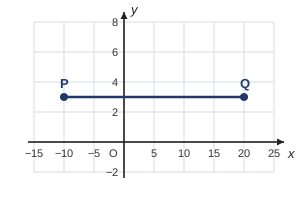
Diagram 1 shows the line PQ on a Cartesian plane. One square on the x-axis is 5 units. What is the distance PQ?
Show answerHide answer
A
PQ covers 20 − (−10) = 30 units, which is 6 squares × 5 units. 6 forgets the scale; 25 and 15 come from mistakes with the negative sign.
4
Question 4
The points A(1, 2) and B(4, 6) are joined. What is the length AB?
Show answerHide answer
B
AB = √[(4 − 1)² + (6 − 2)²] = √(9 + 16) = √25 = 5 units. 7 is 3 + 4 (the sides added); 25 forgets the square root.
5
Question 5
Calculate the distance between (−3, 4) and (5, −2).
Show answerHide answer
A
Horizontal: 5 − (−3) = 8. Vertical: −2 − 4 = −6, squared 36. √(64 + 36) = √100 = 10. √28 comes from subtracting the squares (64 − 36) instead of adding; 14 is 8 + 6.
6
Question 6
The distance between A(−1, 2) and B(5, k) is 10 units, and k is greater than 2. Find the value of k.
Show answerHide answer
C
(5 − (−1))² + (k − 2)² = 100 gives 36 + (k − 2)² = 100, so (k − 2)² = 64 and k − 2 = ±8. k = 10 or k = −6. Since k is greater than 2, k = 10.
7
Question 7
Find the midpoint of the line joining (2, 5) and (8, 1).
Show answerHide answer
B
((2 + 8)/2, (5 + 1)/2) = (5, 3). (10, 6) forgets to halve; (3, 2) is half the differences.
8
Question 8
What is the midpoint of (−8, 5) and (2, −11)?
Show answerHide answer
D
((−8 + 2)/2, (5 + (−11))/2) = (−6/2, −6/2) = (−3, −3). (5, −8) uses subtraction, which gives half the distances; (−6, −6) forgets to halve.
9
Question 9
The straight line joining (−8, 3) and (s, 3) has the midpoint (1, u). Find the values of s and u.
Show answerHide answer
C
(−8 + s)/2 = 1 gives s = 10. (3 + 3)/2 = 3 gives u = 3. s = 9 comes from forgetting to double the midpoint (1 − (−8)), and u = 6 forgets to halve.
10
Question 10
The vertices of a triangle are A(−3, 0), B(3, 0) and C(0, 4). What is its perimeter?
Show answerHide answer
B
AB = 6 (same y). AC = √(3² + 4²) = 5 and BC = √(3² + 4²) = 5. Perimeter = 6 + 5 + 5 = 16 units. 12 is the area, not the perimeter.
Section B: structured questions
32 marksAnswer all questions. Show your working.
11
Question 11
State the distance between each pair of points.
[1 mark]
(a)(2, −3) and (7, −3)
Show answerHide answer
Tick each point you got.
[1 mark]
(b)(−4, 5) and (−4, −1)
Show answerHide answer
Tick each point you got.
12
Question 12
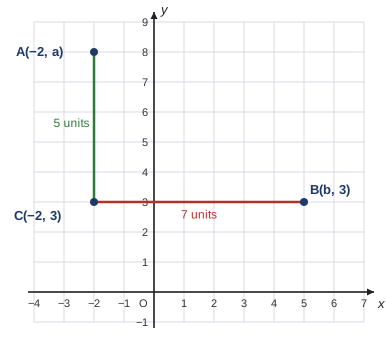
Diagram 2 shows three points A, B and C on a Cartesian plane. AC is parallel to the y-axis and CB is parallel to the x-axis.
[2 marks]
(a)AC = 5 units. Find the value of a.
Show answerHide answer
Tick each point you got.
[2 marks]
(b)CB = 7 units. Find the value of b.
Show answerHide answer
A and C share the x-coordinate; B and C share the y-coordinate.
Tick each point you got.
13
Question 13
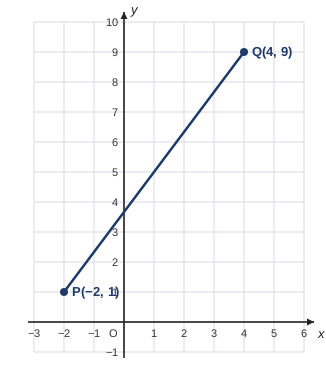
Diagram 3 shows the points P(−2, 1) and Q(4, 9).
[2 marks]
(a)State the horizontal distance and the vertical distance between P and Q.
Show answerHide answer
Tick each point you got.
[2 marks]
(b)Calculate the length PQ.
Show answerHide answer
Tick each point you got.
14
Question 14
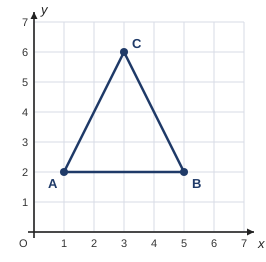
Diagram 4 shows triangle ABC with A(1, 2), B(5, 2) and C(3, 6).
[3 marks]
(a)Show that triangle ABC is an isosceles triangle.
Show answerHide answer
Tick each point you got.
[2 marks]
(b)Calculate the perimeter of the triangle.
Show answerHide answer
√20 = 4.47 correct to 2 decimal places.
Tick each point you got.
15
Question 15
The distance between P(−2, 3) and Q(m, 7) is 5 units, where m is greater than 0. Calculate the value of m.
[4 marks]
(a)Form an equation and solve it to find m.
Show answerHide answer
Tick each point you got.
16
Question 16
Find the midpoint of the line joining each pair of points.
[1 mark]
(a)(2, −4) and (8, 6)
Show answerHide answer
Tick each point you got.
[1 mark]
(b)(−7, 0) and (3, −5)
Show answerHide answer
Tick each point you got.
17
Question 17
M(1, −2) is the midpoint of the straight line AB. The coordinates of A are (−5, 4). Calculate the coordinates of B.
[3 marks]
(a)Find the coordinates of B.
Show answerHide answer
Check: ((−5 + 7)/2, (4 + (−8))/2) = (1, −2).
Tick each point you got.
18
Question 18
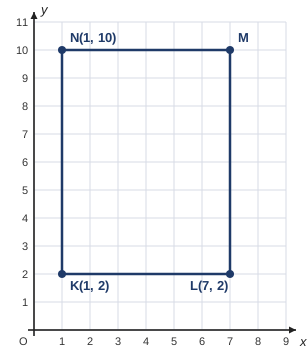
Diagram 5 shows a rectangle KLMN with K(1, 2), L(7, 2) and N(1, 10).
[1 mark]
(a)State the coordinates of M.
Show answerHide answer
Tick each point you got.
[2 marks]
(b)Calculate the length of the diagonal LN.
Show answerHide answer
Tick each point you got.
[1 mark]
(c)Find the midpoint of LN.
Show answerHide answer
Tick each point you got.
[1 mark]
(d)Mei says that the midpoint of the other diagonal, KM, is the same point as the midpoint of LN. Is Mei right?
Show answerHide answer
Yes
Midpoint of KM = ((1 + 7)/2, (2 + 10)/2) = (4, 6). The diagonals of a rectangle bisect each other.
19
Question 19
A line joins two points. The midpoint of the line is (3, −1).
[2 marks]
(a)Write down the coordinates of one possible pair of end points. Neither point may lie on an axis.
Show answerHide answer
Tick each point you got.
[1 mark]
(b)Show by calculation that your points have the midpoint (3, −1).
Show answerHide answer
Tick each point you got.