Mathematics questions, chapter 7
Nama / NameKelas / ClassTarikh / Date
Plans and Elevations
42 marks. Use Practice to check each answer as you go, or Exam to answer everything first. Use the measurements marked on each diagram. For drawing questions, write what the drawing shows (shape, lengths, type of line); sketch it on paper and compare with the marking scheme. Show your working for Section B.
Section A: objective questions
11 marksChoose the correct answer. Each question carries 1 mark.
1
Question 1
What is a normal to a plane?
Show answerHide answer
B
A normal to a plane is a straight line that is perpendicular to the plane, so it makes a right angle with any line on the plane.
2
Question 2
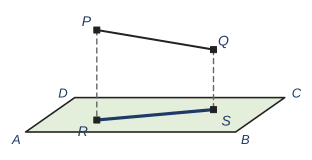
In Diagram 1, PR and QS are normals to the horizontal plane ABCD. Which line is the orthogonal projection of the line PQ on the plane ABCD?
Show answerHide answer
D
The orthogonal projection of a line is found by joining the feet of the normals from its two ends. The feet are R and S, so the projection is RS.
3
Question 3
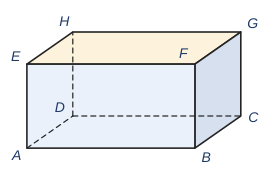
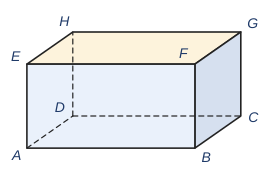
Diagram 2 shows a cuboid ABCDEFGH on a horizontal plane. Which line is a normal to the plane BCGF?
Show answerHide answer
A
AB meets the plane BCGF at B at a right angle. BC, BF and FG all lie on the plane BCGF, so they are not normals.
4
Question 4
A rectangular card 8 cm by 5 cm is tilted so that its 8 cm sides stay horizontal and its 5 cm sides are inclined to the horizontal plane. Which statement describes the orthogonal projection of the card on the horizontal plane, seen from above?
Show answerHide answer
C
Sides parallel to the plane keep their length, so the 8 cm sides stay 8 cm. The inclined 5 cm sides become shorter. The right angles stay right angles, so the projection is a rectangle.
5
Question 5
In an elevation, a side of the object that is hidden from the viewing direction is drawn as ______.
Show answerHide answer
A
Hidden sides are dashed. Visible sides are thick solid lines and thin solid lines are only construction lines.
6
Question 6
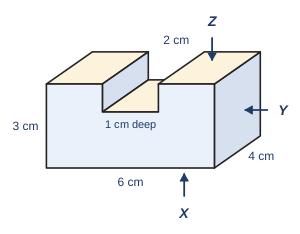
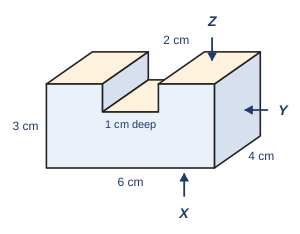
Diagram 3 shows a block with a channel 2 cm wide and 1 cm deep along its whole top. Which drawing is the front elevation as viewed from X?
Show answerHide answer
D
From X you see the end of the block: 6 cm wide and 3 cm high, with the channel as a notch in the top. A is the plan; B is the side elevation as viewed from Y; C puts the channel at the corner.
7
Question 7
In method 1 for drawing on four quadrants, the side elevation is viewed from the right. Where is it drawn?
Show answerHide answer
B
In method 1 the side elevation is in the second quadrant, on the left of the front elevation. In method 2 (viewed from the left) it is on the right.
8
Question 8
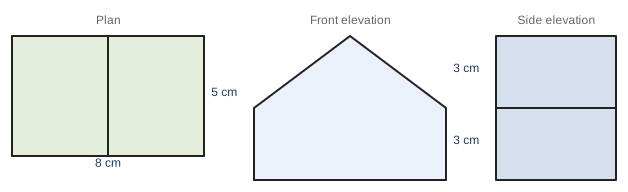
Diagram 4 shows the plan, front elevation and side elevation of an object. What is the object?
Show answerHide answer
B
The front elevation is a rectangle with a triangle on top. The plan has one straight line (the ridge) and the side elevation is a rectangle, so the roof is a triangular prism. A pyramid would show diagonals in the plan and a triangle in the side elevation. A cone and cylinder would show a circle.
9
Question 9
Diagram 5 shows a block with a channel along its whole top. Calculate the volume of the block.
Show answerHide answer
C
Block 6 × 4 × 3 = 72 cm³. The channel is 2 × 1 × 4 = 8 cm³. Volume = 72 − 8 = 64 cm³. 72 forgets the channel; 80 adds it; 8 is the channel only.
10
Question 10
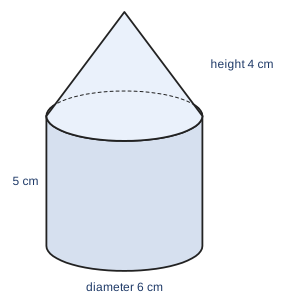
Diagram 6 shows a cone placed on a cylinder, both with diameter 6 cm. Which is the plan of the object?
Show answerHide answer
A
Seen from above, both solids are circles of the same diameter, so only one circle shows. The apex of the cone is directly above the centre, so it is a dot. A rectangle or a triangle on a rectangle is a front or side elevation.
11
Question 11
Which statement about orthogonal projections is false?
Show answerHide answer
D
A side perpendicular to the plane is projected as a single point, not with its actual length. The other three statements are true.
Section B: structured questions
31 marksAnswer all questions. Show your working.
12
Question 12
Diagram 7 shows a cuboid ABCDEFGH with a horizontal base ABCD.
[2 marks]
(a)Name two normals to the plane ABCD.
Show answerHide answer
The four upright edges meet the base at right angles. The foot of the normal on the plane is written last, so it may also be written EA, FB, GC and HD.
Tick each point you got.
[1 mark]
(b)State the orthogonal projection of the line FD on the plane ABCD.
Show answerHide answer
The normal from F meets the base at B. D is already on the plane. The projection joins B and D.
Tick each point you got.
13
Question 13
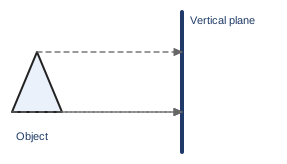
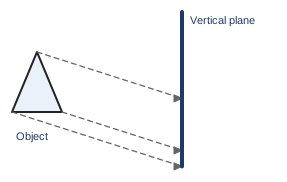
Diagram 8 and Diagram 9 each show a triangular object and the lines that project it on a vertical plane.
[1 mark]
(a)Is the projection in Diagram 9 an orthogonal projection?
Show answerHide answer
No
The projecting lines are slanted.
[1 mark]
(b)Give a reason for your answer to (a).
Show answerHide answer
Tick each point you got.
14
Question 14
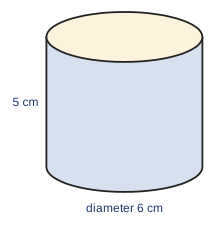
Diagram 10 shows a cylinder of diameter 6 cm and height 5 cm standing on a horizontal plane.
[1 mark]
(a)State the shape and the size of the orthogonal projection on the horizontal plane, viewed from above.
Show answerHide answer
Tick each point you got.
[2 marks]
(b)State the shape and the size of the orthogonal projection on a vertical plane, viewed from the side.
Show answerHide answer
Tick each point you got.
15
Question 15
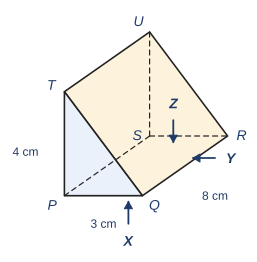
Diagram 11 shows a right prism PQRSTU. The base PQRS is a rectangle on a horizontal plane and the cross section PQT is a right-angled triangle with PQ = 3 cm and PT = 4 cm. PS = 8 cm.
[2 marks]
(a)Describe the plan of the prism, viewed from Z.
Show answerHide answer
Tick each point you got.
[2 marks]
(b)Describe the front elevation of the prism, viewed from X.
Show answerHide answer
Tick each point you got.
[2 marks]
(c)The sloping edge TQ is 5 cm long. State the length of TQ in the plan and give a reason why it is not 5 cm.
Show answerHide answer
Tick each point you got.
16
Question 16
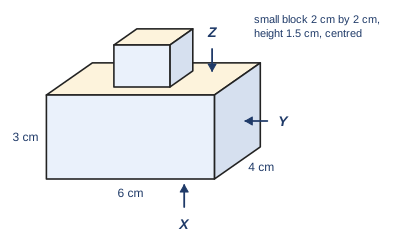
Diagram 12 shows a cuboid 6 cm by 4 cm by 3 cm with a small block, 2 cm by 2 cm and 1.5 cm high, placed in the centre of its top face.
[2 marks]
(a)Describe the plan viewed from Z.
Show answerHide answer
Tick each point you got.
[2 marks]
(b)Describe the front elevation viewed from X.
Show answerHide answer
Tick each point you got.
[2 marks]
(c)Calculate the volume of the object.
Show answerHide answer
Tick each point you got.
17
Question 17
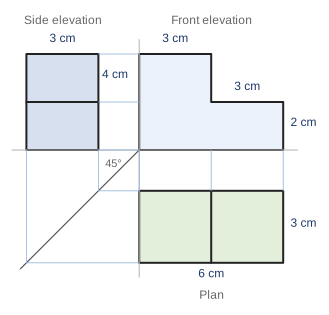
Diagram 13 shows the plan, the front elevation and the side elevation of a solid. The side elevation is viewed from the right.
[1 mark]
(a)State the height of the tallest part of the solid.
Show answerHide answer
Tick each point you got.
[1 mark]
(b)Describe the solid.
Show answerHide answer
Tick each point you got.
[2 marks]
(c)Calculate the volume of the solid.
Show answerHide answer
Tick each point you got.
18
Question 18
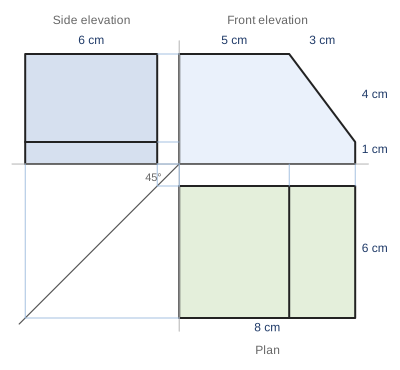
Diagram 14 shows the plan, front elevation and side elevation of a solid. The solid was a cuboid 8 cm × 6 cm × 5 cm. A right prism with a triangular cross section was removed from one top edge.
[2 marks]
(a)Calculate the length, in cm, of the sloping edge in the front elevation.
Show answerHide answer
Tick each point you got.
[2 marks]
(b)Calculate the volume, in cm³, of the prism that was removed.
Show answerHide answer
Tick each point you got.
[2 marks]
(c)Calculate the volume, in cm³, of the solid shown.
Show answerHide answer
Tick each point you got.
[1 mark]
(d)Find the ratio of the volume removed to the volume of the solid shown, in its simplest form.
Show answerHide answer
Tick each point you got.