Science questions, chapter 1
Nama / NameKelas / ClassTarikh / Date
Stimuli and responses
44 marks. Use Practice to check each answer as you go, or Exam to answer everything against the clock first.
Section A: objective questions
12 marksChoose the best answer for each question.
1
Question 1
Which two parts make up the central nervous system?
Show answerHide answer
C
The central nervous system is the brain and the spinal cord. Cranial and spinal nerves make up the peripheral nervous system (Figure 1.1, p. 4).
2
Question 2
Which of the following is an involuntary action that is controlled by the spinal cord?
Show answerHide answer
B
Sneezing is a reflex action controlled by the spinal cord. Peristalsis, breathing and secretion of saliva are involuntary actions controlled by the medulla oblongata.
3
Question 3
Rina hears her phone ring and picks it up. Which sequence shows the pathway of the impulse?
Show answerHide answer
A
Voluntary action: the affector (ear) sends impulses to the brain, and the brain sends impulses to the effector (hand muscles). The spinal cord is the control centre only for reflex actions.
4
Question 4
Which cells in the retina are sensitive to the colour of light in bright conditions?
Show answerHide answer
D
Cone cells detect colour (red, green and blue) in bright light. Rod cells detect light intensity, including faint light, but not colour.
5
Question 5
What is the function of the Eustachian tube?
Show answerHide answer
A
The Eustachian tube (middle ear) balances air pressure on both sides of the eardrum. The ossicles amplify vibrations, the cochlea produces impulses and the semicircular canals detect the position of the head.
6
Question 6
Which sequence shows the correct path of sound through the ear?
Show answerHide answer
D
Earlobe → ear canal → eardrum → ossicles → oval window → cochlea → auditory nerve → brain (Figure 1.14, p. 17).
7
Question 7
A student is given four cordial drinks of different flavours and identifies each flavour with his eyes covered. The results are shown in the table.
Which inference is correct?
| Condition of the nose | Flavours identified correctly (out of 4) |
|---|---|
| Pinched | 1 |
| Not pinched | 4 |
Show answerHide answer
C
The flavours are identified more easily when the nose is not pinched, so smell and taste work together. Eyes were covered in both trials, so they do not explain the difference.
8
Question 8
Haziq can read a book clearly but cannot see the writing on the whiteboard. Which statement explains his problem and its correction?
Show answerHide answer
B
He is short-sighted: the lens is too thick or the eyeball too long, so the image of a distant object forms in front of the retina. A concave lens corrects this.
9
Question 9
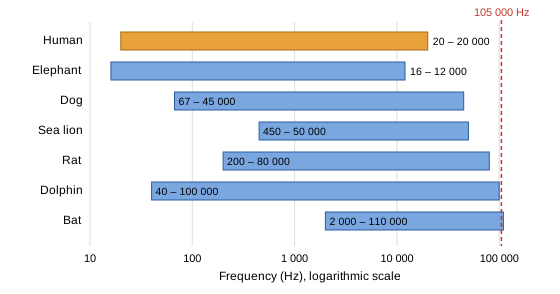
Diagram 1 shows the hearing ranges of some animals. A machine produces ultrasound of frequency 105 000 Hz. Which animal is able to hear this sound?
Show answerHide answer
D
105 000 Hz lies inside the bat's range (2 000 to 110 000 Hz). The dolphin's range ends at 100 000 Hz and the others end even lower.
10
Question 10
A green pea seedling is grown in a box with a small opening on the left side only. After five days its shoot has bent towards the left. What does this show?
Show answerHide answer
A
Growth towards the stimulus (light) is positive phototropism. It gives the shoot and leaves enough sunlight for photosynthesis. The direction depends on the light, so it is tropism, not nastic movement.
11
Question 11
Which statement about nastic movement in plants is correct?
Show answerHide answer
C
Nastic movement, such as the folding of Mimosa leaves, is rapid and independent of the direction of the stimulus. Directional, slow responses are tropisms.
12
Question 12
A rabbit has its eyes on opposite sides of its head. How does this help the rabbit to survive?
Show answerHide answer
B
Prey animals have monocular vision. The wide field of vision lets them detect predators coming from any direction.
Section B: structured questions
32 marksAnswer all questions. Write your answers in the spaces provided.
13
Question 13
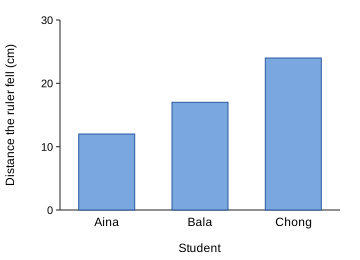
Three students, Aina, Bala and Chong, carried out the falling-ruler activity to measure their reaction times. Diagram 2 shows the distance the ruler fell in the first attempt of each student.
[2 marks]
(a)Which student has the fastest reaction time? Give a reason.
Show answerHide answer
Tick each point you got.
[2 marks]
(b)Chong made four attempts in all (the first is shown in Diagram 2) and the ruler fell 24 cm, 20 cm, 22 cm and 26 cm. Calculate the average distance.
Show answerHide answer
Tick each point you got.
[1 mark]
(c)Is catching the ruler a voluntary or an involuntary action?
Show answerHide answer
Voluntary
The student decides to catch the ruler; the response is controlled by the brain.
14
Question 14
Sound travels through the ear to the brain.
[1 mark]
(a)State the function of the ossicles.
Show answerHide answer
Tick each point you got.
[1 mark]
(b)Name the part of the ear that converts sound vibrations into nerve impulses.
Show answerHide answer
Tick each point you got.
[2 marks]
(c)A person's auditory nerve is damaged, but the rest of his ear works normally. Explain why he cannot hear.
Show answerHide answer
Tick each point you got.
15
Question 15
A student blindfolded his partner and touched four parts of the body with two toothpicks 0.5 cm apart, three times each. The table shows how many times the partner correctly felt two points.
| Part of the body | Correct answers (out of 3) |
|---|---|
| Tip of the index finger | 3 |
| Back of the hand | 2 |
| Arm | 1 |
| Elbow | 0 |
[1 mark]
(a)Which part of the body is the most sensitive to touch?
Show answerHide answer
Tick each point you got.
[2 marks]
(b)Give two reasons for your answer in (a).
Show answerHide answer
Tick each point you got.
[1 mark]
(c)Explain why Braille is read with the fingertip and not with the palm of the hand.
Show answerHide answer
Tick each point you got.
16
Question 16
Ravi can read a book without difficulty but the words on the whiteboard look blurry. An optometrist tells him that he is short-sighted.
[1 mark]
(a)State one possible cause of Ravi's defect.
Show answerHide answer
Any 1 points
Tick each point you got.
[1 mark]
(b)Which type of lens should Ravi's spectacles have?
Show answerHide answer
Concave lens
[2 marks]
(c)Ravi's friend sees part of an object clearer than the rest. Name this defect and the lens used to correct it.
Show answerHide answer
Tick each point you got.
17
Question 17
Siti arranged green pea seedlings in different positions on moist cotton wool in a Petri dish. She kept the dish in a dark cupboard for two days and then observed the direction of growth of the roots and shoots.
[1 mark]
(a)State the manipulated variable.
Show answerHide answer
Tick each point you got.
[2 marks]
(b)State the direction of growth of the roots and of the shoots.
Show answerHide answer
Tick each point you got.
[2 marks]
(c)Name the response shown by the roots and state its importance to the plant.
Show answerHide answer
Tick each point you got.
18
Question 18
Animal X is a predator. It has both eyes at the front of its head.
[2 marks]
(a)Explain how the type of vision of animal X helps it to hunt.
Show answerHide answer
Tick each point you got.
[2 marks]
(b)In the dark, Azman can tell that a mewing cat is on his right. Explain how he can do this.
Show answerHide answer
Tick each point you got.
19
Question 19
Mazlan says that the tongue is only able to detect taste stimuli.
[1 mark]
(a)Do you agree with Mazlan?
Show answerHide answer
Disagree
[2 marks]
(b)Justify your answer.
Show answerHide answer
Tick each point you got.
20
Question 20
Pak Dollah is long-sighted and forgot his glasses in a restaurant. He has a transparent plastic bottle and some water.
[1 mark]
(a)State the type of lens that Pak Dollah needs.
Show answerHide answer
Convex lens
[2 marks]
(b)Describe how Pak Dollah can use the bottle and water to read the newspaper.
Show answerHide answer
Tick each point you got.