Science questions, chapter 2
Nama / NameKelas / ClassTarikh / Date
Respiration
45 marks. Use Practice to check each answer as you go, or Exam to answer everything against the clock first.
Section A: objective questions
12 marksChoose the best answer for each question.
1
Question 1
Which structure closes the trachea when food is swallowed?
Show answerHide answer
A
The epiglottis is a flap that drops down and closes the trachea when a bolus is swallowed, and moves up to open the trachea for breathing.
2
Question 2
Which row describes what happens in the body when a person inhales?
Show answerHide answer
B
On inhalation the intercostal muscles contract (rib cage up and out) and the diaphragm contracts and moves down. The thoracic cavity becomes bigger, so the pressure inside falls and air is forced in.
3
Question 3
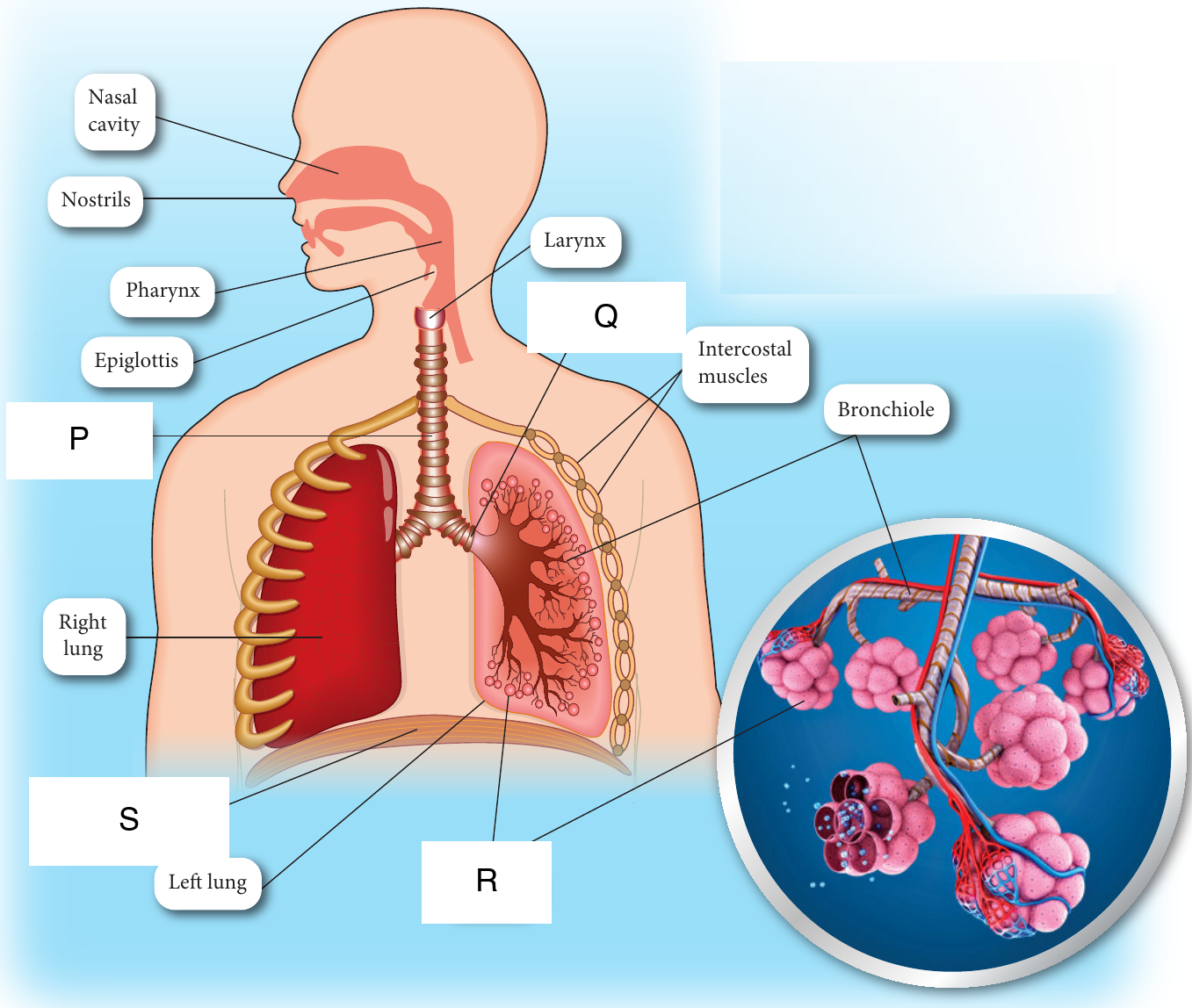
Diagram 1 shows the human respiratory system. Oxygen diffuses into the blood in which labelled part?
Show answerHide answer
C
R points to the alveolus, the tiny air sac where oxygen diffuses into the blood capillaries. P is the trachea, Q a bronchus and S the diaphragm.
4
Question 4
A student breathes out through limewater and the limewater turns cloudy. What does this show?
Show answerHide answer
D
Limewater turns cloudy when carbon dioxide is passed through it. The test shows that exhaled air has a higher concentration of carbon dioxide.
5
Question 5
Oxyhaemoglobin releases oxygen when the blood reaches the body cells. Why does this happen?
Show answerHide answer
A
Oxyhaemoglobin is an unstable compound. Where the oxygen concentration is low, as around body cells, it decomposes to release oxygen and changes back to haemoglobin.
6
Question 6
Which adaptation of the lungs provides a large surface area for gaseous exchange?
Show answerHide answer
B
Millions of alveoli give a very large surface area. Thin walls shorten the diffusion distance, moisture lets gases dissolve and capillaries carry the gases away.
7
Question 7
Why is carbon monoxide in the air dangerous to the human body?
Show answerHide answer
C
Carbon monoxide combines with haemoglobin to form stable carboxyhaemoglobin. There is less oxyhaemoglobin, so the body cells cannot get enough oxygen to release energy.
8
Question 8
Which gas is colourless with a pungent smell and is released when coal is burned in power stations?
Show answerHide answer
D
Sulphur dioxide is a colourless, pungent gas from burning coal. Nitrogen dioxide is brown and comes from vehicle fuels; carbon monoxide is odourless.
9
Question 9
Which respiratory disease is caused by damage to the alveoli and cannot be cured?
Show answerHide answer
A
Emphysema is the condition of damaged alveoli caused by harmful substances such as irritants in cigarette smoke. It cannot be cured, only controlled.
10
Question 10
Which feature of the gills of a fish gives a large surface area for gaseous exchange?
Show answerHide answer
B
The many filaments and the thin, flat lamellae on them give a large surface area. Being surrounded by water keeps the gills moist.
11
Question 11
Why does the blood of a grasshopper not need to carry oxygen to its cells?
Show answerHide answer
C
Air enters through spiracles into the trachea, which divides into fine tracheoles. Oxygen diffuses directly into the cells, so the circulatory system is not involved.
12
Question 12
What happens to the guard cells of a leaf at night?
Show answerHide answer
D
With no light, guard cells do not photosynthesise. Water diffuses out by osmosis, so they become flaccid and straight and the stoma closes.
Section B: structured questions
33 marksAnswer all questions. Write your answers in the spaces provided.
13
Question 13
The flow chart shows the path of air that is breathed out from the lungs: alveolus → (a) → (b) → trachea → (c) → pharynx → nasal cavity → nostrils. Choose the correct part for each letter.
[1 mark]
(a)Which part is (a) in the flow chart?
Show answerHide answer
Bronchiole
From the alveolus, air passes into the bronchiole, then the bronchus.
[1 mark]
(b)Which part is (b) in the flow chart?
Show answerHide answer
Bronchus
The bronchus joins the bronchioles to the trachea.
[1 mark]
(c)Which part is (c) in the flow chart?
Show answerHide answer
Larynx
Air leaves the trachea through the larynx and then passes into the pharynx.
14
Question 14
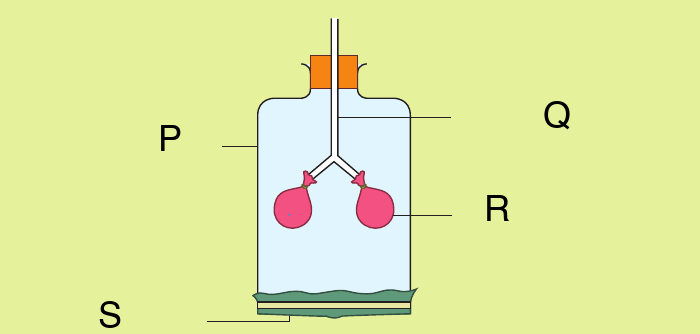
Diagram 2 shows a simple model used to show the breathing mechanism.
[2 marks]
(a)Name the parts of the human respiratory system that are represented by R and S.
Show answerHide answer
Tick each point you got.
[1 mark]
(b)Which action on S represents inhalation?
Show answerHide answer
Pulling S downwards
The diaphragm moves downwards when you inhale.
[2 marks]
(c)Explain why the balloons inflate when S is pulled downwards.
Show answerHide answer
Tick each point you got.
15
Question 15
In Experiment 2.1, a candle was lit and a gas jar divided into five equal parts was inverted over it in a basin of water, once with air and once with exhaled air. The candle went out. Table 1 shows how far the water rose in the jar.
| Type of air in gas jar | Final water level (number of parts out of 5) |
|---|---|
| Air | 1.0 |
| Exhaled air | 0.8 |
[2 marks]
(a)Calculate the percentage of oxygen in the air and in the exhaled air. (Each part = 20%.)
Show answerHide answer
Tick each point you got.
[1 mark]
(b)What conclusion can be made from this experiment?
Show answerHide answer
Tick each point you got.
16
Question 16
Table 2 describes three harmful gases P, Q and R in the air.
| Gas | Colour and smell | Other information |
|---|---|---|
| P | Brown, pungent smell | Produced by burning petrol and diesel in motor vehicles |
| Q | Colourless, no smell | Found in cigarette smoke and vehicle exhaust; combines with haemoglobin |
| R | Colourless, pungent smell | Produced by burning coal in power stations |
[1 mark]
(a)Name gas P.
Show answerHide answer
Tick each point you got.
[1 mark]
(b)Name gas Q.
Show answerHide answer
Tick each point you got.
[2 marks]
(c)A man stays in a stationary car with the windows closed and the engine running. Explain why this is dangerous.
Show answerHide answer
Tick each point you got.
17
Question 17
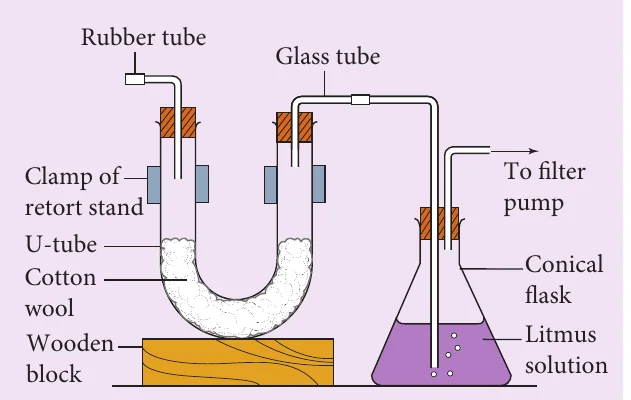
Diagram 3 shows the apparatus used in Experiment 2.2. A lighted cigarette (not shown) was fixed to the open end of the rubber tube and the smoke was drawn through the cotton wool and the litmus solution by a filter pump for 10 minutes. The cotton wool turned from white to brown and the litmus solution turned from purple to red.
[1 mark]
(a)Name the substance that is deposited on the cotton wool.
Show answerHide answer
Tick each point you got.
[1 mark]
(b)What does the colour change of the litmus solution show?
Show answerHide answer
Tick each point you got.
[2 marks]
(c)Amir says, "Smoking only harms the smoker." Do you agree? Justify your answer.
Show answerHide answer
Tick each point you got.
18
Question 18
You want to show that the air a person breathes out after running contains more carbon dioxide than the air breathed out when resting, using limewater.
[2 marks]
(a)State the manipulated variable and the responding variable.
Show answerHide answer
Tick each point you got.
[2 marks]
(b)State one variable that must be kept constant and the result you expect.
Show answerHide answer
Tick each point you got.
19
Question 19
Photosynthesis is taking place in a leaf in bright sunlight. The stomata are open.
[1 mark]
(a)Name the gas that diffuses into the leaf through the stomata.
Show answerHide answer
Tick each point you got.
[2 marks]
(b)Explain why this gas diffuses into the leaf and not out of it.
Show answerHide answer
Tick each point you got.
[2 marks]
(c)In the afternoon on a very hot day the stomata close. Explain how the guard cells close the stomata and why this helps the plant.
Show answerHide answer
Tick each point you got.
20
Question 20
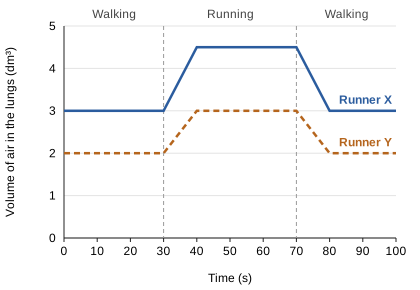
Diagram 4 shows the maximum volume of air in the lungs of two runners, X and Y, before, during and after a run. One of the runners is a smoker.
[1 mark]
(a)State the maximum volume of air in the lungs of runner X and of runner Y while running.
Show answerHide answer
Tick each point you got.
[1 mark]
(b)State the relationship between the type of activity and the maximum volume of air in the lungs.
Show answerHide answer
Tick each point you got.
[1 mark]
(c)Which runner is the smoker?
Show answerHide answer
Runner Y
Runner Y has the smaller maximum volume in both activities.
[2 marks]
(d)Explain your answer in (c).
Show answerHide answer
Tick each point you got.