Science questions, chapter 3
Nama / NameKelas / ClassTarikh / Date
Transportation
44 marks. Use Practice to check each answer as you go, or Exam to answer everything against the clock first.
Section A: objective questions
12 marksChoose the best answer for each question.
1
Question 1
Which of the following organisms does not have a specialised transport system?
Show answerHide answer
C
Amoeba is a unicellular organism. Oxygen, nutrients and carbon dioxide diffuse directly through its cell membrane, so it has no specialised transport system.
2
Question 2
What happens if toxic waste products cannot be eliminated from the cells of an organism?
Show answerHide answer
B
Toxic wastes that stay in the cells poison the cells and can kill the organism (textbook p. 82).
3
Question 3
Which describes the heart of a fish?
Show answerHide answer
D
A fish heart has one atrium and one ventricle, so blood passes through the heart once in one complete cycle (single circulation).
4
Question 4
Which blood vessel carries oxygenated blood from the lungs to the heart?
Show answerHide answer
A
The pulmonary vein carries oxygenated blood from the lungs to the left atrium. The pulmonary artery carries deoxygenated blood to the lungs; the vena cava carries deoxygenated blood from the body.
5
Question 5
What is the function of the valves in a vein?
Show answerHide answer
C
Blood in veins flows at low pressure. Valves ensure it flows in one direction only, back to the heart.
6
Question 6
Which event produces the 'dub' sound heard during a heartbeat?
Show answerHide answer
B
The 'dub' sound is produced by the closing of the semilunar valves when the ventricles relax (diastole). The 'lub' sound is the closing of the tricuspid and bicuspid valves.
7
Question 7
A student counts 14 pulses in 10 seconds. What is her pulse rate?
Show answerHide answer
D
There are six 10-second periods in a minute: 14 × 6 = 84 beats per minute.
8
Question 8
Which is the largest component of human blood?
Show answerHide answer
A
Blood plasma makes up about 55% of blood, red blood cells about 45%, and white blood cells and platelets less than 1%.
9
Question 9
A patient has blood group A. Which other blood group can be given to him safely?
Show answerHide answer
C
The patient has Anti-B antibodies, so he cannot receive B or AB (both have the B antigen). Group O has no antigens, so it is compatible.
10
Question 10
Which statement describes transpiration?
Show answerHide answer
B
Transpiration is the loss of water as water vapour from the leaf surface through evaporation. Loss of liquid water is exudation (guttation).
11
Question 11
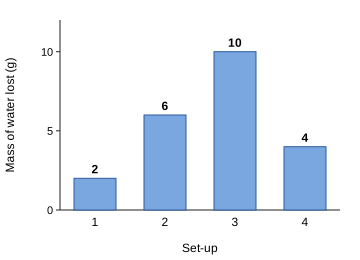
Diagram 1 shows the mass of water lost in 4 hours by the same type of plant in four set-ups: 1 in a dark cupboard, 2 under a lamp in still air, 3 under the same lamp with a fan, and 4 under the lamp with the leaves in a plastic bag. Which set-up has the highest rate of transpiration, and what is the rate?
Show answerHide answer
D
The fan set-up lost the most water (10 g). Rate = 10 ÷ 4 = 2.5 g per hour. Light and moving air both increase the rate of transpiration.
12
Question 12
The roots of a balsam plant are placed in red eosin solution for 30 minutes. Thin cross sections of the root, stem and leaf are then examined under a microscope. Which statement describes what is seen?
Show answerHide answer
A
Eosin dissolves in the water that the roots absorb. Water is carried upwards by the xylem, so only the xylem in the root, stem and leaf is coloured. The phloem carries sucrose from the leaves, not water from the roots.
Section B: structured questions
32 marksAnswer all questions. Write your answers in the spaces provided.
13
Question 13
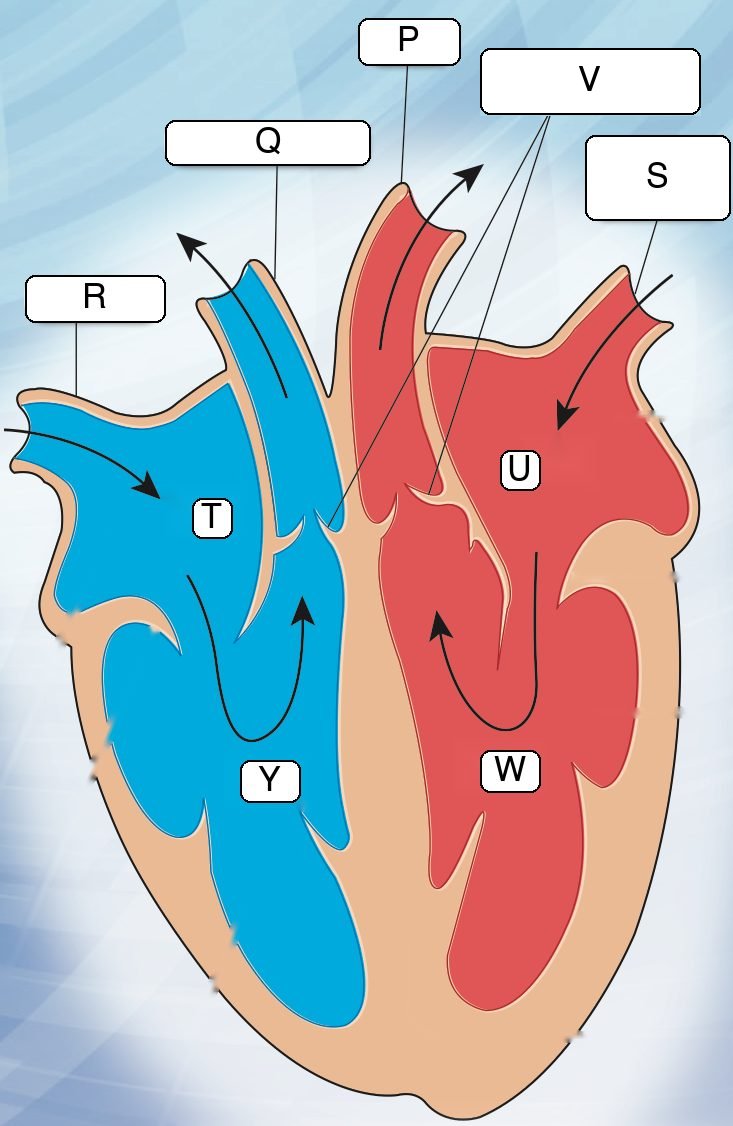
Diagram 2 shows a longitudinal section of the human heart. The blue part contains deoxygenated blood and the red part oxygenated blood.
[1 mark]
(a)Name the blood vessel R.
Show answerHide answer
Tick each point you got.
[2 marks]
(b)Name the blood vessel S and state the type of blood it carries.
Show answerHide answer
Tick each point you got.
[1 mark]
(c)Name the valve between chamber T and chamber Y.
Show answerHide answer
Tick each point you got.
[1 mark]
(d)State the function of the valves at V.
Show answerHide answer
Tick each point you got.
[1 mark]
(e)Chamber W has the thickest wall. Explain why.
Show answerHide answer
Tick each point you got.
14
Question 14
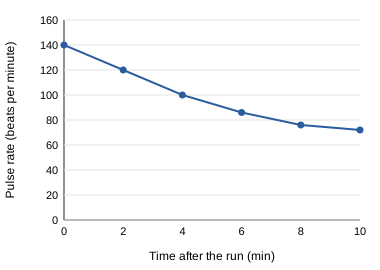
A student ran for 5 minutes and then rested. Diagram 3 shows how her pulse rate changed. Her resting pulse rate was 70 beats per minute.
[1 mark]
(a)What was her pulse rate 4 minutes after the run?
Show answerHide answer
Tick each point you got.
[2 marks]
(b)How many pulses would be counted in 10 seconds at 2 minutes after the run? Show your working.
Show answerHide answer
Tick each point you got.
[2 marks]
(c)Explain why her pulse rate was high immediately after the run.
Show answerHide answer
Tick each point you got.
15
Question 15
Table 1 shows the antigens and antibodies of two blood groups.
| Blood group | Antigen on red blood cells | Antibody in plasma |
|---|---|---|
| B | B | Anti-A |
| AB | A and B | – |
[2 marks]
(a)State the antigen and the antibody present in a person with blood group O.
Show answerHide answer
Tick each point you got.
[2 marks]
(b)Can a person with blood group B receive blood from a donor with blood group AB? Explain your answer.
Show answerHide answer
Tick each point you got.
[1 mark]
(c)Why is a person with blood group AB known as a universal recipient?
Show answerHide answer
Tick each point you got.
16
Question 16
A student studies transpiration using two identical young balsam plants set up on electronic balances. Set-up P is kept in a cool room and set-up Q in a hot room. The two rooms have the same light intensity, air humidity and air movement. Table 2 shows the mass of each set-up.
| Set-up | Initial mass (g) | Mass after 3 hours (g) |
|---|---|---|
| P (cool room) | 250.0 | 247.6 |
| Q (hot room) | 250.0 | 244.0 |
[2 marks]
(a)Calculate the rate of transpiration in set-up Q.
Show answerHide answer
Tick each point you got.
[1 mark]
(b)State the manipulated variable in this investigation.
Show answerHide answer
Tick each point you got.
[1 mark]
(c)State the conclusion of this investigation.
Show answerHide answer
Tick each point you got.
[1 mark]
(d)Explain why set-up Q lost more mass than set-up P.
Show answerHide answer
Tick each point you got.
[1 mark]
(e)State one constant variable in this investigation.
Show answerHide answer
Any 1 points
Tick each point you got.
17
Question 17
A farmer removes a complete ring of bark, including the phloem, from a branch of a fruit tree to find out how food is transported.
[1 mark]
(a)What does the phloem transport?
Show answerHide answer
Tick each point you got.
[2 marks]
(b)Describe the change that will be seen in the bark just above the ring after two months and explain why.
Show answerHide answer
Tick each point you got.
[1 mark]
(c)The part of the branch below the ring slowly starves, but its leaves do not wilt at first. Explain why the leaves do not wilt.
Show answerHide answer
Tick each point you got.
[1 mark]
(d)Suggest why the farmer should not remove the bark from the main trunk of the tree.
Show answerHide answer
Tick each point you got.
18
Question 18
A student wants to investigate how air humidity affects the rate of transpiration. She has two young balsam plants of the same size in conical flasks of water, cotton wool, cooking oil, two plastic bags, anhydrous calcium chloride, an electronic balance and a clock.
[1 mark]
(a)State a hypothesis for the investigation.
Show answerHide answer
Tick each point you got.
[2 marks]
(b)Plan how she can find the rate of transpiration for each plant.
Show answerHide answer
Any 2 points
Tick each point you got.
[2 marks]
(c)State the manipulated variable and the responding variable in this investigation.
Show answerHide answer
Tick each point you got.