Respiration
What this chapter covers
- Draw and label the parts of the human respiratory system, describe the breathing mechanism and compare the oxygen and carbon dioxide content of inhaled and exhaled air (2.1)
- Describe how oxygen and carbon dioxide are moved and exchanged in the human body, and justify the adaptations of the alveolus (2.2)
- State the harmful substances in the air, the respiratory diseases and their symptoms, and the effects of smoking on the lungs (2.3)
- Explain how respiratory systems are adapted in frogs, fish and insects (2.4)
- Explain the mechanism of gaseous exchange in plants through the stoma and guard cells, and why unpolluted air matters for plants (2.5)
2.1Human respiratory system
Parts of the respiratory system
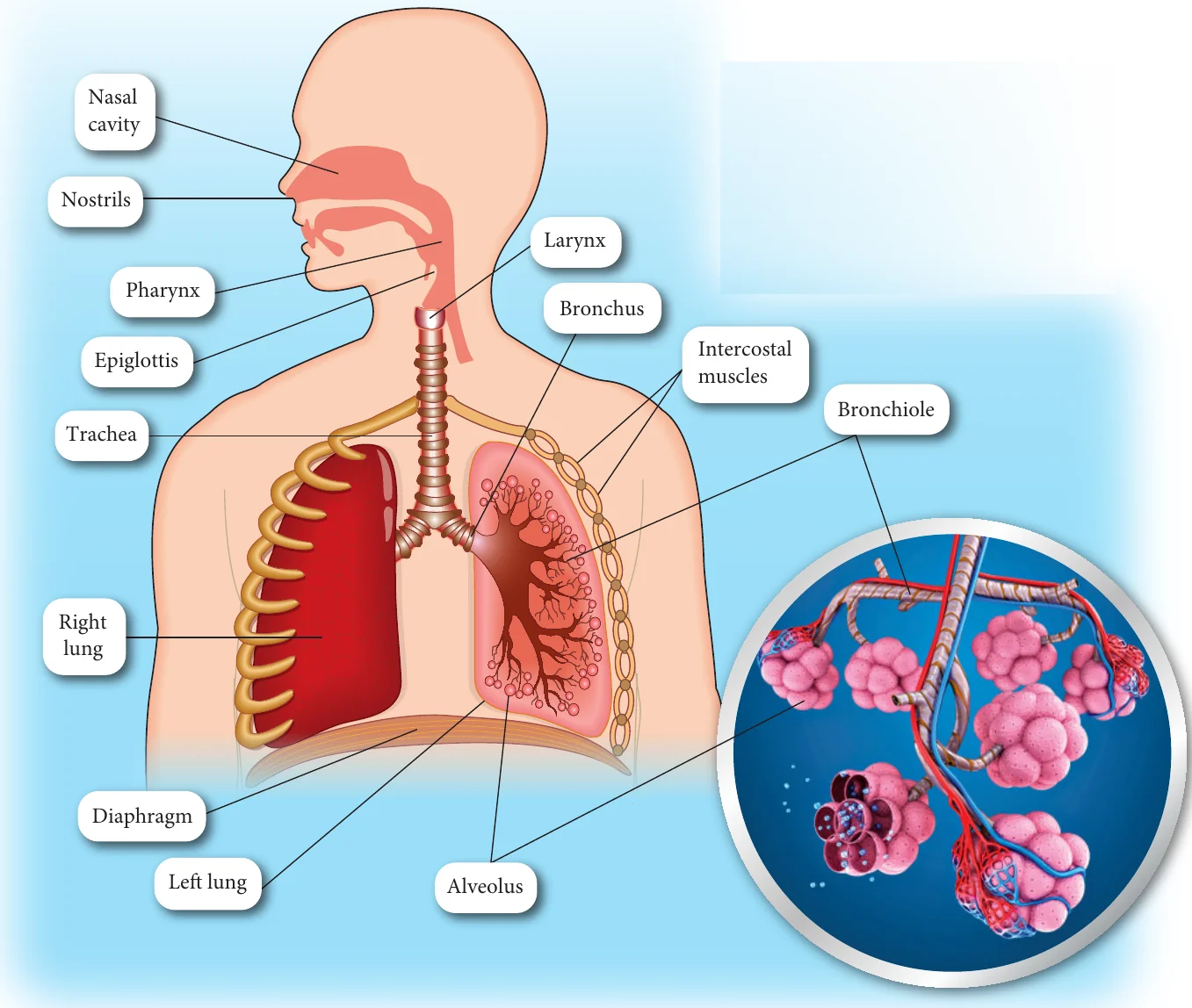
Figure credit: Science Form 3 (DLP) textbook, Figure 2.1, p. 46.
When you exhale, air takes the same path in the opposite direction (alveolus → … → nostrils).
| Part | What to remember |
|---|---|
| Epiglottis | A flap that closes the trachea when food is swallowed and opens it for breathing |
| Trachea, bronchus, bronchiole | Air tubes that carry air to and from the lungs; the trachea divides into two bronchi, each dividing into many bronchioles |
| Alveolus (plural: alveoli) | Tiny air sacs at the end of the bronchioles, where gaseous exchange takes place |
| Intercostal muscles | Muscles between the ribs; they move the rib cage |
| Diaphragm | A sheet of muscle below the lungs; it moves up and down |
Breathing mechanism
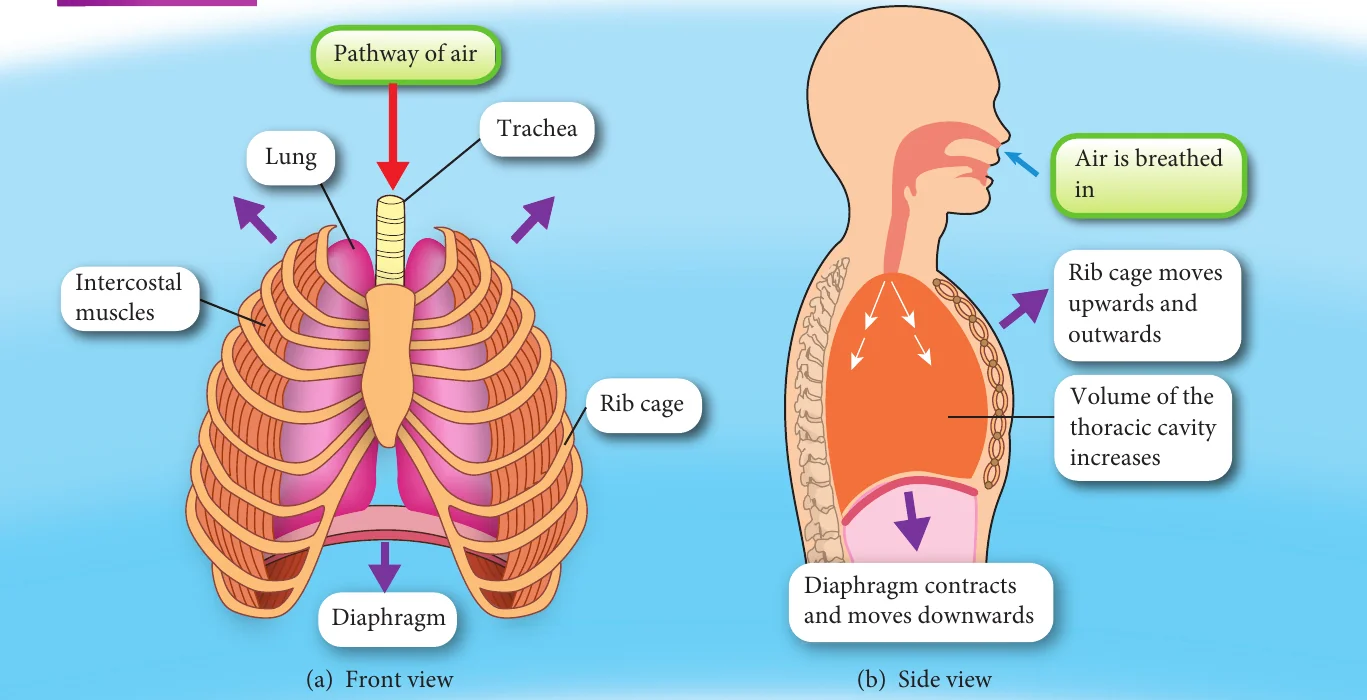
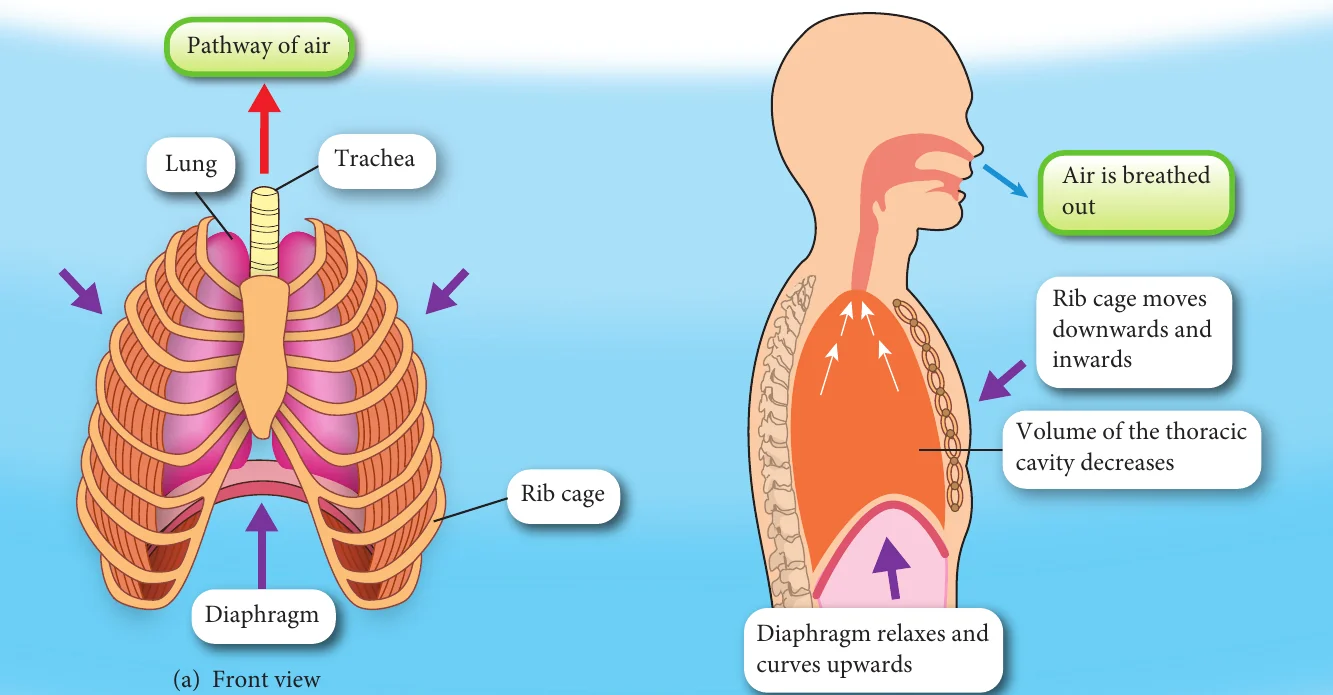
| Inhalation (breathing in) | Exhalation (breathing out) | |
|---|---|---|
| Intercostal muscles | Contract | Relax |
| Rib cage | Moves upwards and outwards | Moves downwards and inwards |
| Diaphragm | Contracts, moves downwards and becomes flat | Relaxes and curves upwards |
| Volume of thoracic cavity | Increases | Decreases |
| Air pressure in the thoracic cavity | Decreases (lower than outside) | Increases (higher than outside) |
| Air | Higher pressure outside forces air into the lungs | Higher pressure inside pushes air out |
Model of the breathing mechanism
In the bell-jar type of model: the glass jar stands for the rib cage and thoracic cavity, the Y-shaped tube for the trachea and bronchi, the balloons for the lungs and the thin rubber sheet for the diaphragm. Pulling the sheet down models inhalation (the balloons fill with air); pushing it up models exhalation. The model is limited because the jar is rigid and cannot move like a rib cage.
Inhaled and exhaled air
| Gas | Inhaled air | Exhaled air | Test used |
|---|---|---|---|
| Oxygen | Higher percentage | Lower percentage | Burning candle in an inverted gas jar over water: the water rises higher in inhaled air than in exhaled air (candle uses up more oxygen; about one part in five of the jar is oxygen in air) |
| Carbon dioxide | Lower concentration | Higher concentration | Limewater turns cloudy (milky) more with exhaled air |
Show answerHide answer
2.2Movement and exchange of gases in the human body
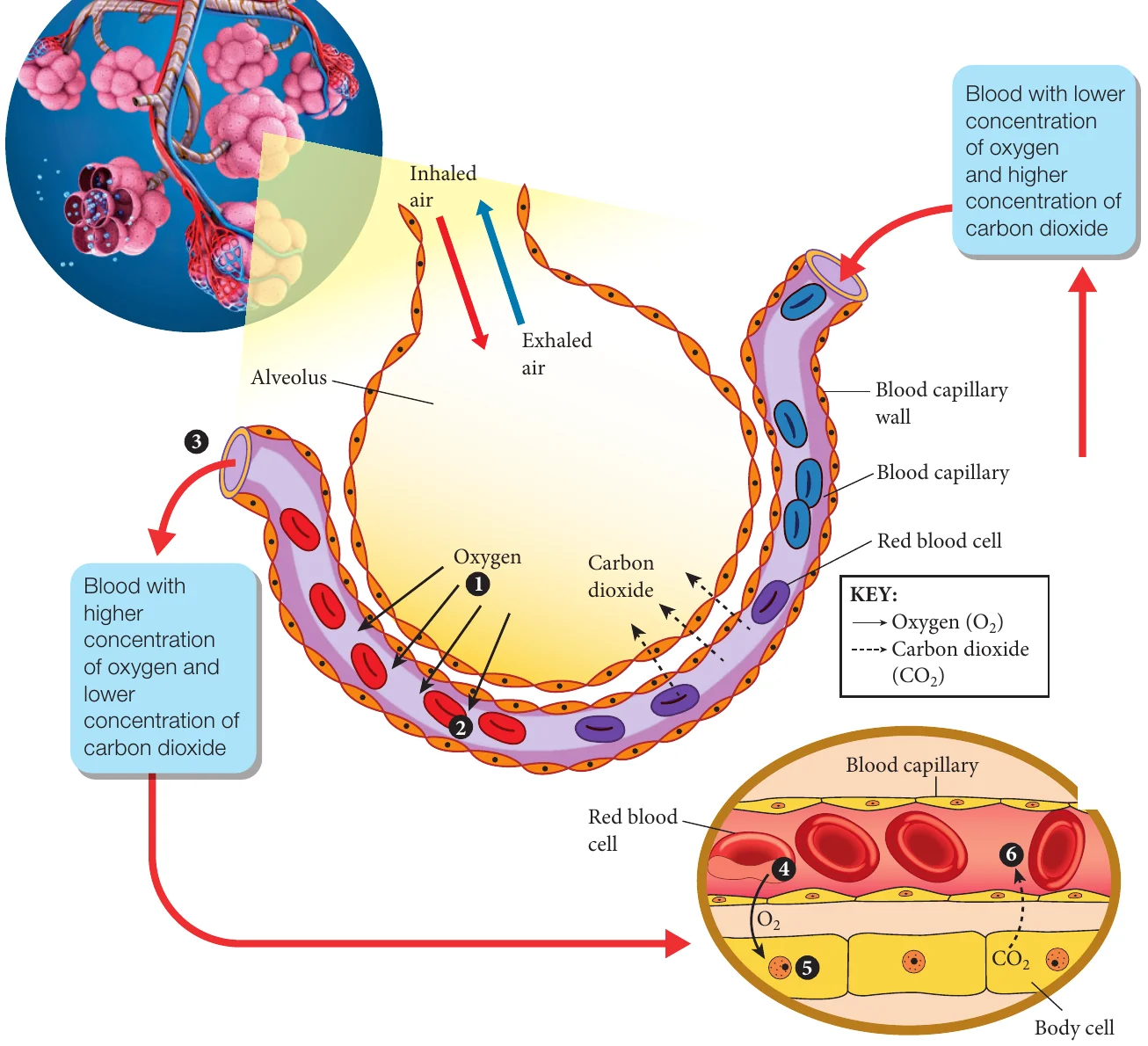
Figure credit: Science Form 3 (DLP) textbook, Figure 2.9, p. 54.
2. In the red blood cells, haemoglobin (dark red) combines with oxygen to form oxyhaemoglobin (bright red, an unstable compound).
3. Blood with oxyhaemoglobin goes to the heart and is pumped to all parts of the body.
4. Near body cells the oxygen concentration is low, so oxyhaemoglobin decomposes to release oxygen and becomes haemoglobin again.
5. The oxygen diffuses into the cells and oxidises glucose in cellular respiration.
6. Carbon dioxide made by the cells diffuses into the blood capillaries, is carried to the alveolus and leaves the body in exhaled air.
| Process | Equation |
|---|---|
| Oxygen is picked up (in the lungs) | Haemoglobin + oxygen → oxyhaemoglobin |
| Oxygen is released (at body cells) | Oxyhaemoglobin → haemoglobin + oxygen |
| Cellular respiration | Glucose + oxygen → carbon dioxide + water + energy |
Adaptations of the alveolus
| Adaptation | Why it makes gaseous exchange efficient |
|---|---|
| Thin walls (one cell thick) for alveolus and capillary | Gases diffuse across a very short distance, so diffusion is fast |
| Moist wall of the alveolus | Gases dissolve in the moisture and diffuse into the blood |
| Millions of alveoli | A very large surface area for gaseous exchange |
| Dense network of capillaries around each alveolus | Blood flow keeps the concentration difference high and increases the rate of exchange |
The greater the difference in concentration of a gas between the alveoli and the blood capillaries, the higher the rate of diffusion. At high altitude the air has less oxygen, so less oxygen reaches the cells; the body responds by making more red blood cells and releasing oxygen from oxyhaemoglobin more easily.
Show answerHide answer
2.3Health of the human respiratory system
Harmful substances
| Substance | Source | Effect |
|---|---|---|
| Cigarette tar | Cigarette smoke | Sticks to and kills cells in the air passages; increases mucus and phlegm (smokers cough); a carcinogen that causes lung cancer |
| Carbon monoxide (colourless, odourless) | Cigarette smoke, vehicle exhaust | Combines with haemoglobin to form carboxyhaemoglobin, a stable compound, so less oxyhaemoglobin forms and cells get too little oxygen for energy |
| Sulphur dioxide (colourless, pungent smell) | Burning coal in power stations | Irritates the air passages: cough, difficulty in breathing, bronchitis, lung cancer |
| Nitrogen dioxide (brown, pungent smell) | Burning petrol and diesel in vehicles | Irritates the air passages: cough, difficulty in breathing, asthma |
| Haze, dust, pollen (fine solid particles) | Vehicle smoke, open burning, forest fires; pollen from plants | Irritate the respiratory system and trigger asthma |
Respiratory diseases
| Disease | Cause | Symptoms |
|---|---|---|
| Asthma | Triggered by dust, pollen, haze, smoke from cigarettes and vehicles, open burning | Shortness of breath, wheezing, coughing |
| Bronchitis | Inflammation of the bronchus by tar and irritants in cigarette smoke | Shortness of breath, persistent coughing, insomnia |
| Emphysema | Alveoli damaged by harmful substances such as irritants in cigarette smoke; cannot be cured, symptoms can be controlled | Shortness of breath, pain when breathing, tiredness from light tasks |
| Lung cancer | Carcinogens inhaled, for example tar in cigarette smoke | Persistent coughing, blood in the phlegm, pain when breathing |
Effects of smoking on the lungs (Experiment 2.2)
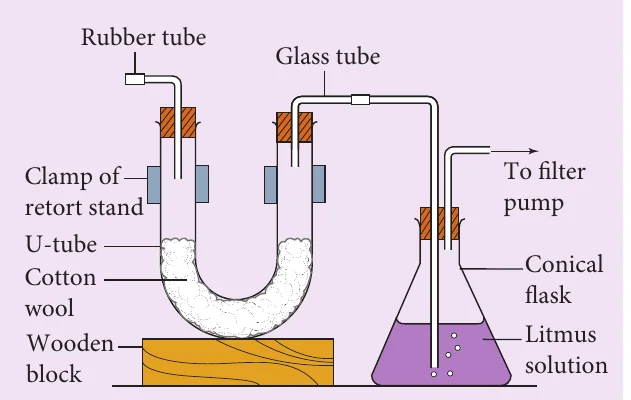
| Observation | Without smoke | With cigarette smoke | Inference |
|---|---|---|---|
| Cotton wool | Stays white | Turns brown | Tar is deposited, as it is on the lungs |
| Litmus solution | Stays purple | Turns red | Cigarette smoke contains acidic gases |
A passive smoker is a person who does not smoke but inhales the smoke of others. Cigarette smoke harms passive smokers as well.
Show answerHide answer
2.4Adaptations in respiratory systems
Efficient gaseous exchange surfaces have three features: they are thin (often one cell thick), moist and have a large surface area. Different animals adapt these features to their surroundings.
| Animal | Respiratory structure | How it is adapted |
|---|---|---|
| Frog (amphibian) | Moist outer skin (and lungs) | Thin skin, very permeable to gases; always moist because of a layer of mucus so gases dissolve and diffuse easily; dense network of blood capillaries under the skin |
| Fish | Gills | Two rows of fine filaments with many thin, flat lamellae give a large surface area; surrounded by water so gases dissolve and diffuse easily |
| Insect (grasshopper) | Trachea system | Air enters through spiracles into air tubes (trachea) that branch into fine tracheoles with thin, moist walls; oxygen diffuses directly into the cells; air sacs help during energetic activity |
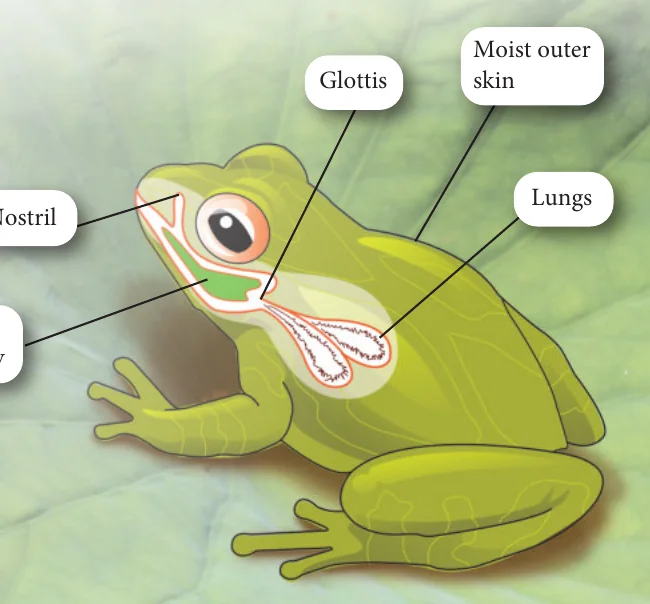
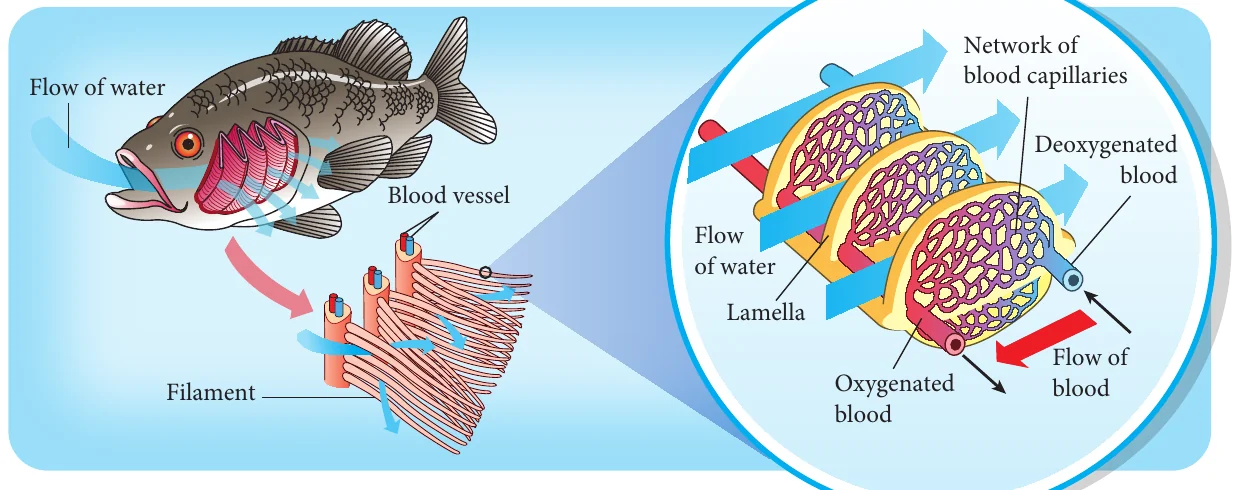
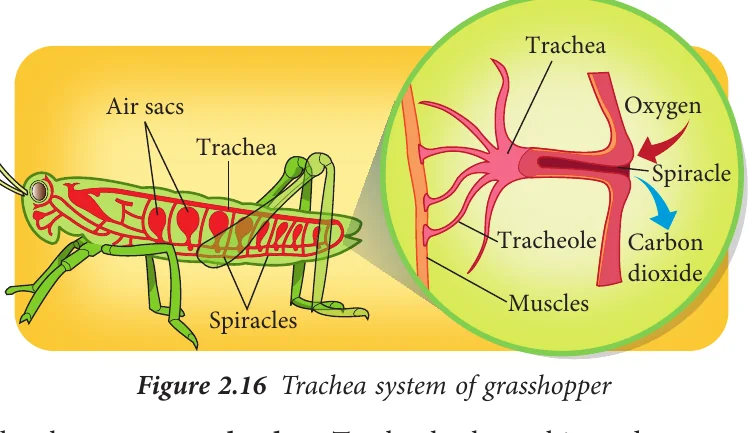
Show answerHide answer
2.5Gaseous exchange in plants
Plants exchange gases through their leaves, stems and roots (for example, the aerial roots of mangrove plants take in oxygen). All plants respire day and night; during the day they also photosynthesise.
| Day (light) | Night (dark) | |
|---|---|---|
| Takes in | Carbon dioxide (photosynthesis) and some oxygen (respiration) | Oxygen |
| Gives out | Oxygen (net) and some carbon dioxide (respiration) | Carbon dioxide |
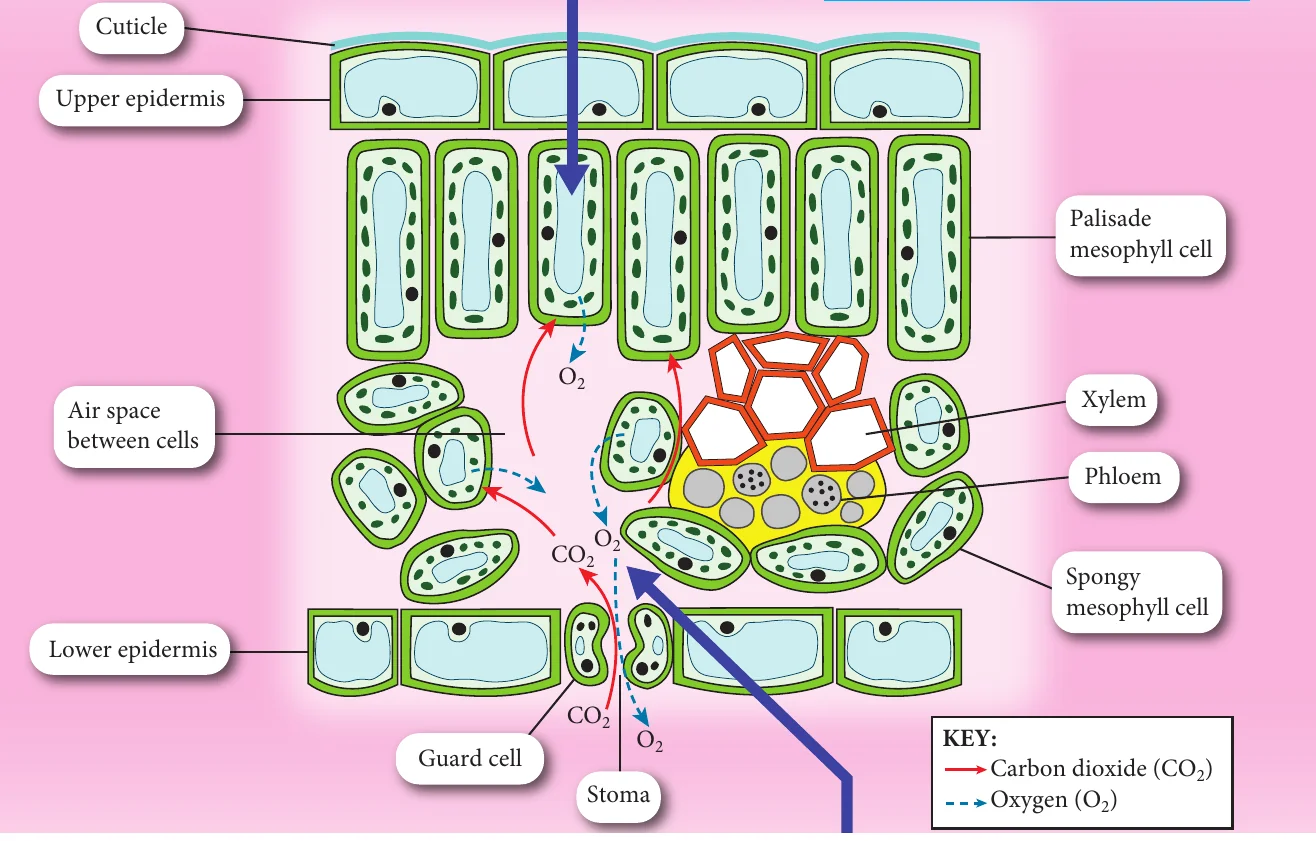
During photosynthesis the cells use up carbon dioxide, so its concentration inside the leaf is lower than in the air outside. Carbon dioxide therefore diffuses in through the open stoma, into the air spaces and then, dissolved in the moist surface of the cells, into the cells.
Stoma and guard cells

| In light (day) | In the dark or on a hot day | |
|---|---|---|
| Guard cells | Photosynthesise, so glucose concentration rises; water enters by osmosis | Water diffuses out by osmosis |
| Shape | Turgid and curved | Flaccid and straight |
| Stoma | Open: carbon dioxide can diffuse in | Closed: reduces loss of water |
Why unpolluted air matters to plants
- Haze and dust reduce the sunlight reaching leaves (less photosynthesis) and clog the stomata, which blocks gaseous exchange.
- Acid rain: sulphur dioxide and nitrogen dioxide dissolve in rainwater. Acid rain kills plant cells and makes the soil acidic and less fertile, so crop yields fall.
- Prevention: ban open burning, limit vehicles on the road, and use alternative energy such as solar energy. Air pollution crosses borders, so countries must co-operate.