Biology notes, chapter 11
Immunity in Humans
Textbook Biology Form 4 KSSM (DLP), pages 198–213
What this chapter covers
- Define immunity, antigen and antibody (11.1.1)
- Describe the first, second and third lines of body defence (11.1.2)
- Discuss the actions of antibodies on antigens - neutralisation, agglutination, precipitation, opsonisation and lysis (11.2.1)
- Compare active and passive immunity, natural and artificial (11.3.1, 11.3.2)
- Describe health issues related to AIDS (11.4.1)
11.1Body defence
Immunity is the body's ability to fight infections caused by pathogens or other foreign objects, through specific attacks on the pathogens.
Pathogen
A microorganism that causes disease: bacteria, viruses, parasites.
A microorganism that causes disease: bacteria, viruses, parasites.
Antigen
A foreign particle that enters the body and stimulates the immune response.
A foreign particle that enters the body and stimulates the immune response.
Antibody
A protein on the surface of a lymphocyte, or released by lymphocytes into the blood plasma, that reacts with an antigen and destroys it.
A protein on the surface of a lymphocyte, or released by lymphocytes into the blood plasma, that reacts with an antigen and destroys it.
Antibodies are specific: each type of antibody has an antigen receptor site that fits only one type of antigen.
Remember the order: 1st line keeps pathogens out (not specific), 2nd line attacks any pathogen that got in (not specific), 3rd line is the specific lymphocyte response.
The first line of defence
Physical and chemical barriers that stop pathogens entering the body. It is not specific.
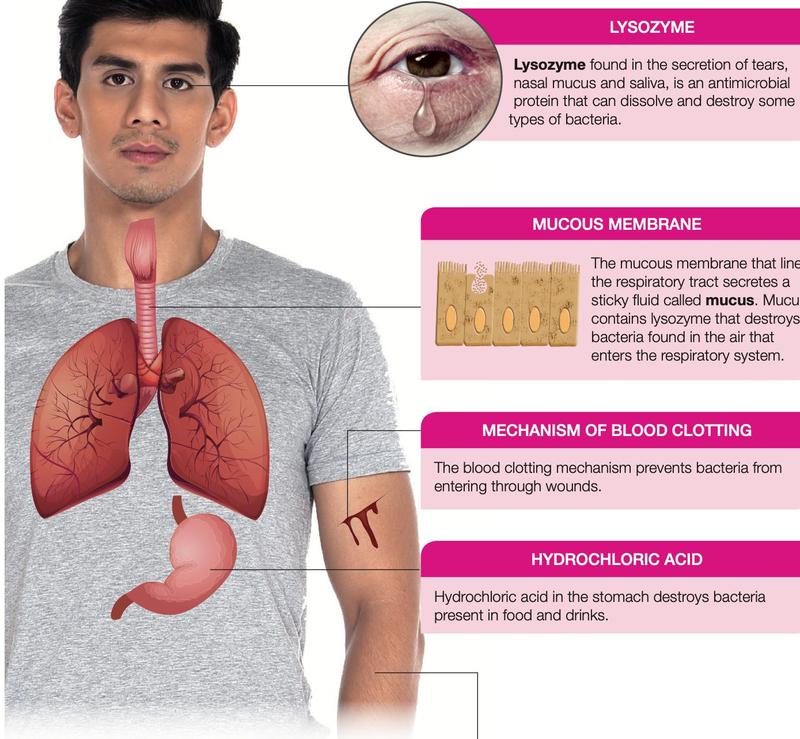
Figure: Biology Form 4 (DLP) textbook, Figure 11.2, p. 201.
| Defence | Type | How it protects |
|---|---|---|
| Skin | Physical and chemical | Tough, hard to penetrate; dead cell layers are shed continuously; sebum (oil and acid) stops microorganisms growing; sweat contains lysozyme |
| Lysozyme (tears, nasal mucus, saliva) | Chemical | Antimicrobial enzyme that dissolves some bacteria |
| Mucous membrane of the respiratory tract | Chemical | Secretes sticky mucus containing lysozyme that destroys bacteria in the air breathed in |
| Blood clotting | Physical | Seals wounds so bacteria cannot enter |
| Hydrochloric acid in the stomach | Chemical | Destroys bacteria in food and drinks |
Name two ways the skin acts as a first line of defence.
Show answerHide answer
Any two: tough physical barrier; shedding of dead cells; sebum (oil and acid) prevents microorganisms growing; sweat contains lysozyme.
The second line of defence
Fever, phagocytosis and inflammation. Also not specific.
- Fever increases phagocytic activity and helps fight the microorganisms.
- Phagocytosis: phagocytes (neutrophils and monocytes, a type of leucocyte) trap and digest microorganisms or dead cells.
- Inflammation: an immediate response at the early stage of infection. The area swells, turns red and is painful.
Stages of phagocytosis
- The phagocyte extends a pseudopodium towards the bacterium and envelops it.
- The bacterium is ingested and forms a phagosome.
- The phagosome combines with a lysosome, which secretes lysozyme into it.
- Lysozyme destroys the bacterium, which decomposes.
- The phagocyte expels the remains of the digested microorganism out of the cell.
Inflammatory response
- Damaged tissue releases histamine.
- Histamine makes the blood capillaries widen, so more blood flows to the area, and makes them more permeable to phagocytes.
- Phagocytes and clotting factors accumulate at the infected area, and blood clotting is triggered.
- Phagocytes carry out phagocytosis.
Histamine does not kill bacteria. It widens capillaries and makes them more permeable so that phagocytes can reach the infection.
The third line of defence
If pathogens overcome the second line, the lymphocytes respond. This line is specific.
- Lymphocytes (formed in the lymph nodes) produce antibodies. Lymph nodes swell during infection because many lymphocytes gather there.
- T lymphocytes attack cells infected by pathogens and stimulate B lymphocytes to produce memory cells.
- Memory cells remember the pathogen. If the same pathogen attacks again, they produce antibodies at once.
| Line | Defences | Specific? |
|---|---|---|
| First | Skin, lysozyme, mucus, HCl, blood clotting | No |
| Second | Fever, phagocytosis, inflammation | No |
| Third | Antibodies, memory cells | Yes |
11.2Actions of antibodies
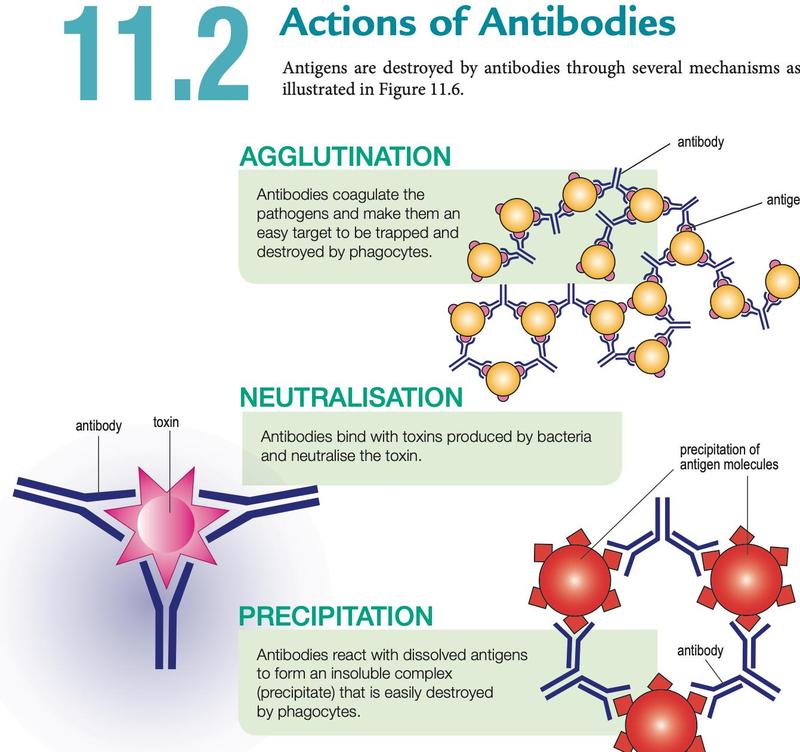
Figure: Biology Form 4 (DLP) textbook, Figure 11.6, pp. 204–205.
| Action | What the antibodies do |
|---|---|
| Neutralisation | Bind with toxins produced by bacteria and neutralise the toxins |
| Agglutination | Clump the pathogens together so phagocytes can trap and destroy them easily |
| Precipitation | React with dissolved antigens to form an insoluble complex (precipitate) that phagocytes destroy |
| Opsonisation | Combine with antigens and act as a marker so phagocytes recognise and destroy them |
| Lysis | Combine with antigens and cause the bacteria to break down and decompose |
Antibodies join with dissolved antigens to form an insoluble complex. Which action is this?
Show answerHide answer
Precipitation.
11.3Types of immunity
Active immunity: lymphocytes produce their own antibodies in response to antigens. Passive immunity: the body receives antibodies from an external source.
| Natural | Artificial | |
|---|---|---|
| Active | After recovering from an infection (e.g. chickenpox, influenza); memory cells give permanent immunity | Vaccine injection: weakened, dead or non-virulent pathogens (e.g. Salk, BCG, HPV vaccines) |
| Passive | Antibodies pass from mother to foetus through the placenta; colostrum and breast milk after birth | Antiserum injection with specific antibodies (e.g. antitetanus, anti-rabies, snake antivenom) |
Artificial active and artificial passive immunity
| Aspect | Artificial active | Artificial passive |
|---|---|---|
| Injected | Vaccine | Antiserum (ready-made antibodies) |
| Purpose | Prevention | Treatment, or immediate protection |
| Protection | Not immediate | Immediate |
| Duration | Long | Temporary |
| Antibodies made by | The person's own lymphocytes | Another source (antiserum) |
| Second injection | Booster dose raises antibodies above the level of immunity | Given only when the antibody level falls below the level of immunity and the patient is still infected |
Both protect the body from infectious disease and both involve antibody and antigen interaction.
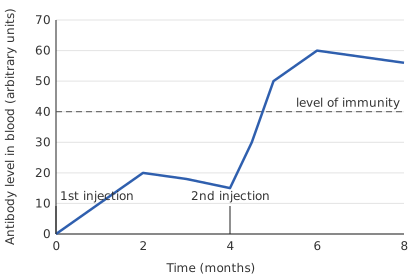 Vaccine
The first dose gives a low level (20 units); the booster pushes it to 60, above the level of immunity (40).
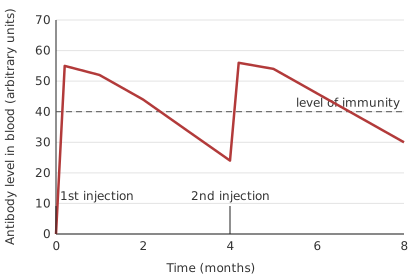 Antiserum
Level jumps to 55 at once but falls below 40 after about 3 months, so protection is short.
Vaccine = prevent, slow, lasting. Antiserum = treat, fast, short. Snake bite or a high risk of tetanus needs antiserum, because there is no time to wait for the body to make antibodies.
A first vaccine dose is usually not enough. This is why the immunisation plan must be completed with booster doses.
Why does a baby gain protection from its mother's milk, and which type of immunity is this?
Show answerHide answer
The milk (especially colostrum) contains the mother's antibodies. The baby does not make them itself, so this is natural passive immunity.
11.4Health issues related to immunity
HIV (human immunodeficiency virus) attacks the immune system, entering and destroying lymphocytes. HIV infection leads to AIDS (Acquired Immunodeficiency Syndrome).
- An infected person shows no symptoms for the first few years, but HIV is actively attacking the immune system.
- Symptoms such as chronic diarrhoea and fungal infections appear only after 8 to 10 years. The patient dies from other infections because the immune system is paralysed.
- Transmission: body fluids such as blood and semen; unprotected sexual relations; sharing contaminated needles; infected blood transfusion; from an infected mother to her baby during pregnancy, birth or breastfeeding (this can be prevented with proper medical treatment).
Being HIV-positive is not the same as having AIDS. AIDS is the stage after the immune system has been badly weakened.
Other immune-related conditions to know by name: systemic lupus erythematosus (SLE) and allergy.
Why is a person with AIDS easily infected by other diseases?
Show answerHide answer
HIV destroys lymphocytes, so the immune system cannot produce enough antibodies to fight other pathogens.