Biology questions, chapter 11
Nama / NameKelas / ClassTarikh / Date
Immunity in Humans
45 marks. Use Practice to check each answer as you go, or Exam to answer everything against the clock first.
Section A: objective questions
12 marksChoose the best answer for each question.
1
Question 1
What is an antigen?
Show answerHide answer
B
Antigens are foreign particles that enter the body and stimulate the immune response. Antibodies are the proteins made against them.
2
Question 2
Which of the following is part of the first line of defence?
Show answerHide answer
C
Hydrochloric acid destroys bacteria in food and drink (first line, chemical). Fever and phagocytosis are the second line; memory cells are the third.
3
Question 3
Lysozyme is found in tears, saliva and nasal mucus. What is its function?
Show answerHide answer
A
Lysozyme is an antimicrobial enzyme that breaks down the cell wall of some bacteria.
4
Question 4
A cut on the skin becomes red, swollen and painful. Which chemical released by the damaged tissue causes the blood capillaries to widen?
Show answerHide answer
B
Histamine widens the capillaries and makes them more permeable so phagocytes can reach the infected area (inflammation).
5
Question 5
Which cells carry out phagocytosis?
Show answerHide answer
C
Neutrophils and monocytes are phagocytes, a type of leucocyte.
6
Question 6
In phagocytosis, which structure combines with the phagosome to release lysozyme onto the bacterium?
Show answerHide answer
D
The phagosome combines with a lysosome, which secretes lysozyme into it and destroys the bacterium.
7
Question 7
Antibodies clump bacteria together so that phagocytes can trap them easily. What is this action called?
Show answerHide answer
C
Agglutination = clumping of pathogens. Precipitation involves dissolved antigens; neutralisation involves toxins; lysis breaks the bacterium down.
8
Question 8
Bacteria produce a toxin that harms body cells. Which action of antibodies makes the toxin harmless?
Show answerHide answer
D
Antibodies bind with the toxin and neutralise it.
9
Question 9
Which situation is an example of natural passive immunity?
Show answerHide answer
D
The baby receives the mother's antibodies in colostrum, so it is natural and passive. The other options are natural active, artificial active and artificial passive.
10
Question 10
A hiker is bitten by a poisonous snake. What should the doctor give?
Show answerHide answer
A
Antiserum contains ready-made antibodies and gives immediate protection. A vaccine is too slow because the body needs time to make its own antibodies.
11
Question 11
Which statement correctly compares artificial active immunity with artificial passive immunity?
Show answerHide answer
C
In active immunity the lymphocytes make antibodies (and memory cells), so it lasts long. Passive immunity uses antibodies from outside and is temporary.
12
Question 12
Which cells does HIV attack and destroy?
Show answerHide answer
A
HIV spreads in and destroys lymphocytes, so the immune system is progressively weakened.
Section B: structured questions
33 marksAnswer all questions. Write your answers in the spaces provided.
13
Question 13
Diagram 1 shows the first line of defence of the body.
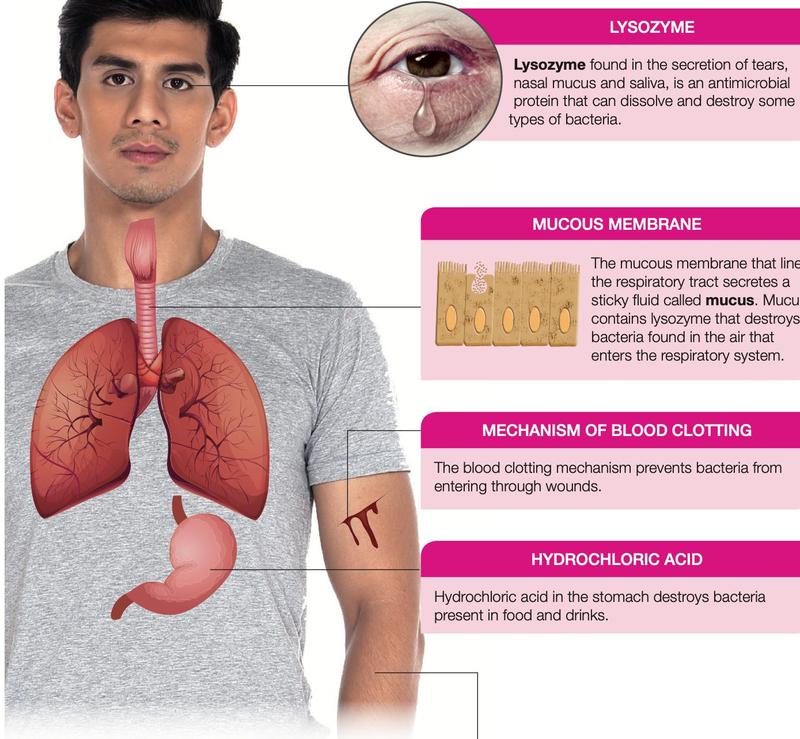
[1 mark]
(a)What is the function of hydrochloric acid in the stomach?
Show answerHide answer
Tick each point you got.
[2 marks]
(b)How does the mucous membrane of the respiratory tract protect the body?
Show answerHide answer
Tick each point you got.
[1 mark]
(c)State one way in which blood clotting protects the body.
Show answerHide answer
Tick each point you got.
14
Question 14
State the correct order of the stages of phagocytosis by writing the letters P to S.
| Letter | Stage |
|---|---|
| P | The phagosome combines with a lysosome |
| Q | The phagocyte extends a pseudopodium towards the bacterium |
| R | The bacterium is ingested and forms a phagosome |
| S | Lysozyme destroys the bacterium |
[2 marks]
(a)Order of the stages (first to last)
Show answerHide answer
Tick each point you got.
[1 mark]
(b)Name the process in which phagocytes trap and digest pathogens.
Show answerHide answer
Tick each point you got.
[2 marks]
(c)Phagocytosis belongs to which line of defence? Is this line specific?
Show answerHide answer
Tick each point you got.
15
Question 15
Choose the action of antibodies described in each statement.
[1 mark]
(a)Antibodies bind to toxins produced by bacteria.
Show answerHide answer
Neutralisation
[1 mark]
(b)Antibodies react with dissolved antigens to form an insoluble complex.
Show answerHide answer
Precipitation
[1 mark]
(c)Antibodies mark the antigens so that phagocytes recognise them.
Show answerHide answer
Opsonisation
[1 mark]
(d)Antibodies cause the bacterium to break down.
Show answerHide answer
Lysis
16
Question 16
Diagram 2 shows the antibody level in the blood of individual X after two injections. Diagram 3 shows individual Y after two injections of a different substance. The dashed line is the level of immunity.
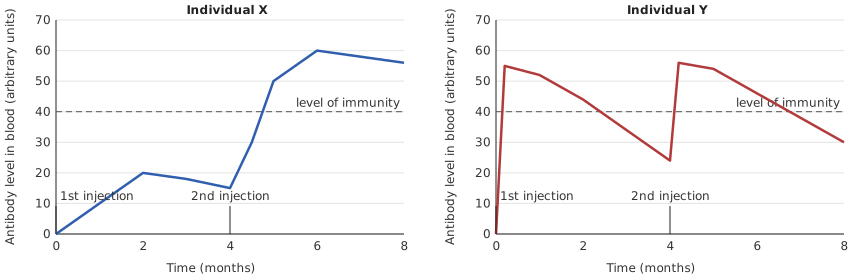
[2 marks]
(a)What substance was injected into X? Give a reason.
Show answerHide answer
Tick each point you got.
[1 mark]
(b)What substance was injected into Y?
Show answerHide answer
Tick each point you got.
[2 marks]
(c)State the antibody level of X after the first injection and explain why a second injection is needed.
Show answerHide answer
Tick each point you got.
[2 marks]
(d)State two differences in the immunity gained by X and Y.
Show answerHide answer
Tick each point you got.
17
Question 17
State the type of immunity acquired in each situation.
[1 mark]
(a)A boy is infected with chickenpox and recovers.
Show answerHide answer
Tick each point you got.
[1 mark]
(b)A foetus receives antibodies from its mother through the placenta.
Show answerHide answer
Tick each point you got.
[1 mark]
(c)A student is given the BCG injection.
Show answerHide answer
Tick each point you got.
18
Question 18
A man was infected with HIV 9 years ago and now suffers from chronic diarrhoea and fungal infections.
[1 mark]
(a)What does AIDS stand for?
Show answerHide answer
Tick each point you got.
[2 marks]
(b)Explain why the man is easily infected by other diseases.
Show answerHide answer
Tick each point you got.
[2 marks]
(c)State two ways HIV can be transmitted.
Show answerHide answer
Any 2 points
Tick each point you got.
19
Question 19
Aziman stepped on a rusty nail during a mountain climbing trip, and he had never been vaccinated against tetanus.
[1 mark]
(a)Which injection should the doctor give?
Show answerHide answer
Tick each point you got.
[2 marks]
(b)Explain your answer.
Show answerHide answer
Tick each point you got.
[2 marks]
(c)Why is it still important for children to complete the vaccination schedule?
Show answerHide answer
Tick each point you got.