Biology questions, chapter 12
Nama / NameKelas / ClassTarikh / Date
Coordination and Response in Humans
45 marks. Use Practice to check each answer as you go, or Exam to answer everything against the clock first.
Section A: objective questions
15 marksChoose the best answer for each question.
1
Question 1
Which part of the body responds after a stimulus is detected?
Show answerHide answer
B
The effector (a muscle or gland) produces the response. The receptor detects the stimulus and the integration centre interprets it.
2
Question 2
Which receptor detects a change in blood pressure?
Show answerHide answer
C
Baroreceptors detect pressure change, for example in the aortic arch and carotid artery.
3
Question 3
Which is an internal stimulus?
Show answerHide answer
B
Blood sugar level is a change inside the body. The others come from the external environment.
4
Question 4
Which part of the brain controls the heartbeat, breathing and swallowing?
Show answerHide answer
D
The medulla oblongata controls involuntary actions such as heartbeat, breathing and swallowing.
5
Question 5
A man can think and speak normally but staggers and loses his balance when he walks. Which part of his brain is most likely damaged?
Show answerHide answer
A
The cerebellum maintains balance and coordinates muscle contraction for movement. Thinking and speech (cerebrum) are normal.
6
Question 6
What is the function of the node of Ranvier?
Show answerHide answer
B
Impulses jump from one node of Ranvier to the next along the axon, which makes them travel faster.
7
Question 7
Which statement about transmission across a synapse is correct?
Show answerHide answer
C
Synaptic vesicles release neurotransmitters. The process is chemical, therefore slower, and in one direction only.
8
Question 8
Which pair is correctly matched?
Show answerHide answer
C
Voluntary actions involve the somatic system, skeletal muscles and the cerebral cortex. Involuntary actions involve the autonomic system and smooth muscles or glands.
9
Question 9
Which sequence is correct for the knee jerk reflex?
Show answerHide answer
A
The knee jerk is a two-neurone reflex arc with no relay neurone: receptor, sensory neurone, motor neurone, effector.
10
Question 10
Which hormone lowers the blood glucose level?
Show answerHide answer
D
Insulin from the pancreas lowers blood glucose by promoting conversion of glucose to glycogen. Glucagon and adrenaline raise it.
11
Question 11
Which statement is true of the endocrine system but NOT of the nervous system?
Show answerHide answer
A
Only hormones travel in the blood. Both the nervous system and the endocrine system coordinate the body, produce a response to a stimulus and help to maintain homeostasis.
12
Question 12
A patient passes a large volume of urine and feels thirsty all the time, but the blood glucose level is normal. Which condition does the patient most likely have?
Show answerHide answer
D
Diabetes insipidus is caused by too little ADH, so too much water is lost in urine. In diabetes mellitus the blood glucose is high.
13
Question 13
Why is an individual who has taken alcohol not allowed to drive?
Show answerHide answer
B
Alcohol delays the transfer of nerve impulses and disrupts coordination and thinking, so responses are slow.
14
Question 14
Which hormone stimulates the thyroid gland to secrete thyroxine?
Show answerHide answer
D
TSH (thyroid-stimulating hormone) does this. ACTH acts on the adrenal cortex.
15
Question 15
How many pairs of spinal nerves are there in the human peripheral nervous system?
Show answerHide answer
C
There are 12 pairs of cranial nerves and 31 pairs of spinal nerves.
Section B: structured questions
30 marksAnswer all questions. Write your answers in the spaces provided.
16
Question 16
A runner's blood pressure rises during a race. The body responds to bring the pressure back to normal.
[1 mark]
(a)Name the receptor that detects the change.
Show answerHide answer
Tick each point you got.
[1 mark]
(b)Name the integration centre.
Show answerHide answer
Tick each point you got.
[2 marks]
(c)Name the effectors that react.
Show answerHide answer
Tick each point you got.
17
Question 17
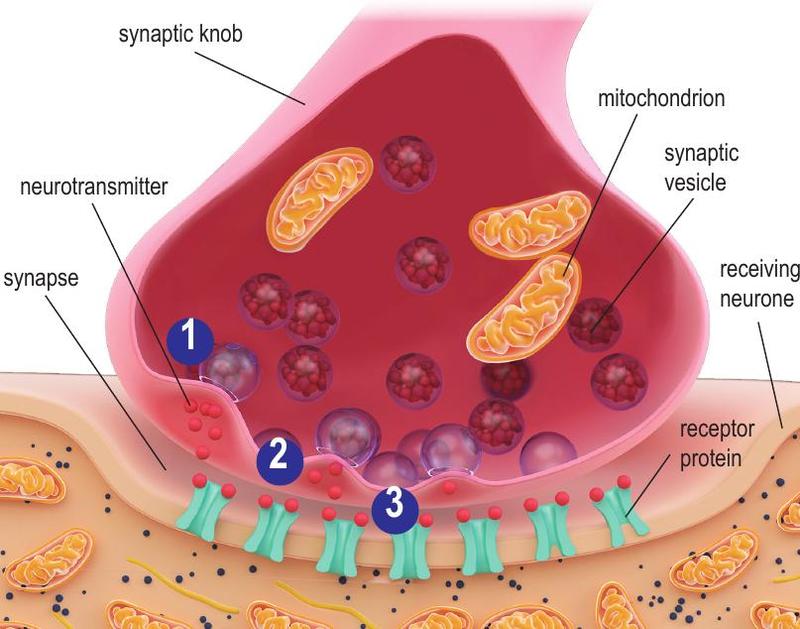
Diagram 1 shows the transmission of impulses across a synapse. The stages are numbered 1 to 3.
[1 mark]
(a)Name the chemical substance that crosses the synapse.
Show answerHide answer
Tick each point you got.
[1 mark]
(b)State one example of this substance.
Show answerHide answer
Any 1 points
Tick each point you got.
[2 marks]
(c)Explain what happens at stage 3.
Show answerHide answer
Tick each point you got.
18
Question 18
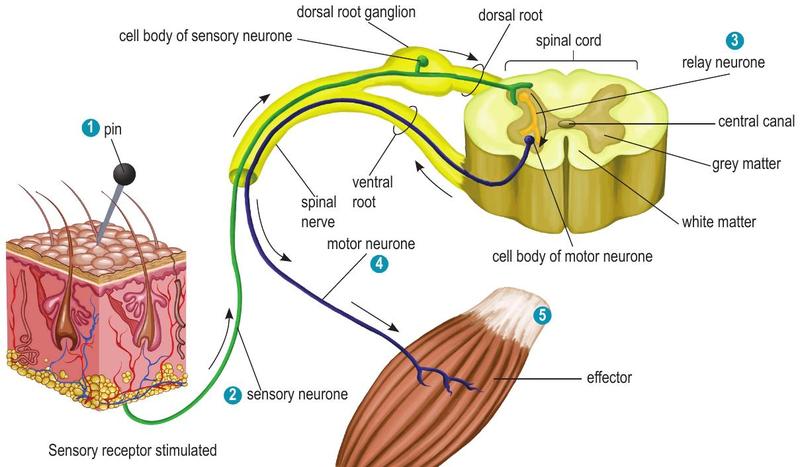
Diagram 2 shows the reflex arc when a finger is pricked by a pin.
[1 mark]
(a)Name the neurone that connects the sensory neurone to the motor neurone.
Show answerHide answer
Tick each point you got.
[1 mark]
(b)State where the cell body of the sensory neurone is found.
Show answerHide answer
Tick each point you got.
[2 marks]
(c)State the importance of a reflex action.
Show answerHide answer
Tick each point you got.
19
Question 19
Voluntary and involuntary actions are two types of response in humans.
[2 marks]
(a)Give one example of a voluntary action and one of an involuntary action.
Show answerHide answer
Tick each point you got.
[1 mark]
(b)Name the part of the brain that controls voluntary actions.
Show answerHide answer
Tick each point you got.
[2 marks]
(c)State two differences between voluntary and involuntary actions.
Show answerHide answer
Any 2 points
Tick each point you got.
20
Question 20
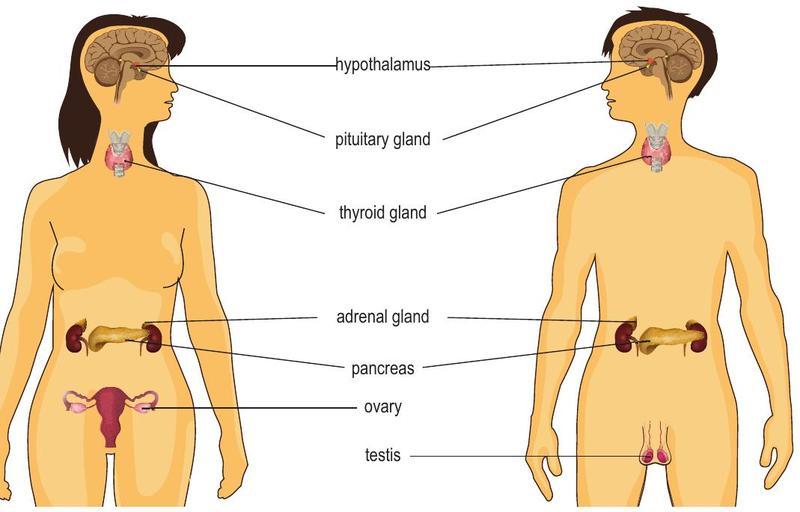
Diagram 3 shows the endocrine glands of the human body.
[2 marks]
(a)Name the main endocrine gland and give a reason.
Show answerHide answer
Tick each point you got.
[2 marks]
(b)Name the hormone secreted by the thyroid gland and state one function.
Show answerHide answer
Tick each point you got.
21
Question 21
A girl is chased by a dog. Her heart beats fast and she runs away quickly.
[1 mark]
(a)Name the hormone secreted by the adrenal gland in this situation.
Show answerHide answer
Tick each point you got.
[2 marks]
(b)State two changes the hormone causes in her body.
Show answerHide answer
Tick each point you got.
[2 marks]
(c)Explain why these changes help her to run away.
Show answerHide answer
Tick each point you got.
22
Question 22
Two patients visit a clinic. Patient P is 12 years old and 1.9 m tall with unusually long hands. Patient Q is an adult who is always cold, tired and gaining weight, and has a slow heartbeat.
[2 marks]
(a)Name the condition of patient P and the hormone involved.
Show answerHide answer
Tick each point you got.
[2 marks]
(b)Name the condition of patient Q and the hormone involved.
Show answerHide answer
Tick each point you got.