Coordination and Response in Humans
What this chapter covers
- {'Sequence and describe the components of human coordination': 'stimulus, receptor, integration centre, effector and response (12.1.1)'}
- Identify external and internal stimuli, list the types of sensory receptors and justify the need to respond (12.1.2–12.1.4)
- Describe the organisation of the nervous system and the functions of the parts of the brain and spinal cord (12.2)
- Draw and label sensory and motor neurones and explain how an impulse crosses a synapse (12.3)
- Compare voluntary and involuntary actions and describe two-neurone and three-neurone reflex arcs (12.4)
- Describe health issues of the nervous system and the effects of drug and alcohol abuse (12.5)
- State the hormones of each endocrine gland, explain the fight or flight response and compare the nervous and endocrine systems (12.6)
- Predict the effects of hormonal imbalance on health (12.7)
12.1Coordination and response
Pathway of coordination: stimulus → receptor → sensory neurone → integration centre → motor neurone → effector → response.
| Type of stimulus | Examples |
|---|---|
| External | Light, sound, smell, taste, surrounding temperature, pressure, touch |
| Internal | Blood osmotic pressure, body temperature, blood sugar level |
Types of sensory receptor
| Receptor | Detects |
|---|---|
| Photoreceptor | Light |
| Thermoreceptor | Change in temperature |
| Chemoreceptor | Chemical substances |
| Baroreceptor | Change in pressure (e.g. blood pressure in the aortic arch and carotid artery) |
| Mechanoreceptor | Touch and pressure |
| Nociceptor | Pain |
Responding to stimuli is needed for survival: animals move to find shelter when the climate changes, and the body must correct internal changes (e.g. a rise in body temperature) to stay in the normal range.
Show answerHide answer
12.2The nervous system
The nervous system has two subsystems. The central nervous system (CNS) is the brain and spinal cord. The peripheral nervous system (PNS) is 12 pairs of cranial nerves, 31 pairs of spinal nerves and the sensory receptors.
| Part of brain | Function |
|---|---|
| Cerebrum | Largest part; folded surface. Controls emotions, hearing, sight, personality and voluntary actions; learning, memory, language and mathematical skills. Receives information, interprets it and decides the response. |
| Hypothalamus | Controls body temperature, water balance and blood pressure; senses hunger, thirst and fatigue. Links the nervous and endocrine systems through the pituitary gland. |
| Cerebellum | Maintains body balance and coordinates muscle contraction for body movement. |
| Medulla oblongata | Controls involuntary actions: heartbeat, breathing, peristalsis, blood pressure, vomiting, coughing, sneezing, swallowing. |
| Pituitary gland | Main endocrine gland; its hormones control other endocrine glands. |
Spinal cord
- Lies inside the vertebral column, surrounded by cerebrospinal fluid.
- Grey matter (butterfly or H shape) holds cell bodies; white matter holds axons covered in myelin sheath.
- The dorsal root carries sensory neurones in (cell bodies in the dorsal root ganglion); the ventral root carries motor neurones out.
- Functions: processes some sensory information, controls reflex actions, connects the brain to the PNS.
Peripheral nervous system
The somatic nervous system controls voluntary actions. The autonomic nervous system controls involuntary actions such as heartbeat and contraction of blood vessels. Together they connect the receptors and effectors to the CNS.
Show answerHide answer
12.3Neurones and synapses
| Part of neurone | Function |
|---|---|
| Dendrite | Receives impulses and sends them to the cell body |
| Cell body | Has the nucleus; integrates signals and coordinates metabolism |
| Axon | Carries impulses away from the cell body |
| Myelin sheath | Insulates the axon, protects it and supplies nutrients |
| Node of Ranvier | Gap in the myelin sheath; impulses jump from node to node, so they travel faster |
| Synaptic knob | Swelling at the end of the axon; sends signals to muscle, gland or another neurone |
| Neurone | Where | Function |
|---|---|---|
| Sensory | Dorsal root; cell body in dorsal root ganglion | Carries impulses from receptors to the CNS |
| Relay | Entirely inside the CNS (grey matter) | Connects sensory neurone to motor neurone |
| Motor | Ventral root; cell body in grey matter | Carries impulses from the CNS to effectors |
Transmission across a synapse
The synapse is the narrow gap between a synaptic knob and the dendrite of the next neurone. Impulses cross it chemically, so transmission is slower and goes in one direction only.
- The electrical impulse reaches the synaptic knob and synaptic vesicles release neurotransmitter (e.g. acetylcholine, noradrenaline) into the synapse.
- The neurotransmitter diffuses across the synapse and binds to receptor proteins on the dendrite of the receiving neurone.
- Binding starts a new electrical impulse in the receiving neurone.
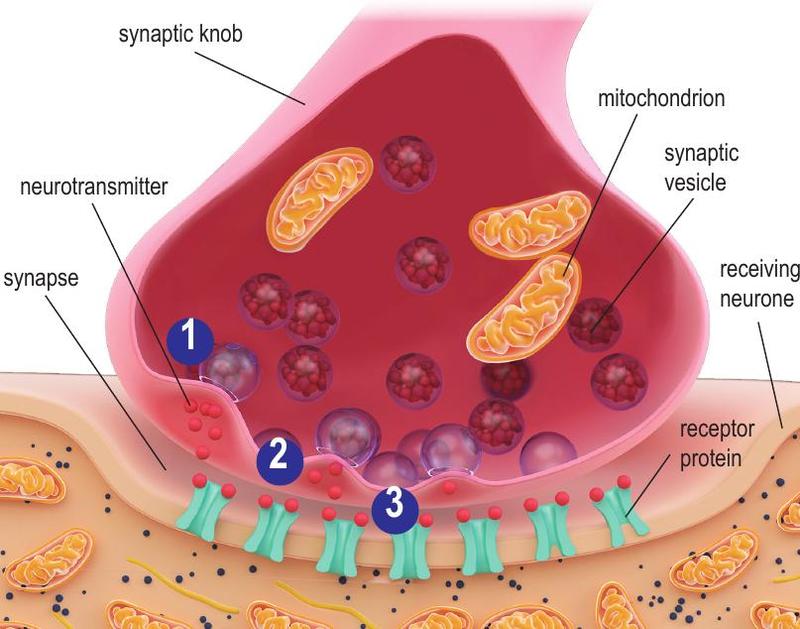
Textbook Figure 12.9, p. 225.
Show answerHide answer
12.4Voluntary and involuntary actions
| Voluntary action | Involuntary action | |
|---|---|---|
| Awareness | Done consciously, by our own will | Automatic, without being aware |
| Nervous system | Somatic | Autonomic |
| Controlled by | Cerebral cortex (cerebrum) | Medulla oblongata and hypothalamus |
| Effector | Skeletal muscles | Smooth muscles and glands |
Both involve a stimulus, impulses, neurones and an effector.
Reflex action and the reflex arc
Three-neurone arc (pricking a finger): receptor → sensory neurone (dorsal root) → relay neurone in the spinal cord → motor neurone (ventral root) → effector muscle. Two-neurone arc (knee jerk): stretch receptor → sensory neurone → motor neurone in the spinal cord → quadriceps muscle contracts. There is no relay neurone.
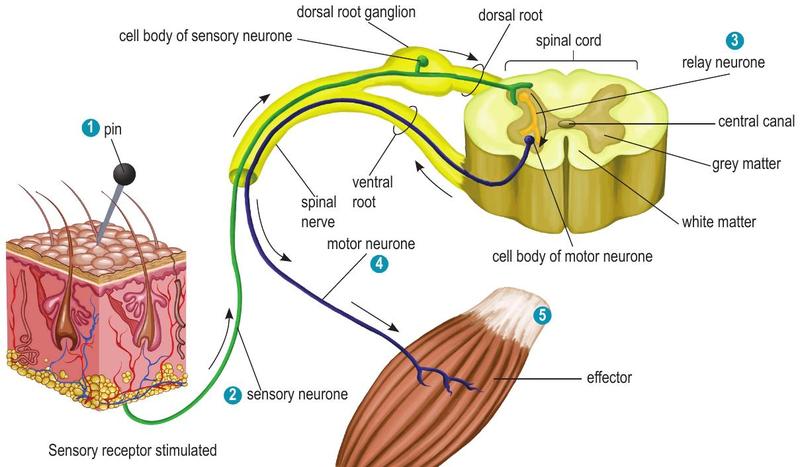
Textbook Figure 12.11, p. 228.
Importance: the response is quick, so injury is reduced, and the brain is free for higher thinking. Examples: coughing, pupil reflex.
Show answerHide answer
12.5Health issues of the nervous system
| Condition | Key point |
|---|---|
| Multiple sclerosis | Immune system attacks the myelin sheath; impulses cannot pass properly |
| Alzheimer's disease | Loss of reasoning, memory and self-care; confusion |
| Parkinson's disease | Shrinkage of the nervous system; tremors, poor posture and balance |
| ALS (Lou Gehrig) | Motor neurones die; movement such as chewing and walking is lost |
| Epilepsy | Abnormal brain activity; unconsciousness, muscle spasms |
| Cerebral palsy | Brain damage before or after birth; poor muscle control |
| ADHD | Hyperactive, unable to concentrate |
| Autism | Problems communicating and interacting |
Drugs and alcohol
| Substance | Effect |
|---|---|
| Stimulant | Increases CNS activity; excess gives euphoria followed by depression |
| Sedative (depressant) | Slows transmission of impulses; calms the mind |
| Hallucinogen | Causes hallucination; relief from pain and anxiety |
| Narcotic | Slows the normal functions of the brain |
| Alcohol | Disrupts coordination and thinking; slows transfer of impulses |
12.6The endocrine system
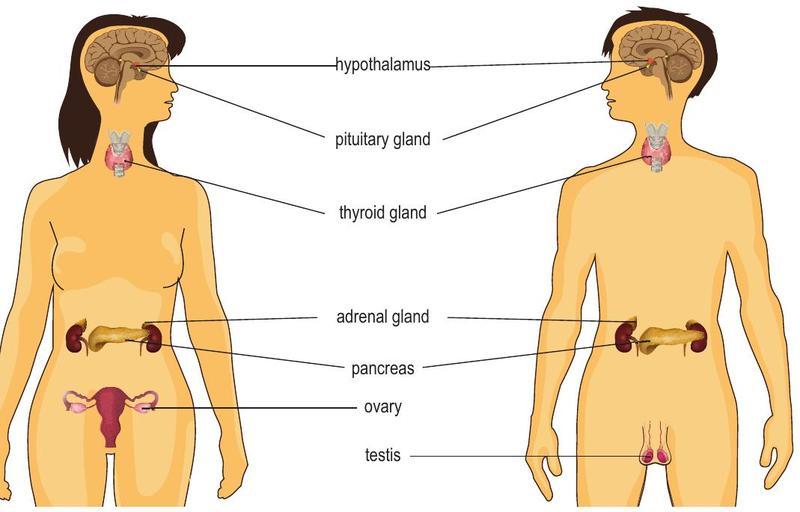
Textbook Figure 12.13, p. 233.
| Gland | Hormone | Function |
|---|---|---|
| Hypothalamus | GnRH | Stimulates the pituitary to secrete FSH and LH |
| Anterior pituitary | GH | Growth, protein synthesis, fat metabolism |
| FSH | Follicle development (ovary); spermatogenesis (testis) | |
| LH | Ovulation, corpus luteum, oestrogen and progesterone (ovary); testosterone (testis) | |
| TSH | Stimulates thyroid to secrete thyroxine | |
| ACTH | Stimulates adrenal cortex | |
| Posterior pituitary | Oxytocin | Uterine contraction at birth; milk production |
| ADH | Kidney tubule reabsorbs more water | |
| Thyroid | Thyroxine | Raises metabolic rate and body temperature; growth and development |
| Pancreas | Insulin | Lowers blood glucose; glucose converted to glycogen |
| Glucagon | Raises blood glucose; glycogen converted to glucose | |
| Adrenal | Adrenaline | Raises blood sugar, respiratory rate and heartbeat; contracts blood vessels |
| Aldosterone | Kidneys reabsorb salt | |
| Ovary | Oestrogen, progesterone | Female secondary sexual characteristics, repair of uterus wall; placenta formation |
| Testis | Testosterone | Male secondary sexual characteristics; spermatogenesis |
Fight or flight
In danger, the hypothalamus sends impulses to the adrenal medulla, which secretes adrenaline and noradrenaline. Heart rate, breathing rate, blood pressure, blood glucose and metabolism all rise, so more oxygen and glucose reach the brain and skeletal muscles. Both systems work together, and the body returns to normal when the danger has passed.
Nervous system versus endocrine system
| Nervous system | Endocrine system | |
|---|---|---|
| Signal | Electrical impulses along neurones | Hormones in the blood |
| Speed of response | Fast | Slow |
| Duration of effect | Short | Long |
| Area affected | One organ | Several organs (target cells) |
Show answerHide answer
12.7Hormonal imbalance
| Condition | Cause | Effects |
|---|---|---|
| Diabetes mellitus | Too little insulin or insulin not used | High blood glucose, frequent urination, thirst, blurred vision, slow wound healing |
| Hypoglycaemia | Too much insulin | Low blood glucose, faintness, headache, fatigue |
| Diabetes insipidus | Too little ADH | Large volume of urine, thirst, dehydration |
| Hypothyroidism | Too little thyroxine | Slow heartbeat, sensitive to cold, tiredness, weight gain |
| Hyperthyroidism | Too much thyroxine | Sweating, heat intolerance, palpitations, weight loss |
| Gigantism | Too much GH in childhood | Abnormally long bones, very tall |
| Dwarfism | Too little GH in childhood | Bones grow slowly, body stays small |