Chemical Bond
What this chapter covers
- Explain why atoms form chemical bonds, using the stable duplet and octet electron arrangements (5.1)
- Describe the formation of ions and ionic bonds, and write half-equations (5.2)
- Describe single, double and triple covalent bonds and compare ionic and covalent bonds (5.3)
- Explain hydrogen bonds and their effect on boiling point and solubility (5.4)
- Explain the formation of a dative bond, for example in H3O+ and NH4+ (5.5)
- Explain the metallic bond and why metals conduct electricity (5.6)
- Compare the properties and uses of ionic and covalent compounds (5.7)
5.1Basics of compound formation
Noble gases exist as single atoms (monoatomic) and are unreactive because they already have a stable duplet (helium) or octet electron arrangement. Atoms of other elements become stable by transferring or sharing electrons.
| Bond | How electrons are used | Between |
|---|---|---|
| Ionic bond | Transfer of electrons | Metal atom and non-metal atom |
| Covalent bond | Sharing of electrons | Non-metal atoms |
Textbook Figures 5.1 and 5.2, pp. 110-111
Show answerHide answer
5.2Ionic bond
- A metal atom donates valence electrons and becomes a positive ion (cation). Na → Na+ + e−
- A non-metal atom accepts electrons and becomes a negative ion (anion). F + e− → F−
- Oppositely charged ions attract one another and form an ionic compound.
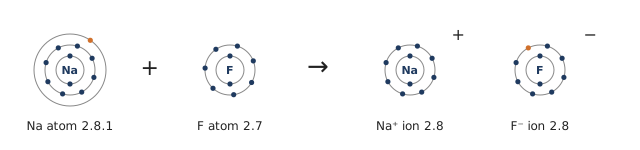
Based on textbook Figure 5.6, p. 113
Each Cl is 2.8.7 and accepts 1 electron: Cl + e− → Cl− (2.8.8).
One Mg gives electrons to two Cl, so the formula is MgCl2.
Show answerHide answer
5.3Covalent bond
| Type | Pairs shared | Example | Why |
|---|---|---|---|
| Single bond | 1 | Chlorine, Cl2; HCl; H2O | Cl (2.8.7) needs 1 electron |
| Double bond | 2 | Oxygen, O2; CO2 | O (2.6) needs 2 electrons |
| Triple bond | 3 | Nitrogen, N2 | N (2.5) needs 3 electrons |
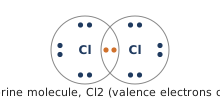
Based on textbook Figures 5.7 and 5.8, pp. 114-115
A Lewis structure shows only the valence electrons, and a line between two atoms stands for one shared pair (Cl–Cl, O=O, N≡N).
Ionic bond and covalent bond
| Ionic bond | Covalent bond | |
|---|---|---|
| Electrons | Transferred | Shared |
| Between | Metal and non-metal | Non-metal and non-metal |
| Particles formed | Positive and negative ions | Molecules |
| Similarity | Only valence electrons are involved and atoms achieve a stable duplet or octet. | |
Show answerHide answer
5.4Hydrogen bond
- Water molecules form hydrogen bonds with one another. Ice is less dense than water, so ice floats.
- Boiling point: besides weak Van der Waals forces, hydrogen bonds must be broken, so more heat is needed. Ethanol (C2H5OH) boils at a higher temperature than Cl2.
- Solubility: ethanol dissolves in water because it forms hydrogen bonds with water molecules.
- Daily life: wet hair sticks together and paper sticks to a wet finger because of hydrogen bonds with water.
Textbook Figures 5.12 to 5.16, pp. 117-119
Show answerHide answer
5.5Dative bond
In H3O+, a water molecule uses a lone pair on oxygen to bond with a hydrogen ion, H+, which has no electrons. The same happens in NH4+, where nitrogen in NH3 supplies the pair. After bonding, oxygen has an octet and each hydrogen has a duplet.
Textbook Figure 5.18, p. 120
Show answerHide answer
5.6Metallic bond
- Metal atoms are packed closely in an orderly way. Their valence electrons are donated and become delocalised (free to move, owned by no particular atom).
- When electricity is supplied, the delocalised electrons move freely and carry charge from the negative terminal to the positive terminal, so metals conduct electricity.
Textbook Figures 5.19 and 5.20, p. 121
Show answerHide answer
5.7Properties of ionic and covalent compounds
| Property | Ionic compounds | Covalent compounds (simple molecules) |
|---|---|---|
| Melting and boiling point | High: much heat needed to overcome strong electrostatic forces | Low: little heat needed to overcome weak Van der Waals forces |
| Conductivity | None as solid; conducts when molten or in aqueous solution (ions move freely) | None in any state (neutral molecules) |
| Solubility | Soluble in water; insoluble in organic solvents | Insoluble in water (mostly); soluble in organic solvents |
Textbook Experiment 5.1 and Figures 5.24 to 5.26, pp. 123-127
Water is a polar solvent: oxygen has partial negative charge and hydrogen partial positive charge. Water molecules attract the ions and break up the lattice, so ionic compounds dissolve.
Simple and giant molecules
| Simple molecule | Giant molecule | |
|---|---|---|
| Example | H2O, CO2, CH4 | SiO2, diamond |
| Forces overcome on melting | Weak Van der Waals forces between molecules | Strong covalent bonds throughout the structure |
| Melting and boiling point | Low | High |
Textbook Figure 5.27, p. 128
Uses
- Ionic: LiI in batteries, KCl and NH4NO3 in fertilisers, NaHCO3 in antacids, NaClO3 in detergents.
- Covalent: pigment and turpentine in paint, bromoethane in pesticides, paracetamol for fever, glycerol in skincare.