Chemistry questions, chapter 5
Nama / NameKelas / ClassTarikh / Date
Chemical Bond
45 marks. Use Practice to check each answer as you go, or Exam to answer everything against the clock first.
Section A: objective questions
13 marksChoose the best answer for each question.
1
Question 1
Why are noble gases unreactive and unable to form compounds?
Show answerHide answer
B
Noble gases already have a stable duplet (helium) or octet electron arrangement, so they do not need to transfer or share electrons.
2
Question 2
Which half-equation shows the formation of the fluoride ion?
Show answerHide answer
A
A fluorine atom (2.7) accepts one electron to become F− (2.8).
3
Question 3
Element P has proton number 12 and element Q has proton number 17. What is the formula of the compound they form?
Show answerHide answer
C
P is 2.8.2 and donates 2 electrons (P2+). Q is 2.8.7 and accepts 1 electron (Q−). Two Q ions balance one P ion, so PQ2.
4
Question 4
How many pairs of electrons are shared between the atoms in a nitrogen molecule, N2?
Show answerHide answer
D
Nitrogen (2.5) needs 3 more electrons, so two atoms share 3 pairs, forming a triple bond.
5
Question 5
Which molecule contains a double bond?
Show answerHide answer
B
Oxygen (2.6) shares two pairs of electrons. H2 and Cl2 have single bonds and N2 has a triple bond.
6
Question 6
An atom of element Y has the electron arrangement 2.5. How many hydrogen atoms bond with one atom of Y in a covalent compound?
Show answerHide answer
C
Y has 5 valence electrons and needs 3 more for an octet, so it shares with 3 hydrogen atoms (like NH3).
7
Question 7
Which compound can form hydrogen bonds between its molecules?
Show answerHide answer
A
Hydrogen bonds form when H is bonded to N, O or F. In H2O, hydrogen is bonded to oxygen. Cl, and C in CH4, do not qualify.
8
Question 8
Ethanol, C2H5OH, dissolves in water. What is the reason?
Show answerHide answer
D
The O–H group in ethanol forms hydrogen bonds with water molecules, so it dissolves.
9
Question 9
Which ion contains a dative bond?
Show answerHide answer
C
In NH4+ the nitrogen lone pair in NH3 is shared with H+, a dative bond. The other ions are simple monoatomic ions.
10
Question 10
Why can a metal conduct electricity?
Show answerHide answer
B
Valence electrons are delocalised in a sea of electrons and move from the negative to the positive terminal.
11
Question 11
Table 1 shows the properties of four substances. Which substance is a giant covalent compound?
| Substance | Melting point (°C) | Soluble in water | Conducts electricity (solid and molten) |
|---|---|---|---|
| P | 801 | Yes | Only when molten |
| Q | −7 | No | No |
| R | 1 710 | No | No |
| S | 1 085 | No | Yes |
Show answerHide answer
D
R has a very high melting point, does not dissolve and does not conduct: giant covalent. P is ionic, Q is a simple molecule and S is a metal.
12
Question 12
Why does sodium chloride dissolve in water?
Show answerHide answer
C
Water is a polar solvent. Its partial charges attract Na+ and Cl− and break up the lattice.
13
Question 13
A student says: "Solid sodium chloride contains ions, so it should conduct electricity." Which statement evaluates this best?
Show answerHide answer
D
Ions must be free to move to carry charge. In the solid they are fixed in the lattice; they move only when molten or dissolved.
Section B: structured questions
32 marksAnswer all questions. Write your answers in the spaces provided.
14
Question 14
Atom P has proton number 11 and atom Q has proton number 17. They react to form compound PQ.
[2 marks]
(a)Write the electron arrangement of atom P and atom Q.
Show answerHide answer
Tick each point you got.
[2 marks]
(b)Write the half-equation for the formation of each ion.
Show answerHide answer
Tick each point you got.
[1 mark]
(c)State the type of bond in PQ.
Show answerHide answer
Tick each point you got.
[2 marks]
(d)Explain how the bond in PQ is formed.
Show answerHide answer
Tick each point you got.
15
Question 15
Methane, CH4, is formed from carbon (proton number 6) and hydrogen (proton number 1). You are asked to draw its Lewis structure.
[1 mark]
(a)State the number of valence electrons in a carbon atom and in a hydrogen atom.
Show answerHide answer
Tick each point you got.
[2 marks]
(b)Describe the Lewis structure you would draw.
Show answerHide answer
Tick each point you got.
16
Question 16
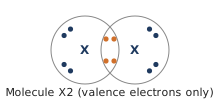
Diagram 1 shows the valence electrons in a molecule of element X (X is not the actual symbol).
[1 mark]
(a)How many pairs of electrons are shared?
Show answerHide answer
Tick each point you got.
[1 mark]
(b)State the type of covalent bond.
Show answerHide answer
Tick each point you got.
[1 mark]
(c)How many valence electrons does one atom of X have?
Show answerHide answer
Tick each point you got.
[2 marks]
(d)X2 has a low melting point. Explain why.
Show answerHide answer
Tick each point you got.
17
Question 17
Water, H2O, is a liquid at room temperature but hydrogen chloride, HCl, is a gas.
[1 mark]
(a)Name the attraction force that exists between water molecules besides Van der Waals forces.
Show answerHide answer
Tick each point you got.
[3 marks]
(b)Explain why water is a liquid but HCl is a gas at room temperature.
Show answerHide answer
Tick each point you got.
[1 mark]
(c)Give one effect of hydrogen bonds in daily life.
Show answerHide answer
Tick each point you got.
18
Question 18
A dative bond is formed in the ammonium ion, NH4+. [Proton number: H = 1, N = 7]
[1 mark]
(a)What is a dative bond?
Show answerHide answer
Tick each point you got.
[3 marks]
(b)Explain the formation of the dative bond in NH4+.
Show answerHide answer
Tick each point you got.
[2 marks]
(c)Boron in BF3 has only six valence electrons. Can BF3 form a dative bond with NH3? Explain.
Show answerHide answer
Tick each point you got.
19
Question 19
Table 2 shows the properties of compounds J and K.
| Compound | Melting point (°C) | Conducts when solid | Conducts when molten |
|---|---|---|---|
| J | 770 | No | Yes |
| K | 80 | No | No |
[2 marks]
(a)State the type of compound (ionic or covalent) for J and for K.
Show answerHide answer
Tick each point you got.
[2 marks]
(b)Explain why J conducts electricity when molten but not when solid.
Show answerHide answer
Tick each point you got.
[2 marks]
(c)Explain why J has a much higher melting point than K.
Show answerHide answer
Tick each point you got.