Chemistry questions, chapter 6
Nama / NameKelas / ClassTarikh / Date
Acid, Base and Salt
44 marks. Use Practice to check each answer as you go, or Exam to answer everything against the clock first.
Section A: objective questions
12 marksChoose the best answer for each question.
1
Question 1
Which of the following is an alkali?
Show answerHide answer
C
An alkali is a base that is soluble in water. KOH dissolves in water to give OH⁻ ions. The other three are bases that are insoluble in water.
2
Question 2
Which acid is diprotic?
Show answerHide answer
B
Sulphuric acid produces two H⁺ ions per molecule, so it is diprotic. HNO₃, HCl and CH₃COOH each produce one H⁺ ion.
3
Question 3
Dry blue litmus paper stays blue in solid oxalic acid, but turns red when water is added. Why?
Show answerHide answer
D
An acid shows acidic properties only in the presence of water, which lets its molecules ionise to H⁺ ions.
4
Question 4
What is the pH value of 0.001 mol dm⁻³ nitric acid, HNO₃?
Show answerHide answer
A
HNO₃ is monoprotic and strong, so [H⁺] = 0.001 = 10⁻³ mol dm⁻³. pH = −log 10⁻³ = 3.
5
Question 5
What is the pH value of 0.01 mol dm⁻³ sodium hydroxide solution, NaOH?
Show answerHide answer
C
[OH⁻] = 0.01, so pOH = 2. pH = 14 − 2 = 12.
6
Question 6
0.1 mol dm⁻³ ethanoic acid has a higher pH than 0.1 mol dm⁻³ hydrochloric acid. What is the reason?
Show answerHide answer
B
Ethanoic acid is a weak acid. Only a small fraction of its molecules ionise, giving a lower [H⁺] and a higher pH.
7
Question 7
Which reaction produces a gas that turns limewater cloudy?
Show answerHide answer
A
Acid + metal carbonate gives salt + water + carbon dioxide, and CO₂ turns limewater cloudy. Zinc with acid gives hydrogen.
8
Question 8
4.0 g of sodium hydroxide, NaOH, is dissolved in water to make 500 cm³ of solution. What is its molarity? [Relative atomic mass: H = 1, O = 16, Na = 23]
Show answerHide answer
D
n = 4.0 ÷ 40 = 0.10 mol. Molarity = 0.10 ÷ 0.500 dm³ = 0.20 mol dm⁻³.
9
Question 9
What volume of 2.0 mol dm⁻³ hydrochloric acid is needed to prepare 250 cm³ of 0.40 mol dm⁻³ hydrochloric acid?
Show answerHide answer
C
M₁V₁ = M₂V₂: 2.0 × V₁ = 0.40 × 250, so V₁ = 50 cm³.
10
Question 10
What volume of 0.10 mol dm⁻³ sulphuric acid, H₂SO₄, exactly neutralises 25 cm³ of 0.10 mol dm⁻³ sodium hydroxide solution, NaOH?
Show answerHide answer
A
H₂SO₄ + 2NaOH → Na₂SO₄ + 2H₂O. n(NaOH) = 0.0025 mol, so n(H₂SO₄) = 0.00125 mol. V = 0.00125 ÷ 0.10 × 1000 = 12.5 cm³.
11
Question 11
Which salt does not dissolve in water?
Show answerHide answer
D
PbSO₄ is one of the insoluble sulphates (Pb, Ba, Ca). All nitrates, ammonium, sodium and potassium salts dissolve.
12
Question 12
A salt solution gives a blue precipitate with sodium hydroxide solution that does not dissolve in excess. With ammonia solution it gives a blue precipitate that dissolves in excess to form a dark blue solution. Which cation is present?
Show answerHide answer
B
Cu²⁺ forms a blue precipitate of Cu(OH)₂, insoluble in excess NaOH but soluble in excess ammonia to give a dark blue solution.
Section B: structured questions
32 marksAnswer all questions. Write your answers in the spaces provided.
13
Question 13
Table 1 shows the pH values of two acids of the same concentration, 0.1 mol dm⁻³.
| Acid | pH value |
|---|---|
| Hydrochloric acid, HCl | 1.0 |
| Ethanoic acid, CH₃COOH | 2.9 |
[1 mark]
(a)State the meaning of a strong acid.
Show answerHide answer
Tick each point you got.
[1 mark]
(b)Which acid is the weak acid?
Show answerHide answer
Tick each point you got.
[2 marks]
(c)Explain why the two acids have different pH values.
Show answerHide answer
Tick each point you got.
[1 mark]
(d)Write the equation for the ionisation of hydrochloric acid in water.
Show answerHide answer
Tick each point you got.
14
Question 14
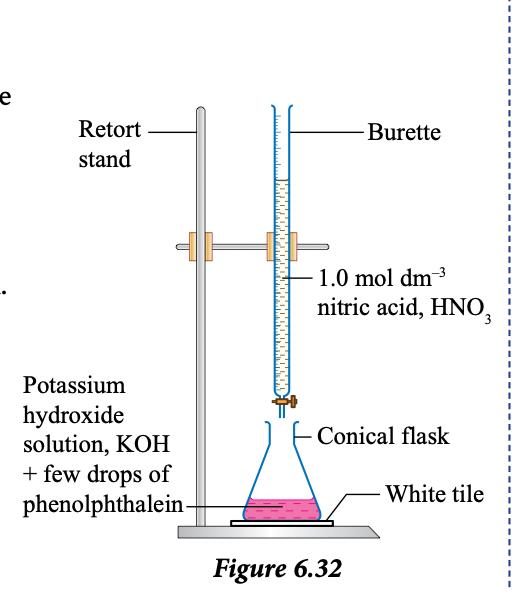
Diagram 1 shows the apparatus used to titrate 1.0 mol dm⁻³ nitric acid, HNO₃, against 25.0 cm³ of potassium hydroxide solution, KOH, using phenolphthalein. Table 2 shows the burette readings.
| Titration | Rough | 1 | 2 | 3 |
|---|---|---|---|---|
| Final reading (cm³) | 20.50 | 20.60 | 40.50 | 20.20 |
| Initial reading (cm³) | 0.00 | 0.50 | 20.60 | 0.20 |
[1 mark]
(a)State the colour change of the solution at the end point.
Show answerHide answer
Tick each point you got.
[1 mark]
(b)Calculate the average volume of nitric acid used. Ignore the rough titration.
Show answerHide answer
Tick each point you got.
[1 mark]
(c)Write the balanced chemical equation for the reaction.
Show answerHide answer
Tick each point you got.
[3 marks]
(d)Calculate the molarity of the potassium hydroxide solution.
Show answerHide answer
Tick each point you got.
15
Question 15
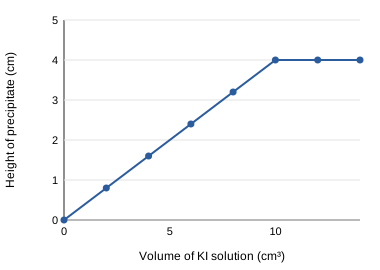
Diagram 2 shows the height of the precipitate formed when different volumes of 0.5 mol dm⁻³ potassium iodide solution, KI, are added to 5 cm³ of 0.5 mol dm⁻³ lead(II) nitrate solution, Pb(NO₃)₂.
[1 mark]
(a)What is the volume of potassium iodide solution that reacts completely with 5 cm³ of lead(II) nitrate solution?
Show answerHide answer
Tick each point you got.
[1 mark]
(b)Calculate the number of moles of Pb²⁺ ions in 5 cm³ of the lead(II) nitrate solution.
Show answerHide answer
Tick each point you got.
[1 mark]
(c)Calculate the number of moles of I⁻ ions that react completely with the Pb²⁺ ions.
Show answerHide answer
Tick each point you got.
[1 mark]
(d)Write the ionic equation for the formation of the precipitate.
Show answerHide answer
Tick each point you got.
[1 mark]
(e)State the colour of the precipitate.
Show answerHide answer
Tick each point you got.
16
Question 16
Salt X is a green solid that is insoluble in water. When heated strongly, it turns black and releases a colourless gas that turns limewater cloudy.
[1 mark]
(a)Name the gas released.
Show answerHide answer
Tick each point you got.
[1 mark]
(b)Name salt X.
Show answerHide answer
Tick each point you got.
[1 mark]
(c)Write the equation for the decomposition of X by heat.
Show answerHide answer
Tick each point you got.
[2 marks]
(d)State two observations when excess dilute hydrochloric acid is added to X.
Show answerHide answer
Tick each point you got.
17
Question 17
A white salt Y dissolves in water to form a colourless solution. A white precipitate forms when sodium hydroxide solution is added, and it dissolves in excess. With ammonia solution, a white precipitate forms that does not dissolve in excess. When Y is heated, a brown gas is released.
[2 marks]
(a)A student says that Y contains Zn²⁺. Do you agree? Give a reason.
Show answerHide answer
Tick each point you got.
[2 marks]
(b)Describe a test to confirm whether the cation is Pb²⁺ or Al³⁺.
Show answerHide answer
Tick each point you got.
[1 mark]
(c)State the anion in Y and explain your answer.
Show answerHide answer
Tick each point you got.
18
Question 18
A student wants to prepare dry crystals of zinc sulphate, ZnSO₄, in the laboratory.
[1 mark]
(a)Name two suitable chemicals for the preparation.
Show answerHide answer
Tick each point you got.
[3 marks]
(b)Describe how the student obtains dry zinc sulphate crystals from the two chemicals.
Show answerHide answer
Tick each point you got.
[1 mark]
(c)Why is zinc added in excess?
Show answerHide answer
Tick each point you got.
[1 mark]
(d)Write the chemical equation for the reaction.
Show answerHide answer
Tick each point you got.