Chemistry questions, chapter 7
Nama / NameKelas / ClassTarikh / Date
Rate of Reaction
43 marks. Use Practice to check each answer as you go, or Exam to answer everything against the clock first.
Section A: objective questions
13 marksChoose the best answer for each question.
1
Question 1
What is meant by the rate of reaction?
Show answerHide answer
B
Rate of reaction is the change in the quantity of reactant used or product formed per unit time.
2
Question 2
Which of the following is a slow reaction?
Show answerHide answer
C
Corrosion of metals, food decay and fermentation are slow. Ignition, combustion of gases and fireworks are fast.
3
Question 3
The reaction between magnesium and hydrochloric acid releases hydrogen gas. Which change can be measured to find the rate of this reaction?
Show answerHide answer
D
Volume of gas collected in a gas syringe or an inverted burette is measured against time.
4
Question 4
60 cm³ of gas is collected in 4 minutes before the reaction stops. What is the overall average rate of reaction?
Show answerHide answer
A
Rate = 60 cm³ ÷ 4 minutes = 15 cm³ minute⁻¹.
5
Question 5
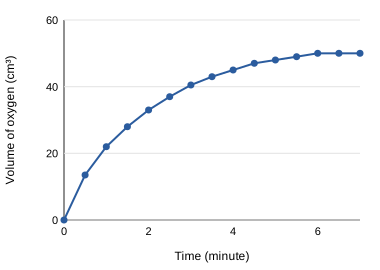
Diagram 1 shows the volume of oxygen released from the decomposition of hydrogen peroxide with manganese(IV) oxide. What is the overall average rate of reaction?
Show answerHide answer
C
The volume reaches 50 cm³ at 6.0 minutes and stays there, so the reaction ends at 6.0 minutes. 50 ÷ 6.0 = 8.3 cm³ minute⁻¹. Dividing by 7 minutes (7.1) is the common mistake.
6
Question 6
Why do small marble chips react faster with hydrochloric acid than large ones of the same mass?
Show answerHide answer
A
Smaller pieces expose a larger total surface area, so collisions with the acid are more frequent.
7
Question 7
Calcium reacts with 200 cm³ of water at room temperature to give 420 cm³ of hydrogen. The experiment is repeated with the water 10 °C warmer. What is the total volume of hydrogen?
Show answerHide answer
B
The quantities of reactants are unchanged, so the same volume of gas forms. Only the rate is higher.
8
Question 8
Which statement about a catalyst is correct?
Show answerHide answer
D
A catalyst is not used up, does not change the quantity of product and lowers the activation energy.
9
Question 9
A reaction takes 80 s at 30 °C. Each rise of 10 °C doubles the rate of reaction. How long will the reaction take at 50 °C?
Show answerHide answer
C
30 °C to 50 °C is two rises of 10 °C, so the rate is 2 × 2 = 4 times higher and the time is 80 ÷ 4 = 20 s.
10
Question 10
The catalytic converter of a car contains platinum. What is its function?
Show answerHide answer
A
Platinum is a catalyst that converts CO, NOx and unburnt hydrocarbons into CO2, N2 and H2O.
11
Question 11
Which pair of conditions is needed for an effective collision between reactant particles?
Show answerHide answer
D
Effective collisions need energy equal to or more than the activation energy and the correct orientation.
12
Question 12
How does a higher temperature increase the rate of reaction?
Show answerHide answer
B
Particles gain kinetic energy, so more reach the activation energy, effective collisions are more frequent and the rate rises. Only a catalyst lowers Ea.
13
Question 13
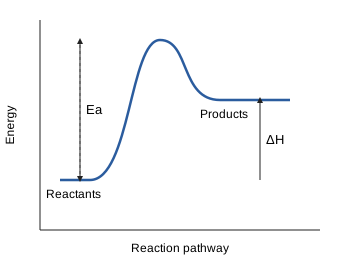
Diagram 2 shows an energy profile diagram. Which statement is correct?
Show answerHide answer
C
Products at a higher energy level than reactants means heat is absorbed: endothermic, ΔH positive.
Section B: structured questions
30 marksAnswer all questions. Write your answers in the spaces provided.
14
Question 14
Chemical reactions occur at different rates.
[1 mark]
(a)What is meant by the rate of reaction?
Show answerHide answer
Tick each point you got.
[2 marks]
(b)Classify each as a fast or a slow reaction: (i) explosion at an oil factory, (ii) fermentation.
Show answerHide answer
Tick each point you got.
[2 marks]
(c)Magnesium reacts with hydrochloric acid. State two changes that can be measured to find the rate.
Show answerHide answer
Tick each point you got.
15
Question 15
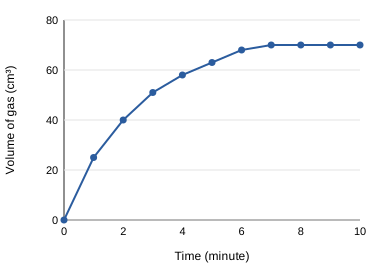
Excess magnesium carbonate is added to sulphuric acid. The volume of carbon dioxide is recorded: 0, 25, 40, 51, 58, 63, 68, 70, 70, 70, 70 cm³ at 0, 1, 2, ... 10 minutes. The reaction stops at the 7th minute.
[2 marks]
(a)Calculate the average rate of reaction in the 5th minute (4th to 5th minute).
Show answerHide answer
Tick each point you got.
[2 marks]
(b)Calculate the overall average rate of reaction.
Show answerHide answer
Tick each point you got.
[1 mark]
(c)Why is the rate in the 5th minute lower than the rate in the 1st minute?
Show answerHide answer
Tick each point you got.
[1 mark]
(d)How is the instantaneous rate at the 2nd minute found from the graph?
Show answerHide answer
Tick each point you got.
16
Question 16
Four experiments use excess dilute sulphuric acid and 40 cm³ of hydrogen gas is collected in each. Experiment I: zinc granules, 1.0 mol dm⁻³ acid, 30 °C, 120 s. Experiment II: zinc powder, 1.0 mol dm⁻³ acid, 30 °C, 40 s. Experiment III: zinc granules, 2.0 mol dm⁻³ acid, 30 °C, 60 s. Experiment IV: zinc granules, 1.0 mol dm⁻³ acid, 40 °C, 60 s.
[1 mark]
(a)Name the manipulated variable when comparing experiments I and II.
Show answerHide answer
Tick each point you got.
[2 marks]
(b)Calculate the average rate of reaction in experiment II.
Show answerHide answer
Tick each point you got.
[3 marks]
(c)Explain, using the collision theory, why experiment II is faster than experiment I.
Show answerHide answer
Tick each point you got.
[2 marks]
(d)Explain why experiment IV is faster than experiment I.
Show answerHide answer
Tick each point you got.
17
Question 17
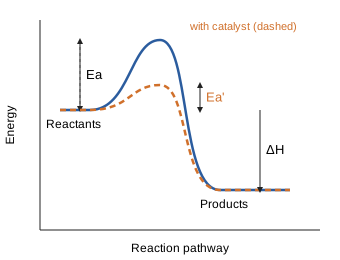
Diagram 4 shows an energy profile diagram of a reaction with and without a catalyst. The solid curve is the reaction without a catalyst and the dashed curve is the reaction with a catalyst.
[1 mark]
(a)What is meant by activation energy?
Show answerHide answer
Tick each point you got.
[2 marks]
(b)Which curve is for the reaction with a catalyst? Explain how it increases the rate of reaction.
Show answerHide answer
Tick each point you got.
[2 marks]
(c)State whether the reaction is exothermic or endothermic. Give a reason.
Show answerHide answer
Tick each point you got.
18
Question 18
A cook wants to prepare a stew with tough meat in a short time.
[3 marks]
(a)State three ways to cook the meat faster and the factor involved in each.
Show answerHide answer
Tick each point you got.
[2 marks]
(b)Use the collision theory to explain one way.
Show answerHide answer
Tick each point you got.
[1 mark]
(c)Why is leftover stew kept in a refrigerator?
Show answerHide answer
Tick each point you got.