Rate of Reaction
What this chapter covers
- Classify fast and slow reactions and explain the meaning of the rate of reaction (7.1)
- Identify the changes that can be observed and measured during a reaction (7.1)
- Calculate the average rate and the instantaneous rate of reaction from data and graphs (7.1)
- Investigate how the size of reactants, concentration, temperature and a catalyst affect the rate of reaction (7.2)
- Explain how the factors that affect the rate of reaction are applied in daily life (7.3)
- Use the collision theory and activation energy to explain the rate of reaction (7.4)
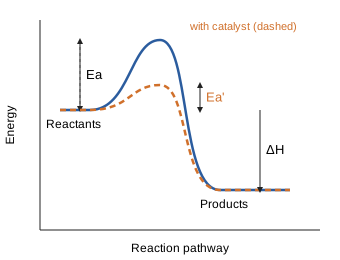
- Interpret energy profile diagrams of exothermic and endothermic reactions, with and without a catalyst (7.4)
7.1Determining rate of reaction
Some reactions are fast (ignition of matches, fireworks, combustion of gases, electric cells). Others are slow (rusting, food decay, photosynthesis, fermentation, erosion of rock).
Rate of reaction = change in the quantity of reactant or product ÷ time taken for the change.
| Quantity measured | Common units of rate |
|---|---|
| Mass of a solid | g s−1 or g minute−1 |
| Volume of a gas | cm3 s−1 or cm3 minute−1 |
| Concentration of a solution | mol dm−3 s−1 or mol dm−3 minute−1 |
Changes you can observe and measure
| Change | Example | How it is measured |
|---|---|---|
| Precipitate forms | AgNO3 + NaCl gives AgCl | Time for a "X" mark to disappear; mass of precipitate |
| Mass of reactants decreases | HNO3 + CaCO3 releases CO2 | Electronic balance |
| Volume of gas increases | HCl + Mg releases H2 | Gas syringe or burette over water |
| Pressure changes | Reactions of gases | Pressure meter |
| Electrical conductivity changes | Reactions with mobile ions | Ammeter |
| pH changes | Acids or bases in solution | pH meter |
Average rate and instantaneous rate
The rate over a period of time. Overall average rate = total volume of gas ÷ time taken for the reaction to finish. For a period t1 to t2: (V2 − V1) ÷ (t2 − t1).
The rate at one moment. Draw a tangent to the curve at that time. The rate is the gradient of the tangent, ΔV ÷ Δt. A bigger triangle gives a more accurate gradient.
Analogy: a car that covers 400 km in 4 hours has an average speed of 100 km h−1. A speed camera that reads 140 km h−1 gives the speed at that instant.
Excess MgCO3 reacts with sulphuric acid. The volume of CO2 is recorded every minute (Table 7.2 in the textbook).
| Time (minute) | 0 | 1 | 2 | 3 | 4 | 5 | 6 | 7 | 8 | 9 | 10 |
|---|---|---|---|---|---|---|---|---|---|---|---|
| Volume (cm3) | 0 | 25 | 40 | 51 | 58 | 63 | 68 | 70 | 70 | 70 | 70 |
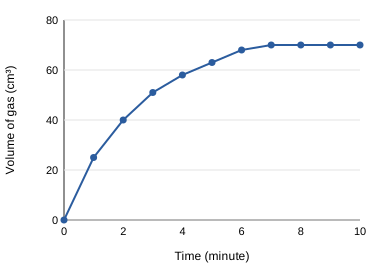
Fifth minute (4th to 5th): (63 − 58) ÷ (5 − 4) = 5 cm3 minute−1.
Overall: the volume stops rising at 7 minutes, so 70 ÷ 7 = 10 cm3 minute−1.
Show answerHide answer
7.2Factors affecting the rate of reaction
| Factor | Change | Effect on rate | Experiment in the textbook |
|---|---|---|---|
| Size of reactant | Smaller pieces (larger total surface area) | Increases | Marble chips with HCl, volume of CO2 against time |
| Concentration | Higher concentration | Increases | Na2S2O3 with H2SO4, time for the "X" mark to disappear |
| Temperature | Higher temperature | Increases | Same reaction from room temperature to 55 °C |
| Catalyst | Catalyst present | Increases | H2O2 with MnO2, glowing splinter relights |
- For a fixed mass, a powder has a larger total surface area than a lump. Cutting a 2 cm cube into smaller pieces raises the total surface area (24 cm2 to 32 cm2 to 40 cm2 in the textbook figure).
- In the sodium thiosulphate experiment, rate = 1 ÷ time. Graph the rate against concentration. At room temperature, a rise of 10 °C roughly doubles the rate.
- A catalyst may change physically (a lump becomes powder) but its mass and chemical properties stay the same.
Experiment I uses 1.0 mol dm−3 HCl and takes 120 s. Experiment II uses 2.0 mol dm−3 HCl and takes 60 s. Same antacid tablet, same temperature.
Rate = 1 ÷ time: I = 1 ÷ 120 = 0.0083 s−1; II = 1 ÷ 60 = 0.017 s−1. The higher concentration doubles the rate.
Show answerHide answer
7.3Factors in daily life
| Factor | Application | Why it works |
|---|---|---|
| Size | Chewing an antacid tablet; slicing potatoes thinly before frying | Larger total surface area exposed |
| Concentration | Iron corrodes faster near industry; petrol vapour compressed in a car engine | More acid rain pollutant; more particles per unit volume |
| Temperature | Washing with hot water and detergent; frying in oil above 100 °C; keeping food in a refrigerator | Higher temperature speeds reactions up; low temperature slows bacterial decay |
| Catalyst | Platinum catalytic converter; yeast enzymes make ethanol at 37 °C | Pollutants (CO, NOx, hydrocarbons) become CO2, N2, H2O |
Show answerHide answer
7.4Collision theory
| Factor increased | What happens to the particles |
|---|---|
| Concentration or pressure | More particles per unit volume, so collisions are more frequent, so effective collisions are more frequent |
| Total surface area | More particles exposed to collision, so effective collisions are more frequent |
| Temperature | Particles gain kinetic energy, more of them reach Ea, effective collisions are more frequent |
| Catalyst | An alternative pathway with a lower activation energy Ea′, so more particles reach it |
Energy profile diagrams
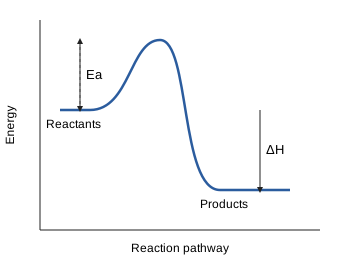 Exothermic
Reactants have more energy than products. Heat is released to the surroundings. ΔH is negative.
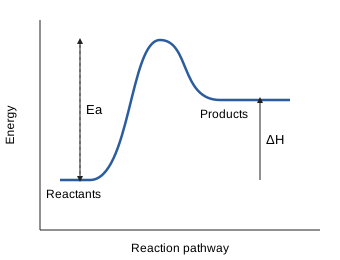 Endothermic
Products have more energy than reactants. Heat is absorbed from the surroundings. ΔH is positive.