Acid, Base and Salt
What this chapter covers
- Define acid, alkali and basicity, and explain the role of water in showing acidic and alkaline properties (6.1)
- Calculate pH and pOH from the concentration of H+ and OH- ions, and relate pH to concentration (6.2)
- Explain the strength of acids and alkalis by their degree of ionisation (6.3)
- Summarise the chemical properties of acids and alkalis, with equations (6.4)
- Calculate concentration in g dm-3 and mol dm-3, and the number of moles in a solution (6.5)
- Prepare a standard solution from a solid and by dilution; use M1V1 = M2V2 (6.6)
- Define neutralisation, carry out a titration and solve neutralisation problems (6.7)
- Define a salt and describe the properties and uses of salt crystals (6.8)
- Classify salts by solubility; prepare soluble and insoluble salts; write ionic equations (6.9)
- Test for gases and describe the effect of heat on carbonate, nitrate and other salts (6.10)
- Identify cations and anions in a salt by qualitative analysis (6.11)
6.1The role of water in showing acidic and alkaline properties
Alkali: a chemical substance that ionises in water to produce hydroxide ions, OH−.
Base: a substance that reacts with an acid to produce salt and water only (metal oxides and metal hydroxides). An alkali is a base that is soluble in water.
In water the H+ ion joins a water molecule to form the hydroxonium ion, H3O+. We usually write H+ to keep things simple.
HCl(aq) → H+(aq) + Cl−(aq) NaOH(aq) → Na+(aq) + OH−(aq)
Basicity of an acid
Basicity is the number of H+ ions that one acid molecule can produce when it ionises in water.
| Type | Basicity | Examples |
|---|---|---|
| Monoprotic | 1 | HCl, HNO3, CH3COOH (ethanoic acid) |
| Diprotic | 2 | H2SO4, H2CO3 |
| Triprotic | 3 | H3PO4 |
Why water is needed
- Dry acid (e.g. solid oxalic acid) exists only as molecules, so there are no H+ ions. Dry blue litmus paper does not change colour. With water, the acid ionises and the blue litmus turns red.
- Solid NaOH pellets hold their OH− ions fixed in the lattice. Red litmus stays red. In solution, the ions move freely and the moist red litmus turns blue.
- Ammonia gas, NH3, shows alkaline properties only with water: NH3 + H2O ⇌ NH4+ + OH−.
Show answerHide answer
6.2pH value
The pH scale (0 to 14) shows how acidic or alkaline a solution is. pH below 7 is acidic, 7 is neutral and above 7 is alkaline. It is measured with universal indicator, pH paper or a pH meter.
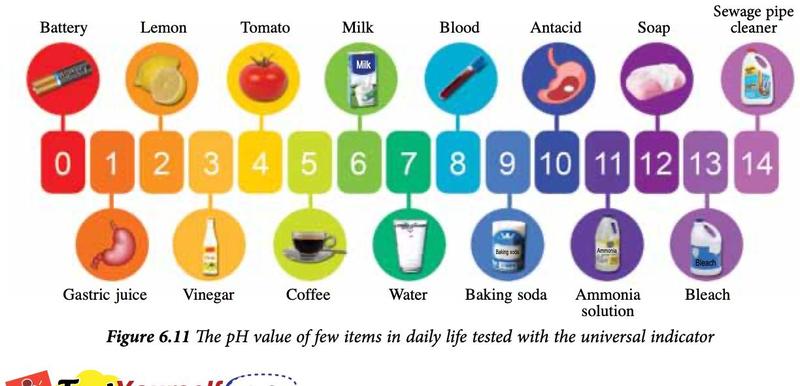
Figure: Chemistry Form 4 KSSM (DLP) textbook, Figure 6.11, p. 148.
[ ] means concentration in mol dm−3.
2. HCl with pH 2.0: log [H+] = −2.0, so [H+] = 10−2 = 0.01 mol dm−3.
3. 0.01 mol dm−3 KOH: pOH = −log 0.01 = 2, so pH = 14 − 2 = 12.
Relationship (Experiments 6.3 and 6.4): the higher the [H+], the lower the pH and the more acidic the solution. The higher the [OH−], the higher the pH and the more alkaline the solution. Each tenfold dilution of an acid raises its pH by 1.
Show answerHide answer
6.3Strength of acids and alkalis
Strength depends on the degree of ionisation in water. It is not the same as concentration.
| Ionisation | [H+] or [OH−] | Equation | Example | |
|---|---|---|---|---|
| Strong acid | Complete | High | HCl → H+ + Cl− | HCl, HNO3, H2SO4 |
| Weak acid | Partial | Low | CH3COOH ⇌ H+ + CH3COO− | Ethanoic acid (about 1% ionised) |
| Strong alkali | Complete | High | NaOH → Na+ + OH− | NaOH, KOH |
| Weak alkali | Partial | Low | NH3 + H2O ⇌ NH4+ + OH− | Ammonia solution |
Show answerHide answer
6.4Chemical properties of acids and alkalis
| Reaction | General equation | Example |
|---|---|---|
| Acid + base | Salt + water | H2SO4 + CuO → CuSO4 + H2O (blue solution) |
| Acid + reactive metal | Salt + hydrogen | 2HCl + Zn → ZnCl2 + H2 |
| Acid + metal carbonate | Salt + water + carbon dioxide | 2HNO3 + CaCO3 → Ca(NO3)2 + H2O + CO2 |
| Alkali + acid | Salt + water | 2KOH + H2SO4 → K2SO4 + 2H2O |
| Alkali + ammonium salt (heat) | Salt + water + ammonia | KOH + NH4Cl → KCl + H2O + NH3 |
| Alkali + metal ion | Insoluble metal hydroxide + cation of alkali | 2NaOH + Mg2+ → Mg(OH)2 + 2Na+ |
- H2 burns with a "pop" sound at a lighted splinter. CO2 turns limewater cloudy.
- NH3 turns moist red litmus blue.
6.5Concentration of aqueous solution
Molarity (mol dm−3) = moles of solute ÷ volume (dm3)
Number of moles n = MV ÷ 1000 (V in cm3) or n = MV (V in dm3)
g dm−3 × (1 ÷ molar mass) = mol dm−3
0.5 mol dm−3 HNO3 (Mr = 63): 0.5 × 63 = 31.5 g dm−3.
200 cm3 of 0.2 mol dm−3 Pb(NO3)2: n = 0.2 × 200 ÷ 1000 = 0.04 mol.
Show answerHide answer
6.6Standard solution
From a solid (e.g. 250 cm3 of 1.0 mol dm−3 Na2CO3)
- Calculate the mass needed: n = MV ÷ 1000 = 0.25 mol; mass = 0.25 × 106 = 26.5 g. Weigh it accurately.
- Dissolve it in about 100 cm3 of distilled water in a beaker.
- Pour it through a funnel into a 250 cm3 volumetric flask. Rinse the beaker, glass rod and funnel into the flask.
- Add distilled water until close to the calibration mark, then use a dropper until the bottom of the meniscus sits on the mark.
- Stopper and invert several times to mix.
By dilution
Adding water changes the concentration but not the number of moles of solute.
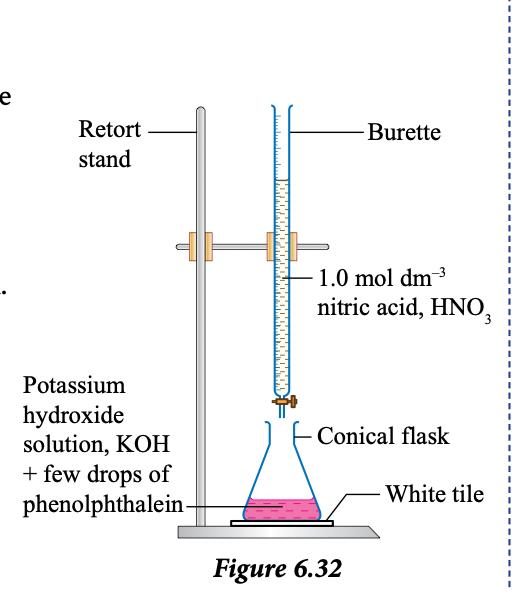
Figure: Chemistry Form 4 KSSM (DLP) textbook, Figure 6.32, p. 170.
6.7Neutralisation
Ionic equation: H+(aq) + OH−(aq) → H2O(l)
Uses: milk of magnesia for gastric pain, toothpaste against acid on teeth, slaked lime on acidic soil, and making fertilisers such as ammonium nitrate and ammonium sulphate.
Titration
- Rinse the pipette with the alkali; pipette 25.0 cm3 into a conical flask; add 2 to 3 drops of phenolphthalein.
- Rinse the burette with the acid, fill it and record the initial reading.
- Run in the acid, swirling, a rough titration first. Then repeat, adding drop by drop near the end point.
- End point: the indicator changes colour (phenolphthalein pink → colourless). Record the final reading.
- Repeat until two or three volumes agree closely; average them (ignore the rough value).
| Indicator | Acid | Neutral | Alkali |
|---|---|---|---|
| Phenolphthalein | Colourless | Colourless | Pink |
| Methyl orange | Red | Orange | Yellow |
0.2 Va = 0.25 × 20, so Va = 25 cm3.
Show answerHide answer
6.8Salts, crystals and their uses
Physical properties of a salt crystal: a regular geometrical shape; flat surfaces, straight edges and sharp vertices; a fixed angle between adjacent faces; the same shape whatever the size. The particles are packed in an orderly arrangement.
| Field | Salt and use |
|---|---|
| Agriculture | Ammonium nitrate, NH4NO3, as fertiliser; iron(II) sulphate in pesticides |
| Medicine | Calcium sulphate (plaster of Paris) to support broken bones; potassium manganate(VII) as antiseptic |
| Preservation | Sodium benzoate in sauces; sodium nitrate in processed meat |
| Food preparation | Sodium chloride as flavour; sodium bicarbonate to raise dough |
6.9Preparation of salts
Solubility of salts
| Salt | Soluble | Insoluble |
|---|---|---|
| Nitrates | All | None |
| Sulphates | All except those on the right | PbSO4, BaSO4, CaSO4 |
| Chlorides | All except those on the right | PbCl2, AgCl, Hg2Cl2 |
| Carbonates | Na2CO3, K2CO3, (NH4)2CO3 | All others |
| Na, K and ammonium salts | All | None |
Choosing a method
| Salt to prepare | Method | Reagents |
|---|---|---|
| Soluble Na, K or ammonium salt | Titration (neutralisation), then crystallise | Acid + alkali |
| Other soluble salt | Add excess solid, filter, crystallise | Acid + metal, metal oxide or metal carbonate |
| Insoluble salt | Double decomposition (precipitation), filter, rinse, dry | Two soluble salt solutions |
- Use the excess solid so that all of the acid reacts; filter off the extra, then heat the filtrate until saturated (a crystal forms on a cold glass rod), cool, filter, rinse with a little distilled water and dry between filter papers.
- Recrystallisation purifies a soluble salt: dissolve in the minimum hot water, filter off insoluble impurities, evaporate to saturation, cool and filter.
- Copper is not used with dilute acid because it is below hydrogen in the reactivity series and does not react.
Spectator ions Na+ and Cl− are cancelled. Ionic equation: Ba2+(aq) + SO42−(aq) → BaSO4(s)
Continuous variation method
Fix the volume of solution A, add increasing volumes of solution B, and measure the height of the precipitate. The height rises, then stays constant. The first tube with the maximum height has the exact ratio of reactants. From the ratio of moles you get the ionic equation.
n(Pb2+) = 0.5 × 5 ÷ 1000 = 0.0025 mol; n(I−) = 0.5 × 10 ÷ 1000 = 0.005 mol. Ratio 1 : 2.
Pb2+(aq) + 2I−(aq) → PbI2(s) (yellow precipitate)
6.10Effect of heat on salts
Gas tests
| Gas | Test | Result |
|---|---|---|
| Oxygen, O2 | Glowing splinter | Rekindles |
| Hydrogen, H2 | Lighted splinter | "Pop" sound |
| Carbon dioxide, CO2 | Limewater | Turns cloudy |
| Ammonia, NH3 | Moist red litmus | Turns blue (pungent smell) |
| Chlorine, Cl2 | Moist blue litmus | Turns red, then bleached white |
| Hydrogen chloride, HCl | Glass rod dipped in conc. ammonia | White fumes |
| Sulphur dioxide, SO2 | Acidified KMnO4 or K2Cr2O7 | Purple to colourless; orange to green |
| Nitrogen dioxide, NO2 | Moist blue litmus | Brown gas; turns red |
Thermal decomposition
- Carbonate: metal carbonate → metal oxide + CO2 (e.g. ZnCO3 → ZnO + CO2). Na2CO3 and K2CO3 do not decompose.
- Nitrate: metal nitrate → metal oxide + NO2 + O2 (2Pb(NO3)2 → 2PbO + 4NO2 + O2).
- Ammonium salt: NH4Cl → NH3 + HCl.
| Residue | Hot | Cold | Cation |
|---|---|---|---|
| ZnO | Yellow | White | Zn2+ |
| PbO | Brown | Yellow | Pb2+ |
| CuO | Black | Black | Cu2+ |
6.11Qualitative analysis
Order of analysis: observe colour and solubility, heat the solid and test the gas, then test for cations and anions.
| Colour | Possible ion |
|---|---|
| Blue solution or blue solid | Cu2+ |
| Green (solid or solution) | Fe2+ (green CuCO3 is insoluble; green CuCl2 gives a blue solution) |
| Brown / yellowish brown | Fe3+ |
| White salt, colourless solution | Zn2+, Al3+, Pb2+, Mg2+, Ca2+, NH4+, Na+, K+ |
Anion tests
| Anion | Reagents | Observation | Ionic equation |
|---|---|---|---|
| CO32− | Dilute acid; pass gas into limewater | Effervescence; limewater cloudy | 2H+ + CO32− → CO2 + H2O |
| Cl− | Excess dilute HNO3, then AgNO3 | White precipitate | Ag+ + Cl− → AgCl |
| SO42− | Excess dilute HCl, then BaCl2 | White precipitate | Ba2+ + SO42− → BaSO4 |
| NO3− | Dilute H2SO4, FeSO4, then conc. H2SO4 down the side of the tilted tube | Brown ring |
Cation tests
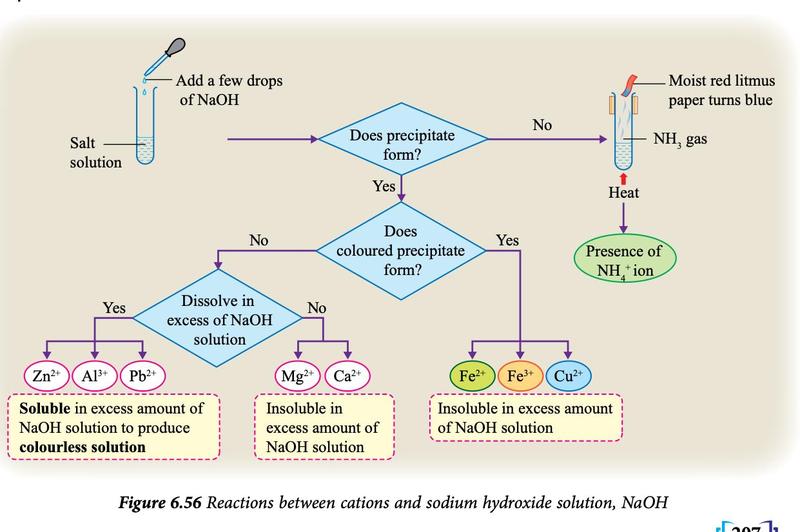
Figure: Chemistry Form 4 KSSM (DLP) textbook, Figure 6.56, p. 207.
| Cation | NaOH solution | Ammonia solution |
|---|---|---|
| Cu2+ | Blue precipitate, insoluble in excess | Blue precipitate, dissolves in excess to give a dark blue solution |
| Fe2+ | Green precipitate, insoluble in excess | Green precipitate, insoluble in excess |
| Fe3+ | Brown precipitate, insoluble in excess | Brown precipitate, insoluble in excess |
| Zn2+ | White precipitate, dissolves in excess | White precipitate, dissolves in excess |
| Al3+, Pb2+ | White precipitate, dissolves in excess | White precipitate, insoluble in excess |
| Mg2+ | White precipitate, insoluble in excess | White precipitate, insoluble in excess |
| Ca2+ | White precipitate, insoluble in excess | No precipitate (or very slight) |
| NH4+ | No precipitate; on heating, NH3 turns moist red litmus blue | No precipitate |
Confirmatory tests
| Ion | Reagent | Observation |
|---|---|---|
| NH4+ | Nessler reagent | Brown precipitate |
| Fe2+ | K3Fe(CN)6 (hexacyanoferrate(III)) | Dark blue precipitate |
| Fe3+ | K4Fe(CN)6 or KSCN | Dark blue precipitate or blood red solution |
| Pb2+ (vs Al3+) | KI solution | Yellow precipitate that dissolves on heating and reappears on cooling |
Show answerHide answer
Summary
| Remember | Key fact |
|---|---|
| Acid / alkali | Produces H+ / OH− in water; water is needed |
| pH | pH = −log [H+]; pH + pOH = 14 |
| Strength | Complete ionisation = strong; partial = weak |
| Concentration | g dm−3 ÷ Mr = mol dm−3; n = MV/1000 |
| Dilution | M1V1 = M2V2 |
| Neutralisation | H+ + OH− → H2O; MaVa/MbVb = a/b |
| Insoluble salt | Double decomposition of two soluble salts |
| Heating | Carbonate → CO2; nitrate → NO2 + O2 |