Manufactured Substances in Industry
What this chapter covers
- Describe alloys with examples, compare an alloy with its pure metal and justify the uses of alloys (8.1)
- Describe the types of glass, their composition, properties and uses (8.2)
- Describe ceramics, their composition, properties and uses in daily life (8.3)
- State the meaning and properties of composite materials and compare them with their constituent materials (8.4)
8.1Alloy and its importance
Why an alloy is harder than its pure metal
In a pure metal the atoms are the same size and sit in orderly layers. When a force is applied the layers slide easily over each other, so a pure metal is ductile (pulled into wires) and malleable (shape changed easily).
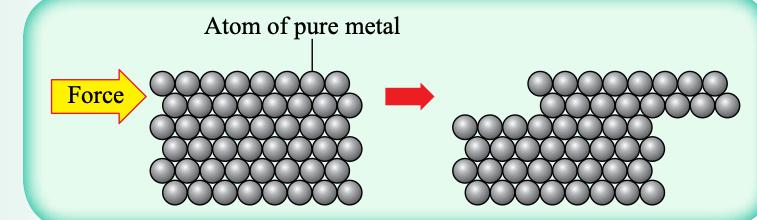
In an alloy, foreign atoms of a different size disrupt the orderly arrangement. The layers cannot slide easily, so the alloy is harder and stronger. Alloying also helps to prevent corrosion.
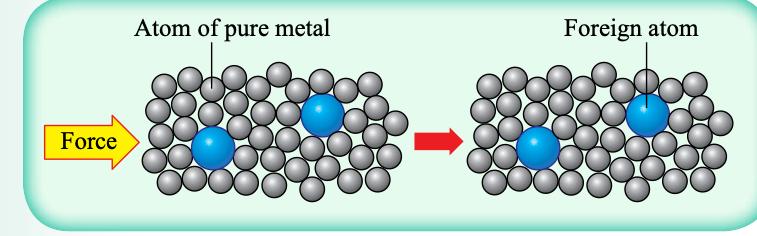
Figures: textbook Figures 8.5 and 8.7, p. 257.
Experiment 8.1: alloy and pure metal
- Corrosion: stainless steel and iron plates in distilled water for a week. Iron rusts, stainless steel does not (manipulated: type of plate; responding: corrosion).
- Hardness: a 1 kg weight dropped from a fixed height onto a steel ball bearing on a bronze block, then on a copper block. The smaller the dent, the harder the block. The bronze dent is smaller, so bronze (alloy) is harder than copper (pure metal).
Composition, properties and uses
| Alloy | Composition | Properties | Uses |
|---|---|---|---|
| Duralumin | 93% Al, 3% Cu, 3% Mg, 1% Mn | Stronger than Al, low density, does not rust | Aeroplane body, electric cables, racing bicycles |
| Bronze | 90% Cu, 10% Sn | Stronger than Cu, does not rust, shiny | Medals, monuments, trophies |
| Brass | 70% Cu, 30% Zn | Stronger than Cu, does not rust, shiny | Musical instruments, doorknobs, keys |
| Steel | 98% Fe, 0.2–2% C | Stronger, harder, malleable | Buildings, railway tracks, car body |
| Stainless steel | 73% Fe, 18% Cr, 8% Ni, 1% C | Stronger than Fe, resists corrosion | Cutlery, sinks, surgical instruments |
| Pewter | 95% Sn, 3.5% Sb, 1.5% Cu | Stronger than Sn, does not rust, shiny | Ornaments, trophies, souvenirs |
Percentages may vary. A superconductor has no electrical resistance at very low temperature and is used to make the magnets of Maglev trains.
Show answerHide answer
8.2Composition of glass and its uses
| Type | Made from | Special property | Uses |
|---|---|---|---|
| Fused silica glass | SiO2 only | Very high melting point (about 1800 °C), hardly expands or contracts | Telescope lenses |
| Soda-lime glass | SiO2, Na2CO3, CaCO3 | Low melting point (about 1000 °C), easily moulded, cracks with sudden temperature change | Bottles, jugs |
| Borosilicate glass | SiO2, Na2CO3, CaCO3, B2O3, Al2O3 | Heat resistant, low expansion coefficient | Beakers, flasks |
| Lead crystal glass | SiO2, Na2CO3, PbO | Soft, dense, high refractive index | Prisms |
Show answerHide answer
8.3Composition of ceramics and its uses
Atoms in ceramics are held by strong ionic and covalent bonds in an indefinite arrangement and cannot slide, so ceramics have a high melting point, are hard and strong, chemically inert and insulators, but are brittle and weak when stretched.
| Type | Made from | Examples and uses |
|---|---|---|
| Traditional | Clay such as kaolin, Al2O3·2SiO2·2H2O | Bricks, pottery, crockery |
| Advanced | Oxides, carbides and nitrides | Silicon carbide in cutting and brake discs; tungsten carbide rings; zirconia dental implants; alumina knee bones; insulators in power stations; jet engine parts |
Show answerHide answer
8.4Composite materials and their importance
| Composite | Matrix | Strengthening | Better property and use |
|---|---|---|---|
| Reinforced concrete | Concrete | Steel bars or wire mesh | Withstands compression and stretching; bridges, dams, buildings |
| Fibre glass | Plastic | Glass fibres | Strong, light, durable; helmets, car bumpers, circuit boards |
| Optical fibre | Glass or plastic cladding and jacket | Silica glass core | Carries data as light by total internal reflection; replaces copper wire |
| Photochromic glass | Glass | AgCl and CuCl | Darkens in sunlight (silver atoms form), clears in dim light; car windows, lenses |
| Superconductor (YBCO) | Yttrium, barium, copper oxides | No resistance at very low temperature; MRI, NMR, particle accelerator magnets | |
Composite and its original components (8.4.3)
| Composite | Original components | Composite is better because |
|---|---|---|
| Reinforced concrete | Concrete: high compression strength, low stretching strength. Steel: high stretching strength, corrodes easily | High compression and stretching strength, resistant to corrosion |
| Fibre glass | Plastic: weak, soft, easily burned. Glass fibre: high stretching strength | High stretching strength, durable, resistant to corrosion, insulator |
| Optical fibre | Glass fibre: hard but low compression strength. Plastic: flexible | High compression strength and flexible |
| Photochromic glass | Glass: does not absorb UV rays. Silver chloride: absorbs UV rays, sensitive to light | Transparent, absorbs UV rays, and the absorption depends on light intensity |
| Superconductor (YBCO) | Its starting compounds have high electrical resistance at room temperature | No electrical resistance at very low temperature |