Operations on Sets
What this chapter covers
- Determine and describe the intersection of sets using various representations, and write it with the symbol ∩ (4.1)
- Determine the complement of the intersection of sets, list its elements and shade it on a Venn diagram (4.1)
- Solve problems involving the intersection of sets (4.1)
- Determine and describe the union of sets using various representations, and write it with the symbol ∪ (4.2)
- Determine the complement of the union of sets (4.2)
- Solve problems involving the union of sets, using n(A ∪ B) = n(A) + n(B) − n(A ∩ B) (4.2)
- Determine and describe combined operations on sets, such as (P ∪ Q) ∩ R, and their complements, with brackets worked first (4.3)
- Solve problems involving combined operations on sets, using Venn diagrams with two or three sets (4.3)
Sets are used to sort and compare data: which pupils join the football club, the drama club, or both? In Form 1 you listed sets and drew simple Venn diagrams. In this chapter you will combine sets with three operations, intersection (∩), union (∪) and complement (′), and use Venn diagrams with two or three sets to solve problems with numbers.
| English | Bahasa Melayu |
|---|---|
| intersection | persilangan |
| union | kesatuan |
| complement | pelengkap |
| set, empty set, subset | set, set kosong, subset |
| element, set notation | unsur, tatatanda set |
4.1Intersection of sets
What is an intersection?
Some pupils like durian, some like rambutan, and a few like both. The pupils who like both fruits belong to the set A ∩ B.
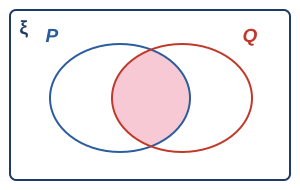
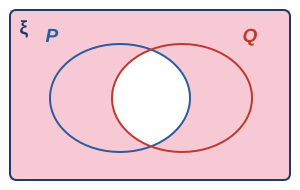
Example 1 (like textbook p. 98)
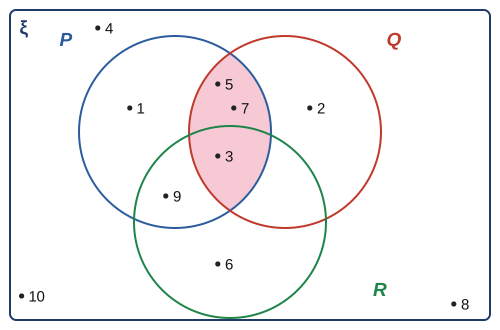
ξ = {x : x is an integer, 1 ≤ x ≤ 10}, P = {odd numbers}, Q = {prime numbers} and R = {multiples of 3}. (a) List P ∩ Q, P ∩ R, Q ∩ R and P ∩ Q ∩ R. (b) State n(P ∩ Q).
- List each set first: P = {1, 3, 5, 7, 9}, Q = {2, 3, 5, 7}, R = {3, 6, 9}.
- (a) P ∩ Q = {3, 5, 7}; P ∩ R = {3, 9}; Q ∩ R = {3}; P ∩ Q ∩ R = {3} (only 3 is in all three sets).
- (b) n(P ∩ Q) = 3.
When there is nothing in common
Example 2 (like textbook p. 99)
A = {numbers on a dice}, B = {even numbers on a dice}, C = {7, 8, 9}. Find A ∩ B, B ∩ C and A ∩ C.
- A = {1, 2, 3, 4, 5, 6}, B = {2, 4, 6}.
- A ∩ B = {2, 4, 6} = B, because B ⊂ A.
- B ∩ C = { } and A ∩ C = φ: they share no element. The Venn diagram draws B and C apart.
Show answerHide answer
b) A = {K, E, L, A, S}, B = {S, E, K, O, L, A, H}. A ∩ B = {K, E, L, A, S} = A, so n(A ∩ B) = 5
c) C = {L, A, U, T}, so A ∩ C = {L, A}
Complement of an intersection
Example 3 (like textbook p. 100)
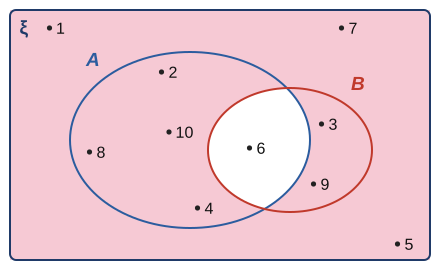
ξ = {1, 2, …, 10}, A = {2, 4, 6, 8, 10} and B = {3, 6, 9}. List (A ∩ B)′ and find n((A ∩ B)′).
- A ∩ B = {6}.
- (A ∩ B)′ = {1, 2, 3, 4, 5, 7, 8, 9, 10}, so n((A ∩ B)′) = 9.
- Check: n(A ∩ B) + n((A ∩ B)′) = 1 + 9 = 10 = n(ξ).
Show answerHide answer
4.2Union of sets
What is a union?
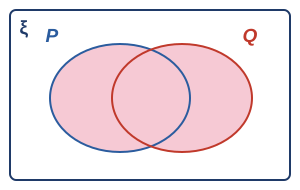
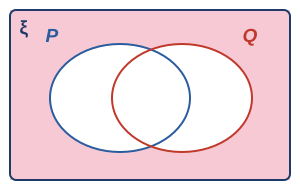
Example 4 (like textbook p. 108)
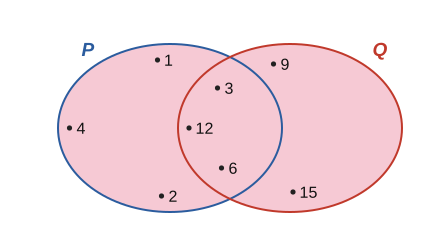
P = {factors of 12} and Q = {multiples of 3 which are less than 16}. List P ∪ Q and find n(P ∪ Q).
- P = {1, 2, 3, 4, 6, 12}, Q = {3, 6, 9, 12, 15}.
- P ∪ Q = {1, 2, 3, 4, 6, 9, 12, 15}: the common elements 3, 6 and 12 are written once.
- n(P ∪ Q) = 8.
Complement of a union
Example 5 (like textbook p. 110)
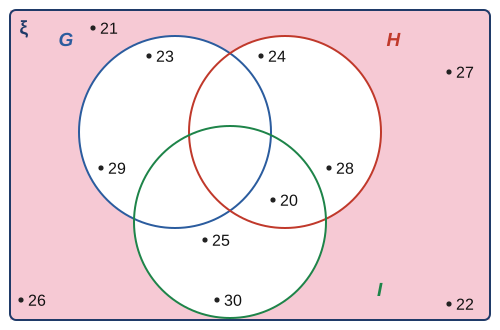
ξ = {x : x is an integer, 20 ≤ x ≤ 30}, G = {prime numbers}, H = {multiples of 4}, I = {multiples of 5}. List (G ∪ H)′, (H ∪ I)′ and (G ∪ H ∪ I)′.
- ξ = {20, 21, …, 30}, G = {23, 29}, H = {20, 24, 28}, I = {20, 25, 30}.
- G ∪ H = {20, 23, 24, 28, 29}, so (G ∪ H)′ = {21, 22, 25, 26, 27, 30}, n = 6.
- H ∪ I = {20, 24, 25, 28, 30}, so (H ∪ I)′ = {21, 22, 23, 26, 27, 29}, n = 6.
- G ∪ H ∪ I = {20, 23, 24, 25, 28, 29, 30}, so (G ∪ H ∪ I)′ = {21, 22, 26, 27}, n = 4.
Show answerHide answer
b) X = {4, 8, 12}, Y = {1, 2, 3, 4, 6, 12}, X ∪ Y = {1, 2, 3, 4, 6, 8, 12}, so (X ∪ Y)′ = {5, 7, 9, 10, 11}
Problems with two sets
Use the steps of the textbook: understand the problem, plan a strategy (draw a Venn diagram), carry it out, and check. Start filling from the middle (the intersection) outwards.
Example 6 (like textbook p. 113)
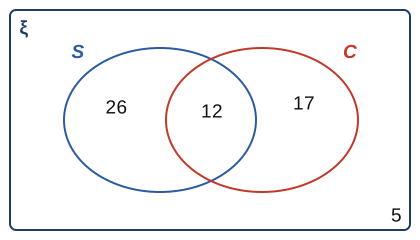
Of 60 pupils, 38 swim, 29 cycle and 12 do both. How many (a) swim only, (b) cycle only, (c) do neither?
- Put 12 in the overlap.
- (a) Swim only = 38 − 12 = 26. (b) Cycle only = 29 − 12 = 17.
- n(S ∪ C) = 26 + 12 + 17 = 55, which agrees with 38 + 29 − 12 = 55.
- (c) Neither = 60 − 55 = 5.
Problems with three sets
Example 7 (like textbook p. 114)
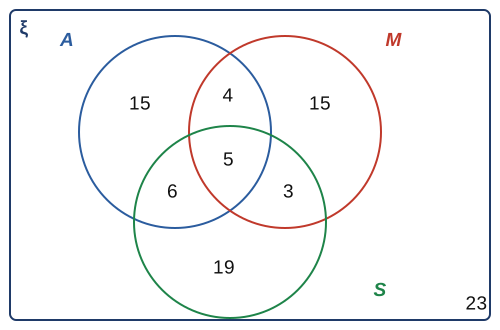
In a group of 90 learners, 30 join Art Club, 27 join Music Club and 33 join Sports Club. 9 join Art and Music, 8 join Music and Sports, 11 join Art and Sports, and 5 join all three clubs. How many join no club?
- Start in the centre: all three = 5.
- Exactly two clubs: Art and Music only = 9 − 5 = 4; Music and Sports only = 8 − 5 = 3; Art and Sports only = 11 − 5 = 6.
- One club only: Art = 30 − 4 − 6 − 5 = 15; Music = 27 − 4 − 3 − 5 = 15; Sports = 33 − 3 − 6 − 5 = 19.
- In at least one club: 15 + 15 + 19 + 4 + 3 + 6 + 5 = 67. No club: 90 − 67 = 23.
Show answerHide answer
b) n(C ∪ T) = 50 − 5 = 45, and 31 + 28 − n(both) = 45, so both = 14
4.3Combined operations on sets
Intersection and union together
Combined operations use ∩, ∪ and ′ in one expression. Brackets first, and otherwise work from left to right. The complement ′ is applied to the set or bracket just before it.
| Expression | Read as | Steps |
|---|---|---|
| (A ∪ B) ∩ C | elements in A or B, that are also in C | A ∪ B, then ∩ C |
| A′ ∩ (B ∪ C) | not in A, but in B or C | A′ and B ∪ C, then ∩ |
| (A ∩ C)′ ∪ (B ∩ C) | not in A ∩ C, or in B ∩ C | (A ∩ C)′ and B ∩ C, then ∪ |
Example 8 (like textbook pp. 116–119)
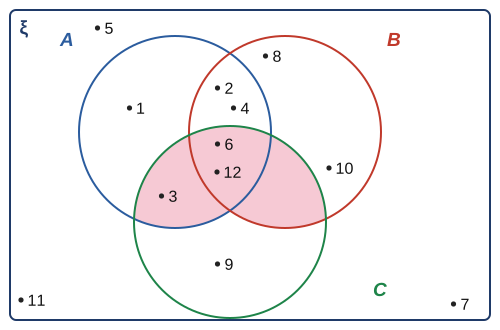
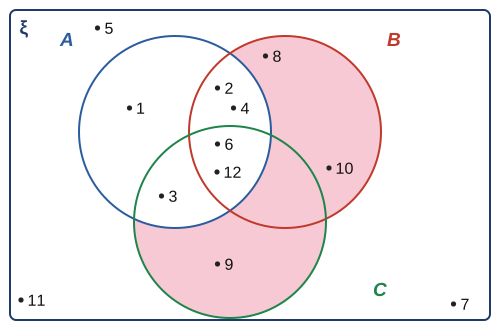
ξ = {1, 2, …, 12}, A = {factors of 12}, B = {even numbers}, C = {multiples of 3}. List (a) (A ∪ B) ∩ C (b) A′ ∩ (B ∪ C).
- A = {1, 2, 3, 4, 6, 12}, B = {2, 4, 6, 8, 10, 12}, C = {3, 6, 9, 12}.
- (a) A ∪ B = {1, 2, 3, 4, 6, 8, 10, 12}. Of these, the ones in C: (A ∪ B) ∩ C = {3, 6, 12}.
- (b) A′ = {5, 7, 8, 9, 10, 11}. B ∪ C = {2, 3, 4, 6, 8, 9, 10, 12}. A′ ∩ (B ∪ C) = {8, 9, 10}.
Shading a combined operation
Shade each part on its own (in pencil, or in your head), then keep the part that meets the operation: for ∩ keep only the region shaded by both parts, for ∪ keep every region shaded by either part.
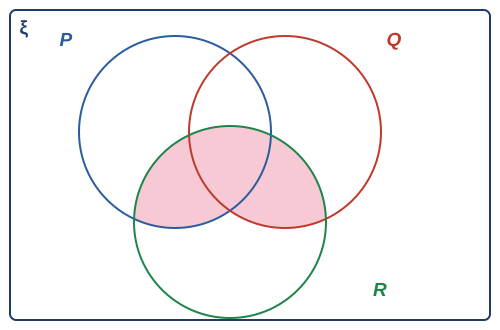
Example 9 (like textbook p. 118)
Using the sets of Example 8, list (A ∩ C)′ ∪ (B ∩ C).
- A ∩ C = {3, 6, 12}, so (A ∩ C)′ = {1, 2, 4, 5, 7, 8, 9, 10, 11}.
- B ∩ C = {6, 12}.
- Union: {1, 2, 4, 5, 6, 7, 8, 9, 10, 11, 12}. Only 3 is missing: it is in A ∩ C but not in B ∩ C.
Show answerHide answer
b) K′ = {7, 8, 9, 10}; K′ ∩ L = {8, 10}
c) K ∪ M = {1, 2, 3, 4, 5, 6, 9}; (K ∪ M)′ = {7, 8, 10}
Summary
| Idea | Key fact | Example |
|---|---|---|
| Intersection P ∩ Q | In both P and Q | {1, 3, 5} ∩ {3, 5, 7} = {3, 5} |
| Union P ∪ Q | In P or Q or both; each element once | {1, 3, 5} ∪ {3, 5, 7} = {1, 3, 5, 7} |
| Complement of a result | (P ∩ Q)′ and (P ∪ Q)′: find the inside first, then take the rest of ξ | n(P ∩ Q) + n((P ∩ Q)′) = n(ξ) |
| Counting two sets | n(P ∪ Q) = n(P) + n(Q) − n(P ∩ Q) | 38 + 29 − 12 = 55 |
| Combined operations | Brackets first, then left to right | (A ∪ B) ∩ C can differ from A ∪ (B ∩ C) |
| Venn diagram problems | Fill from the middle outwards; check the total equals n(ξ) | 15 + 15 + 19 + 4 + 3 + 6 + 5 + 23 = 90 |
Notes and examples follow Mathematics Form 4 KSSM (DLP), Chapter 4, pp. 94–127. Venn diagrams drawn for this site.