Mathematics questions, chapter 4
Nama / NameKelas / ClassTarikh / Date
Operations on Sets
44 marks. Use Practice to check each answer as you go, or Exam to answer everything first. Do not use a calculator. Show your working for Section B.
Section A: objective questions
12 marksChoose the correct answer.
1
Question 1
Which symbol represents the intersection of sets?
Show answerHide answer
B
∩ is the intersection (read "and"). ∪ is the union (read "or"), ′ is the complement and ⊂ means "is a subset of".
2
Question 2
What does the set P ∪ Q contain?
Show answerHide answer
C
The union contains every element of P, every element of Q, and the common elements once. The first option describes P ∩ Q and the last describes (P ∪ Q)′.
3
Question 3
A = {1, 3, 5, 7, 9, 11} and B = {2, 3, 5, 7, 11}. Find A ∩ B.
Show answerHide answer
A
The elements in both sets are 3, 5, 7 and 11. The second option is A ∪ B. {1, 9} is the part of A that is not in B, and {2} is the part of B that is not in A.
4
Question 4
P = {a, b, c, d} and Q = {c, d, e}. Find n(P ∪ Q).
Show answerHide answer
D
P ∪ Q = {a, b, c, d, e}, so n(P ∪ Q) = 5. Check: 4 + 3 − 2 = 5. 7 counts c and d twice, and 2 is n(P ∩ Q).
5
Question 5
ξ = {1, 2, 3, …, 10}, A = {2, 4, 6, 8, 10} and B = {4, 8}. List the elements of (A ∩ B)′.
Show answerHide answer
C
A ∩ B = {4, 8}, so (A ∩ B)′ is everything else in ξ: {1, 2, 3, 5, 6, 7, 9, 10}. {4, 8} is A ∩ B itself, {1, 3, 5, 7, 9} is A′ and {2, 6, 10} is in A but not B.
6
Question 6
ξ = {1, 2, 3, …, 10}, P = {1, 2, 3, 4} and Q = {3, 4, 5, 6}. Find n((P ∪ Q)′).
Show answerHide answer
A
P ∪ Q = {1, 2, 3, 4, 5, 6}, so (P ∪ Q)′ = {7, 8, 9, 10} and n = 4. 6 is n(P ∪ Q) and 2 is n(P ∩ Q).
7
Question 7
If P ∩ Q = φ, which statement about sets P and Q is true?
Show answerHide answer
D
P ∩ Q = φ means the intersection is empty, so no element is in both sets. P and Q may still have elements of their own, so P ∪ Q need not be empty.
8
Question 8
ξ = {1, 2, 3, …, 12}, A = {1, 2, 3, 4}, B = {3, 4, 5, 6} and C = {4, 6, 8, 10}. List the elements of (A ∪ B) ∩ C.
Show answerHide answer
B
A ∪ B = {1, 2, 3, 4, 5, 6}. Of these, only 4 and 6 are in C. {4} is A ∩ B ∩ C, and the third option is A ∪ B ∪ C.
9
Question 9
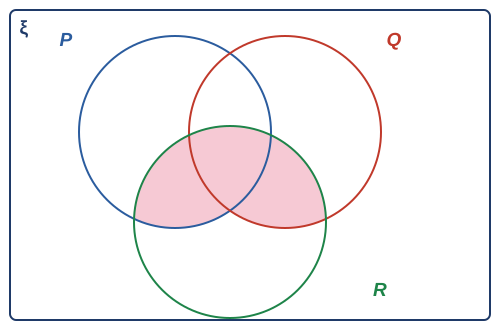
Diagram 1 is a Venn diagram showing sets P, Q and R. Which set is represented by the shaded region?
Show answerHide answer
C
Only the part of R that is also in P or in Q is shaded, which is (P ∪ Q) ∩ R. P ∩ Q ∩ R would be just the centre. P ∪ (Q ∩ R) and (P ∩ Q) ∪ R would shade the whole of P or the whole of R.
10
Question 10
There are 50 pupils in a class. 24 pupils join the Chess Club and 20 pupils join the Drama Club. 8 pupils join both clubs. How many pupils join neither club?
Show answerHide answer
A
n(Chess ∪ Drama) = 24 + 20 − 8 = 36, so neither = 50 − 36 = 14. 6 forgets the overlap (50 − 44). 36 is the number who join at least one club.
11
Question 11
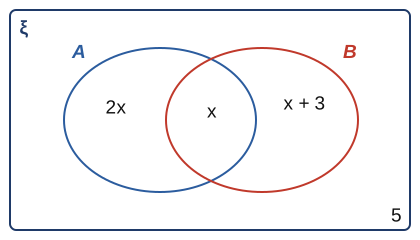
Diagram 2 shows the number of elements in sets A and B. n(ξ) = 32. Find the value of x.
Show answerHide answer
D
2x + x + (x + 3) + 5 = 32, so 4x + 8 = 32 and 4x = 24, giving x = 6. Check: 12 + 6 + 9 + 5 = 32.
12
Question 12
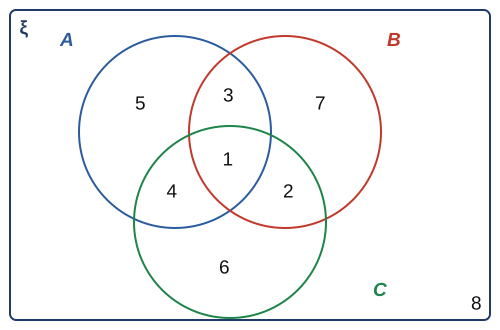
Diagram 3 shows the number of elements in each region of sets A, B and C. Find n(A′ ∩ (B ∪ C)).
Show answerHide answer
B
A′ ∩ (B ∪ C) is the part of B or C that is outside A: B only 7 + C only 6 + (B and C only) 2 = 15. 23 is n(B ∪ C), which includes the parts inside A. 16 wrongly adds the centre (1) as well.
Section B: structured questions
32 marksAnswer all questions. Show your working.
13
Question 13
ξ = {x : x is an integer, 1 ≤ x ≤ 12}, P = {x : x is an even number} and Q = {x : x is a factor of 12}.
[2 marks]
(a)List the elements of P and of Q.
Show answerHide answer
Tick each point you got.
[1 mark]
(b)List the elements of P ∩ Q.
Show answerHide answer
Tick each point you got.
[1 mark]
(c)Find n(P ∪ Q).
Show answerHide answer
Check: 6 + 6 − 4 = 8.
Tick each point you got.
14
Question 14
ξ = {x : x is an integer, 20 ≤ x ≤ 30}, G = {x : x is a prime number}, H = {x : x is a multiple of 4} and I = {x : x is a multiple of 5}.
[2 marks]
(a)List the elements of (G ∪ H)′.
Show answerHide answer
Tick each point you got.
[1 mark]
(b)Find n((H ∪ I)′).
Show answerHide answer
Tick each point you got.
[1 mark]
(c)(G ∩ H)′ = ξ
Show answerHide answer
True
G and H have no element in common, so G ∩ H = φ and its complement is the whole universal set.
15
Question 15
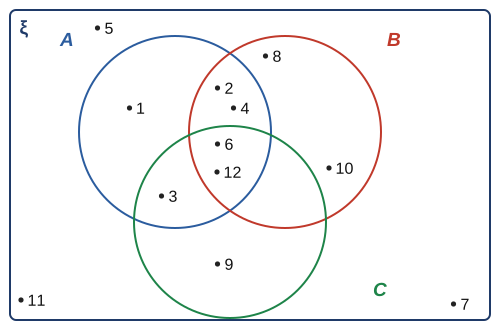
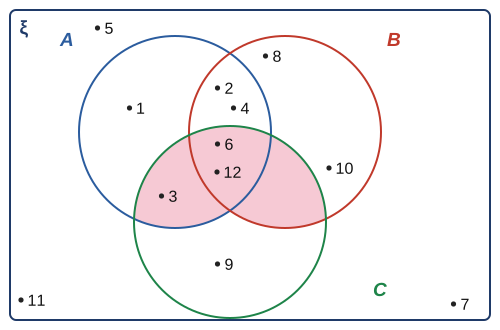
Diagram 4 is a Venn diagram showing ξ = {1, 2, 3, …, 12}, A = {1, 2, 3, 4, 6, 12}, B = {2, 4, 6, 8, 10, 12} and C = {3, 6, 9, 12}.
[1 mark]
(a)List the elements of (A ∪ B) ∩ C.
Show answerHide answer
Tick each point you got.
[2 marks]
(b)List the elements of A′ ∩ (B ∪ C).
Show answerHide answer
Tick each point you got.
[1 mark]
(c)On a copy of Diagram 4, shade the region that represents (A ∪ B) ∩ C.
Show answerHide answer
Tick each point you got.
16
Question 16
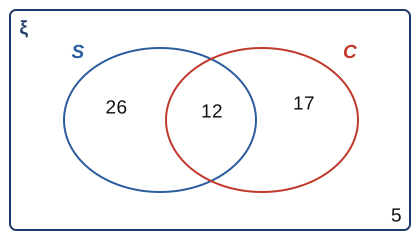
A total of 60 pupils are asked about their sport. 38 pupils swim (S), 29 pupils cycle (C) and 12 pupils do both.
[1 mark]
(a)How many pupils swim only?
Show answerHide answer
Tick each point you got.
[1 mark]
(b)How many pupils cycle only?
Show answerHide answer
Tick each point you got.
[2 marks]
(c)How many pupils do neither sport? Draw a Venn diagram to help you.
Show answerHide answer
Tick each point you got.
17
Question 17
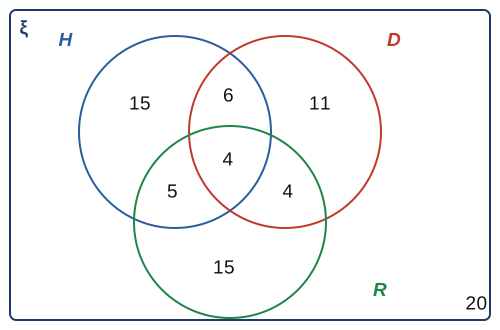
A total of 80 pupils choose clubs. 30 pupils join Chess (H), 25 pupils join Drama (D) and 28 pupils join Robotics (R). 10 pupils join Chess and Drama, 8 pupils join Drama and Robotics and 9 pupils join Chess and Robotics (each of these three numbers includes the pupils in all three clubs). 4 pupils join all three clubs.
[2 marks]
(a)How many pupils join exactly two clubs?
Show answerHide answer
Tick each point you got.
[2 marks]
(b)How many pupils join at least one club?
Show answerHide answer
Tick each point you got.
[1 mark]
(c)How many pupils join no club?
Show answerHide answer
Tick each point you got.
18
Question 18
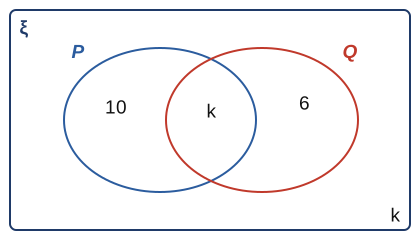
Diagram 5 shows sets P and Q in a universal set ξ with n(ξ) = 40. It is given that n(P ∩ Q) = n((P ∪ Q)′) = k.
[2 marks]
(a)Form an equation in k and find its value.
Show answerHide answer
Tick each point you got.
[1 mark]
(b)Find n(P).
Show answerHide answer
Tick each point you got.
[1 mark]
(c)Find n(Q′).
Show answerHide answer
Tick each point you got.
19
Question 19
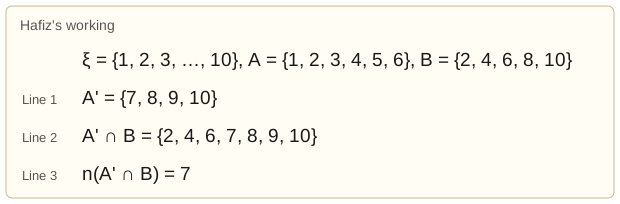
ξ = {1, 2, 3, …, 10}, A = {1, 2, 3, 4, 5, 6} and B = {2, 4, 6, 8, 10}. Diagram 6 shows Hafiz's working to find n(A′ ∩ B).
[2 marks]
(a)In which line did Hafiz make his first mistake? Explain the mistake.
Show answerHide answer
Tick each point you got.
[1 mark]
(b)Write the correct A′ ∩ B and find n(A′ ∩ B).
Show answerHide answer
Tick each point you got.
20
Question 20
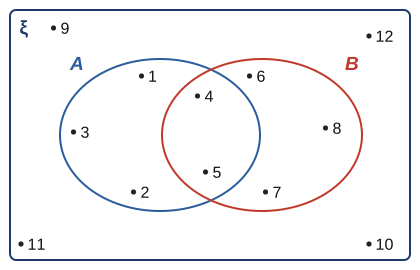
ξ = {1, 2, 3, …, 12}. Design two sets A and B such that n(A) = 5, n(B) = 5, n(A ∩ B) = 2 and n((A ∪ B)′) = 4.
[2 marks]
(a)List the elements of your sets A and B. Show that n((A ∪ B)′) = 4.
Show answerHide answer
Tick each point you got.
[2 marks]
(b)Draw a Venn diagram to represent ξ, A and B.
Show answerHide answer
Sample answer (other correct sets are accepted):
Tick each point you got.